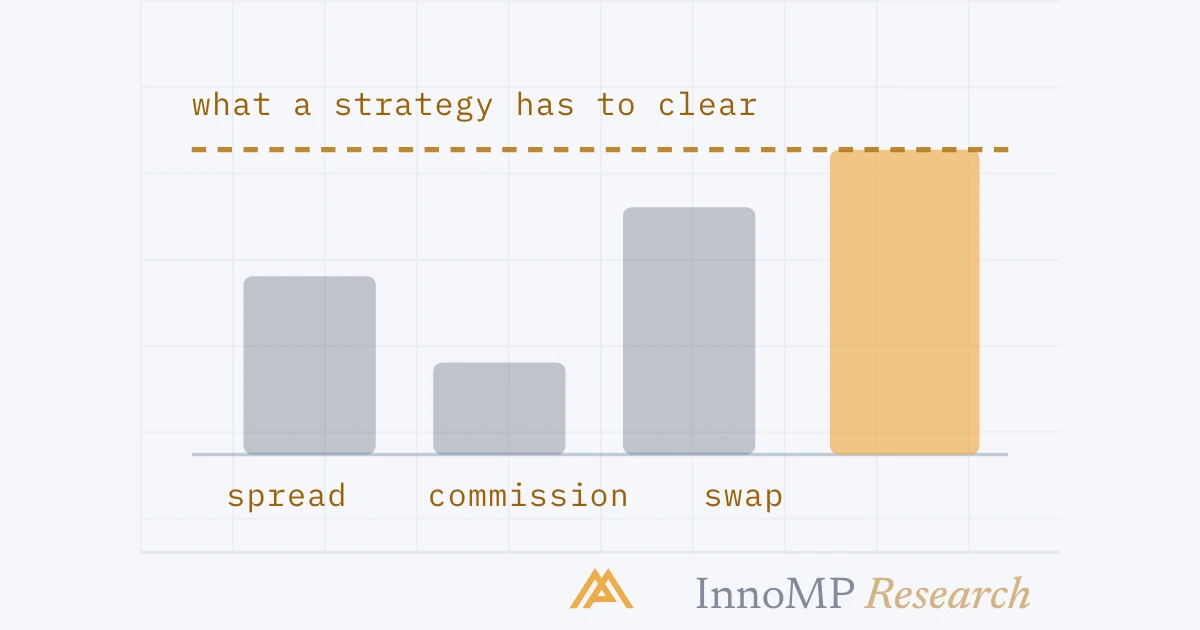
A CFD trade has three costs: the spread, paid on entry; commission, an explicit per-lot charge on some account types; and swap, the nightly financing on any position held past the daily rollover. Spread and commission dominate intraday trading; swap dominates anything held for weeks. One standard lot held thirty days at −4.20 USD a night, with four triple-swap Wednesdays, costs about 159.60 USD in financing against a 6 USD spread — more than twenty-five times the entry cost.
A trade has three costs. Most traders track one of them carefully, glance at the second, and discover the third at the end of the month.
Spread
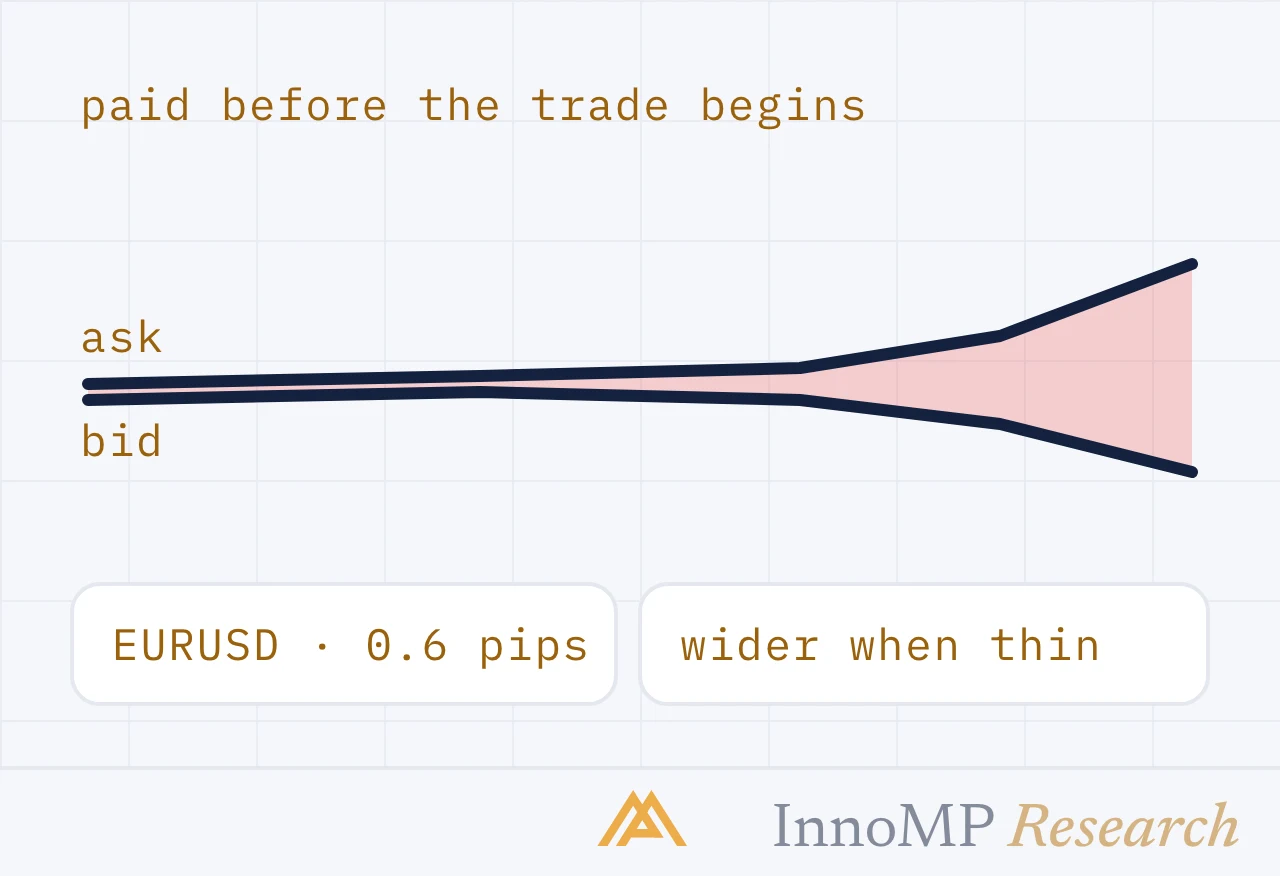
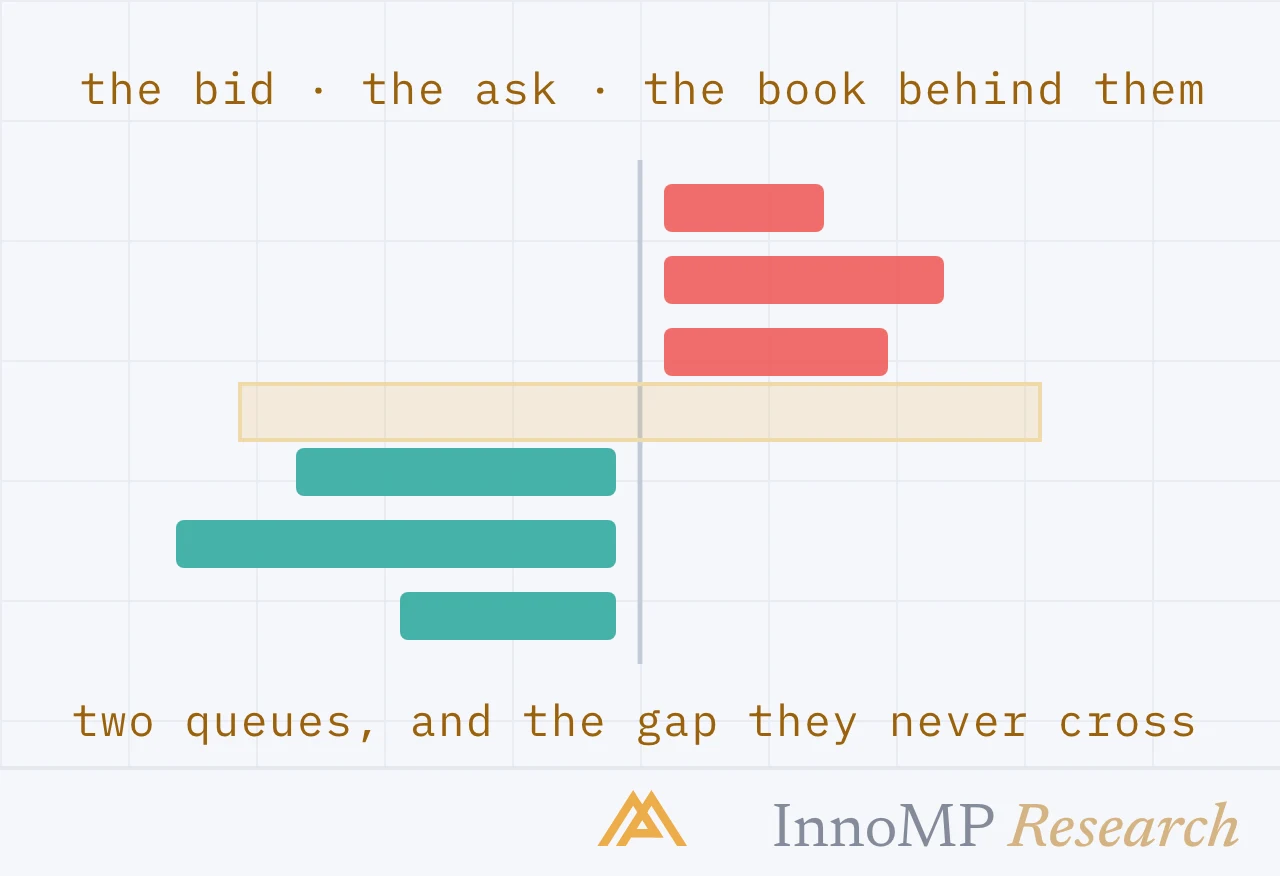
The spread is the gap between the bid and the ask. It is paid on entry — a position opens marginally underwater and has to cover that gap before it is flat.
On a standard lot of EUR/USD, a 0.6-pip spread costs about 6 USD. On its own that is trivial. Across two hundred trades in a month it is 1,200 USD, which is no longer trivial for most account sizes.
Spread is not constant. It widens around scheduled data releases, in the thin hours between the New York close and the Tokyo open, and during market stress. A strategy backtested on average spreads and traded at 3am on a Monday is being tested against a cost structure it was never modelled on.
Commission
Some account types replace part of the spread with an explicit per-lot commission. This is generally the more transparent arrangement — a raw spread plus a stated commission is easier to audit than a marked-up spread where the cost is embedded and invisible.
To compare account types honestly, convert both to a single number:
Total round-turn cost = (Spread in pips × Pip value) + Commission both ways
A 0.2-pip raw spread with 7 USD round-turn commission costs about 9 USD per standard lot. A 1.0-pip spread with no commission costs about 10 USD. The advertised numbers look very different; the outcome barely does.
Swap — the one that compounds
Every position held past the daily rollover is financed, because a leveraged position borrows the currency being sold to fund the currency being bought. The interest differential between the two is credited or debited each night.
Key takeaway Swap can be positive or negative, and it accrues every night whether the position is profitable or not. On a multi-week hold, financing frequently exceeds the spread by an order of magnitude.
Two features surprise people:
Triple swap. Spot settlement is two business days, so the Wednesday rollover carries the weekend. Most instruments charge three days of swap on Wednesday night. A position that costs 4 USD a night costs 12 USD that one night.
Swap changes. Rates are not fixed. They move with the underlying interest rate differential and with the provider’s own funding. A carry that was positive when a position was opened can turn negative while it is still open.
A worked case. One standard lot held for thirty days at a swap of −4.20 USD per night, with four Wednesdays:
- Ordinary nights: 26 × 4.20 = 109.20
- Triple-swap nights: 4 × 12.60 = 50.40
- Total financing: 159.60 USD
Against a 6 USD spread, financing is more than twenty-five times the entry cost. A position needs to move roughly 16 pips in your favour just to cover the month of carry.
What this changes about strategy selection
Cost structure is not a footnote to a strategy — it selects which strategies are viable at all.
Intraday and scalping live or die on spread and commission, because they pay them constantly and never pay swap. A half-pip difference in average spread is decisive.
Swing and position trading barely notice the spread and are dominated by financing. A holding period measured in weeks needs the swap direction checked before entry, not after.
Any strategy should be evaluated on net returns after all three costs. A backtest that ignores swap on multi-day holds is not describing a tradeable result.
Two things worth doing this week
Look up the current swap rates for the three instruments you trade most, in both directions. Some will surprise you — a pair can carry positively in one direction and expensively in the other.
Then add up last month’s total costs: spread paid, commission paid, swap paid. Compare that figure to your net result. For many traders the ratio is the single most useful number they have never calculated.
- The three costs of a trade are spread, commission and swap.
- Round-turn cost = (spread in pips × pip value) + commission both ways; a 0.2-pip raw spread with 7 USD commission costs about the same as a 1.0-pip spread with none.
- Swap is charged or credited every night a position is held past rollover, profit or not.
- Most instruments charge three days of swap on Wednesday night to cover the weekend settlement.
- One lot held for thirty days at −4.20 USD a night costs about 159.60 USD in financing.