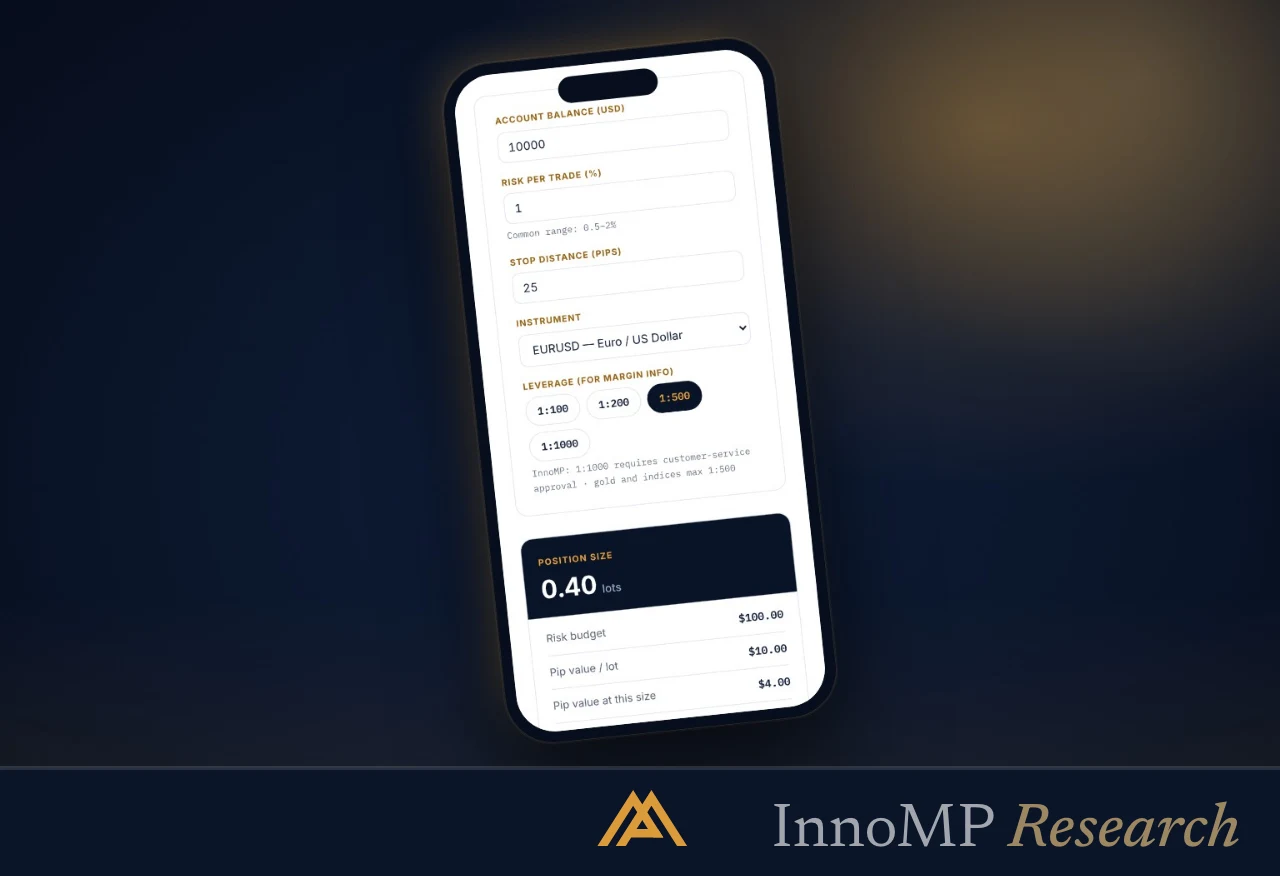
Estimates for information only — not investment advice. Defaults follow InnoMP contract specifications (verified 2026-09-03); all fields are editable for other conditions. Lots are floored to the 0.01 step your platform accepts. Confirm pip value, contract size and margin in your platform before trading. Trading CFDs involves a high risk of loss.
How position size is calculated
Position size in lots = risk budget ÷ (stop distance × value of one increment per lot). The risk budget is the account balance times the percentage you are prepared to lose if the stop is hit. The stop distance comes from the chart, not from the budget — the size is what adjusts.
Worked examples on a 10,000 USD account risking 1% (a 100 USD budget), with the indicative prices this calculator pre-fills:
| Instrument | Stop | Value of the stop per lot | Position size |
|---|---|---|---|
| EUR/USD | 25 pips | 25 × 10 USD = 250 USD | 0.40 lots |
| USD/JPY at 148.20 | 25 pips | 25 × ≈6.75 USD = ≈168.69 USD | 0.59 lots |
| Gold (XAU/USD) | 5.00 in price | 5.00 × 100 oz = 500 USD | 0.20 lots |
| US500 | 20 index points | 20 × 1 contract = 20 USD | 5.00 lots |
The same 100 USD budget produces four very different sizes, which is the whole argument for calculating rather than reusing a familiar lot size. Results are floored to the 0.01-lot step, so the risk actually taken is slightly under the budget.
Entering the stop on gold and indices. The stop field counts increments of the instrument's smallest price step: 0.01 for gold, so a 5.00 stop is entered as 500; 0.1 for US500 and US100, so a 20-point stop is entered as 200. The Pip value / lot line shows the value of one increment, which is a quick way to confirm the units.
Frequently asked
How is position size calculated?
Position size in lots = (account balance × risk %) ÷ (stop distance in pips × pip value per lot). The stop distance comes from your chart; the risk percentage is a rule you set in advance — commonly 0.5% to 2%.
What defaults does this calculator use?
InnoMP contract specifications: 100,000-unit forex contracts, 100 oz gold, minimum 0.01 and maximum 20 lots per order, leverage up to 1:1000 on forex and 1:500 on metals and indices. Every field is editable for other brokers’ conditions.
How do I calculate position size for gold?
Gold (XAU/USD) trades in contracts of 100 ounces, so a 1.00 move in the gold price is 100 USD per lot. Divide the risk budget by the stop distance in dollars times 100: risking 100 USD with a 5.00 stop gives 100 ÷ (5 × 100) = 0.20 lots. In this calculator the gold increment is 0.01, so a 5.00 stop is entered as 500.
What risk percentage per trade should I use?
The calculator does not recommend one — it is a rule you set in advance. Many written trading plans use between 0.5% and 2% per trade; the point of fixing it is that a run of losses then costs a known, survivable amount.
Why does the calculator ask for a price or conversion rate on some pairs?
When the quote currency is not the US dollar — USD/JPY, EUR/GBP — the pip value must be converted into USD. The calculator pre-fills an indicative rate and lets you replace it with the live one.
Read next
The reasoning behind every field on this page: Leverage, margin and why position sizing comes first · What a pip is · Stop-loss placement · Margin calls and stop-outs.