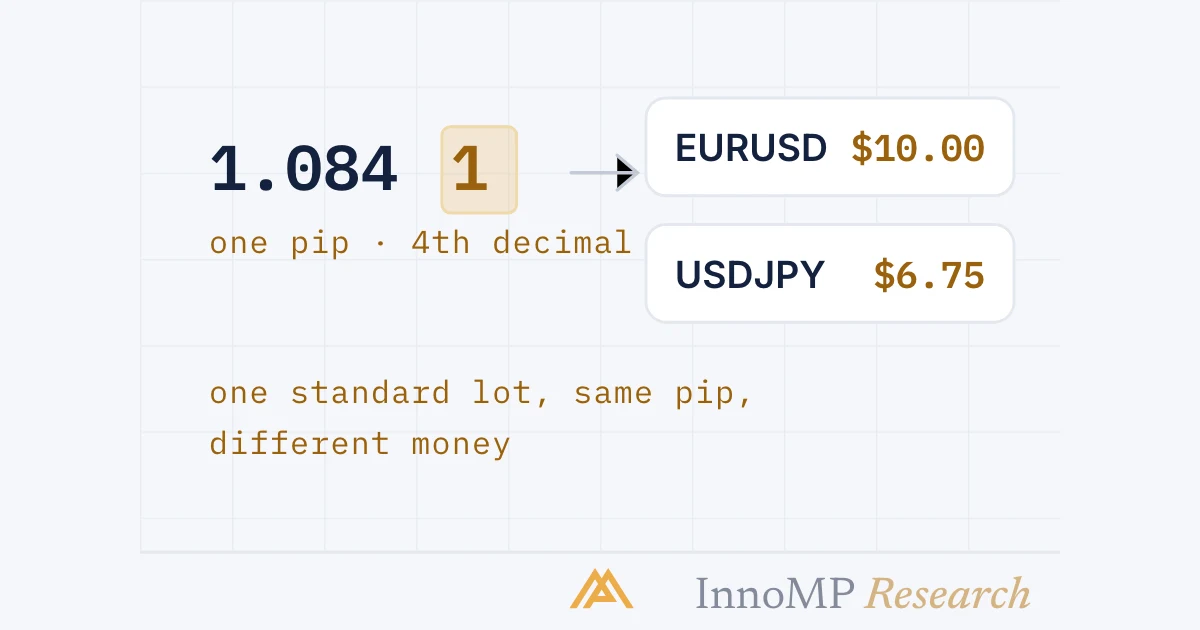
A pip is the standard unit a currency price moves in: the fourth decimal place on most pairs (1.0840 to 1.0841) and the second decimal on yen pairs (148.20 to 148.21). One pip on a standard lot of a USD-quoted pair such as EUR/USD is worth 10 USD, so a 20-pip move is 200 USD on one lot, 20 USD on a mini lot and 2 USD on a micro lot. On other pairs the pip value has to be converted at the current rate.
A pip is the standard increment a currency pair moves in. For most pairs it is the fourth decimal place — 1.0840 to 1.0841 is one pip. For pairs quoted against the yen it is the second decimal — 148.20 to 148.21 is one pip.
That much is simple. What trips people up is that a pip is not a fixed amount of money.
Pip value depends on three things
The lot size. Position sizes are expressed in lots:
| Lot type | Units | Typical pip value |
|---|---|---|
| Standard | 100,000 | 10 |
| Mini | 10,000 | 1 |
| Micro | 1,000 | 0.10 |
The pair. For pairs where the quote currency is the US dollar — EUR/USD, GBP/USD, AUD/USD — one pip on a standard lot is exactly 10 USD. The arithmetic is clean because the pip is already denominated in dollars.
For everything else it is not. On USD/JPY, one pip on a standard lot is 1,000 yen, and what that is worth in dollars depends on the current rate. At 148.20, 1,000 ÷ 148.20 is about 6.75 USD — not 10.
The account currency. If the account is denominated in something other than the pair’s quote currency, a conversion sits between the pip and your balance.
Key takeaway “Ten dollars a pip” is a property of dollar-quoted pairs at one standard lot, not a universal constant. Applying it to a yen cross overstates the risk by roughly a third — in the direction that feels safe until it isn’t.
How much is 20 pips?
Twenty pips is the stop distance most often quoted in beginner examples, so it is worth seeing in every unit at once. Rates as in the examples below; yen figures converted at 148.20.
| Pair | 20 pips in price | Standard lot | Mini lot | Micro lot |
|---|---|---|---|---|
| EUR/USD | 1.0840 → 1.0860 | 200 USD | 20 USD | 2 USD |
| GBP/USD | 1.2735 → 1.2755 | 200 USD | 20 USD | 2 USD |
| USD/JPY | 148.20 → 148.40 | ≈ 135 USD | ≈ 13.50 USD | ≈ 1.35 USD |
The same 20 pips costs about a third less on the yen pair — which is exactly why a fixed lot size does not give a fixed risk.
Turning it into a position size
Pip value only matters because it converts a stop distance into money. That conversion is the whole point:
Position size = Risk budget ÷ (Stop distance in pips × Pip value per lot)
The pip value calculator handles the conversion for any pair, and the position size calculator takes it through to lots.
Two examples on a 5,000 USD account risking 1%, so a 50 USD budget:
EUR/USD, 20-pip stop. Pip value 10 USD per standard lot. 50 ÷ (20 × 10) = 0.25 lots.
USD/JPY, 20-pip stop, rate at 148.20. Pip value about 6.75 USD per standard lot. 50 ÷ (20 × 6.75) = 0.37 lots.
Same account, same risk, same stop distance — and a position nearly 50% larger on the yen pair. A trader who uses 0.25 lots on both because it “worked last time” is under-risking one trade and, more dangerously, would be over-risking in the reverse case.
Points, pips and the fifth decimal
Most platforms now quote an extra decimal: 1.08402 rather than 1.0840. That final digit is a point or pipette, one tenth of a pip.
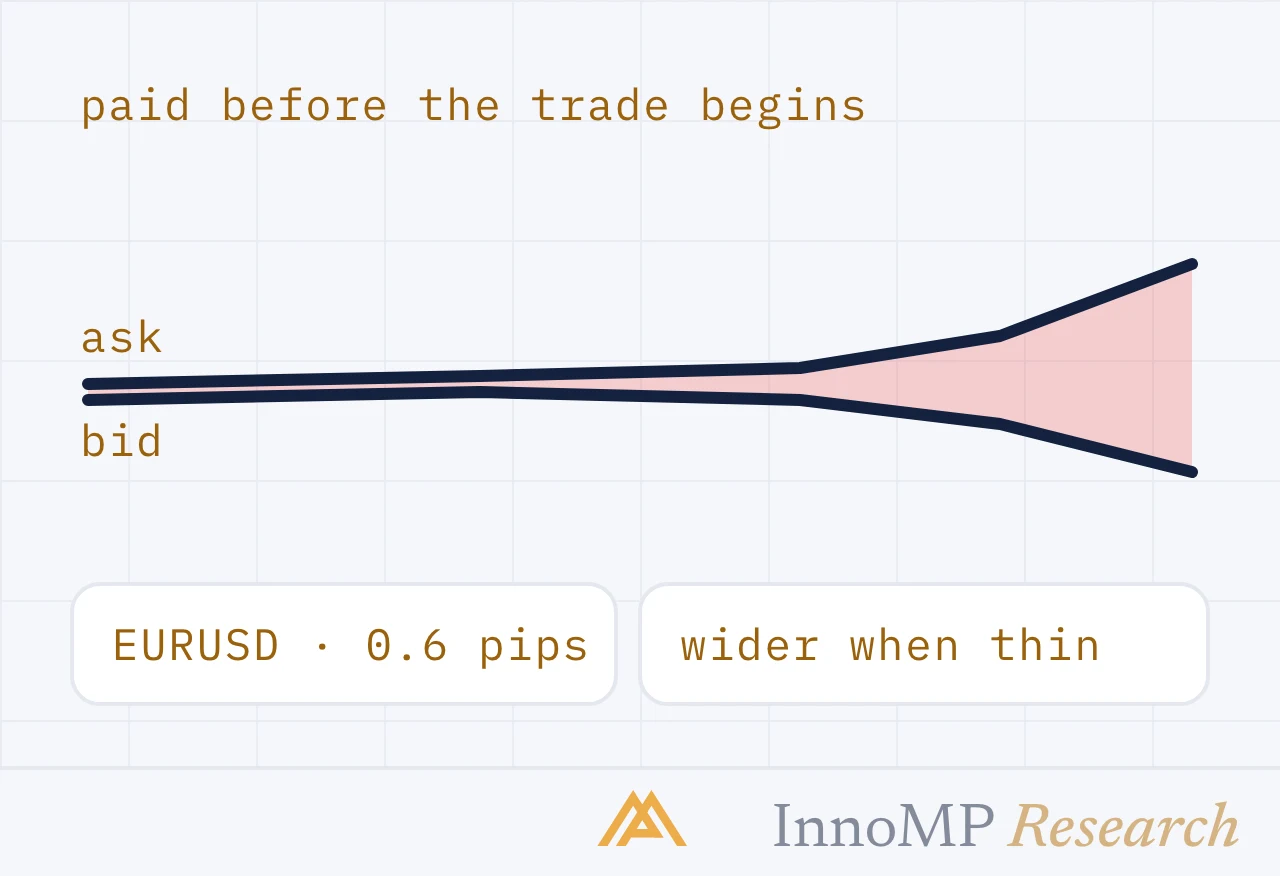
This matters when reading spreads. A spread displayed as “6” on a five-decimal feed is 0.6 pips, not 6 pips. Misreading it by a factor of ten makes a competitive spread look ruinous, or a wide one look attractive.
Indices, metals and energy CFDs use their own conventions — on InnoMP, gold (XAU/USD) trades in contracts of 100 ounces, so a one-dollar move is 100 USD per lot. Check the contract specification for any instrument before sizing a position in it. This is a two-minute task that removes an entire class of error.
The check worth doing
After opening a position, before walking away: multiply your stop distance by the pip value for the size you actually opened. Does that number match what you intended to risk?
If it does not, close or resize now. The gap between intended risk and actual risk does not resolve itself, and it is always discovered at the worst possible moment.
- One pip is 0.0001 on most currency pairs and 0.01 on pairs quoted in Japanese yen.
- On USD-quoted pairs one pip is worth 10 USD per standard lot of 100,000 units, 1 USD per mini lot and 0.10 USD per micro lot.
- A 20-pip move on EUR/USD is a price change of 0.0020 — 200 USD on one standard lot.
- The fifth decimal on a quote is a point, or pipette — one tenth of a pip.
- Position size in lots equals the risk budget divided by stop distance in pips times pip value per lot.