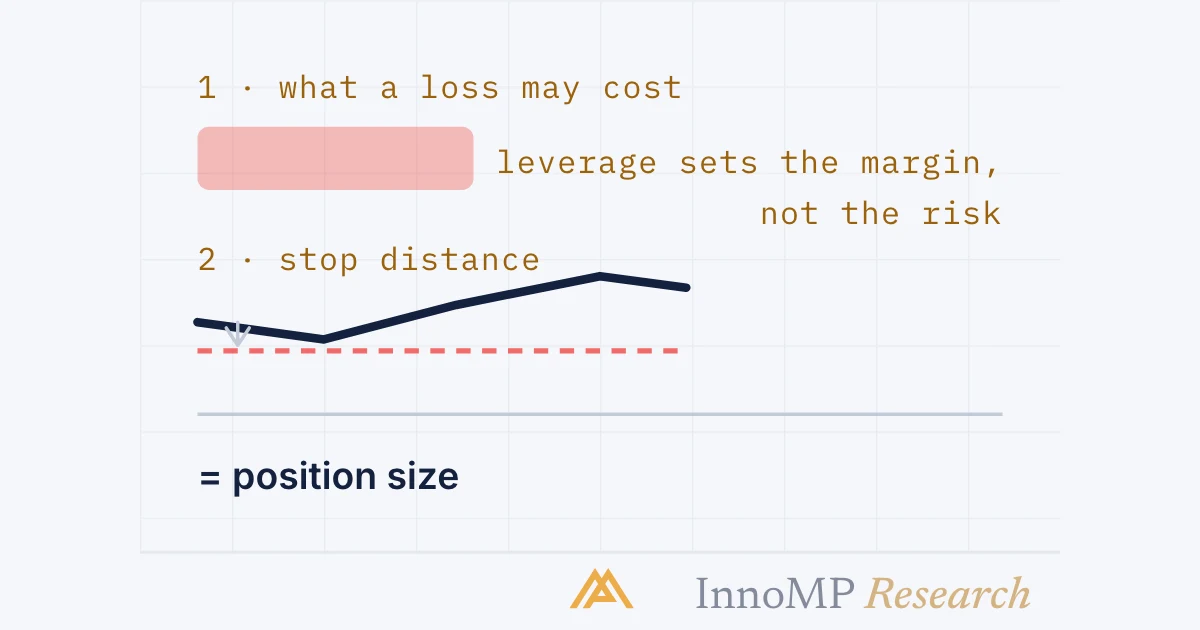
Leverage sets how much margin a position ties up; position size sets how much a losing trade costs. One lot of EUR/USD has the same 108,000 USD exposure and the same roughly 10 USD per pip at 1:100, 1:500 or 1:1000 — only the margin reserved changes. Position size in lots is the risk budget (account × risk %) divided by stop distance in pips times pip value. On a 10,000 USD account risking 1% with a 25-pip stop, that is 100 ÷ (25 × 10) = 0.4 lots.
Most new traders meet leverage first and position sizing second. That order is backwards, and it is the reason so many accounts that were “up big” in month one are gone by month four.
Leverage is a financing arrangement. Position size is a risk decision. Confusing the two produces traders who believe a 1:500 account is five times more dangerous than a 1:100 account, when in reality both accounts are exactly as dangerous as the position sizes traded in them.
What leverage actually changes
Leverage sets the margin required to open a position. Nothing else.
Take one standard lot of EUR/USD — on InnoMP a contract of 100,000 units, so a notional value of roughly 108,000 USD at a rate of 1.0800. InnoMP accounts offer leverage of 100×, 200×, 500× and, with approval, 1000×. Here is what changes as leverage changes:
| Leverage | Margin required | Notional exposure |
|---|---|---|
| 1:100 | 1,080 | 108,000 |
| 1:500 | 216 | 108,000 |
| 1:1000 | 108 | 108,000 |
Read the third column again. It does not move. A one-pip move against that position costs about 10 USD whether the account is 1:100 or 1:1000, because the position is the same size in all three rows.
What higher leverage genuinely does is remove a constraint. At 1:100, a 500 USD account cannot open a full lot — the margin is not there. At 1:1000 it can. Leverage did not make the trade riskier. It made an unaffordable position size possible, and the trader then chose it. This is also why InnoMP gates 1:1000 leverage behind a customer-service approval: the constraint it removes is the last mechanical one between an account and a position size beyond any sensible risk budget.
Key takeaway Leverage governs what you are permitted to open. Position size governs what you stand to lose. Traders who blow up did not lose to leverage — they lost to the position size leverage let them reach.
The one number to set before entry
Decide what percentage of the account a single losing trade may cost. For most traders working with a strategy they have not yet traded through a full drawdown, that number sits between 0.5% and 2%.
From there the position size is arithmetic, not judgement:
Position size = (Account × Risk %) ÷ (Stop distance in pips × Pip value)
Our position size calculator does this arithmetic with InnoMP contract specifications pre-loaded — and every field editable for other conditions.
A worked example. A 10,000 USD account, risking 1%, on a EUR/USD trade with a 25-pip stop:
- Risk budget: 10,000 × 0.01 = 100 USD
- Pip value on one standard lot: 10 USD
- Position size: 100 ÷ (25 × 10) = 0.4 lots
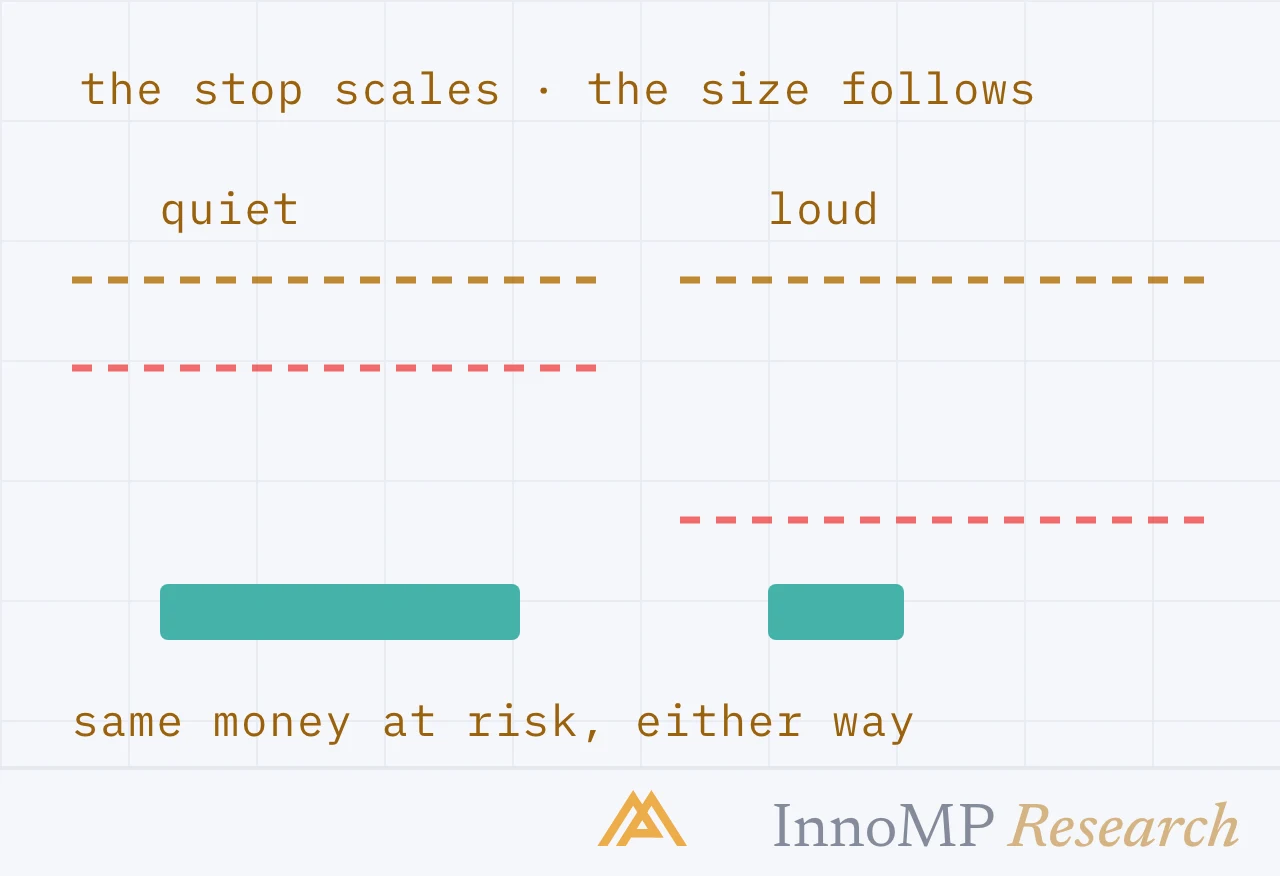
Widen the stop to 50 pips and the position halves to 0.2 lots. The risk budget never moves. This is the mechanism that makes a strategy survivable: the stop distance changes with market conditions, and size absorbs the change so the loss does not.
Why the percentage matters more than the win rate
Traders overwhelmingly focus on how often they win. The arithmetic of drawdown says the more urgent question is what a losing run costs.
Consider eight consecutive losses — an ordinary occurrence for a strategy that wins 45% of the time, not a catastrophe.
| Risk per trade | Account after 8 losses | Gain needed to recover |
|---|---|---|
| 1% | 92.3% | 8.3% |
| 2% | 85.1% | 17.5% |
| 5% | 66.3% | 50.8% |
| 10% | 43.0% | 132.6% |
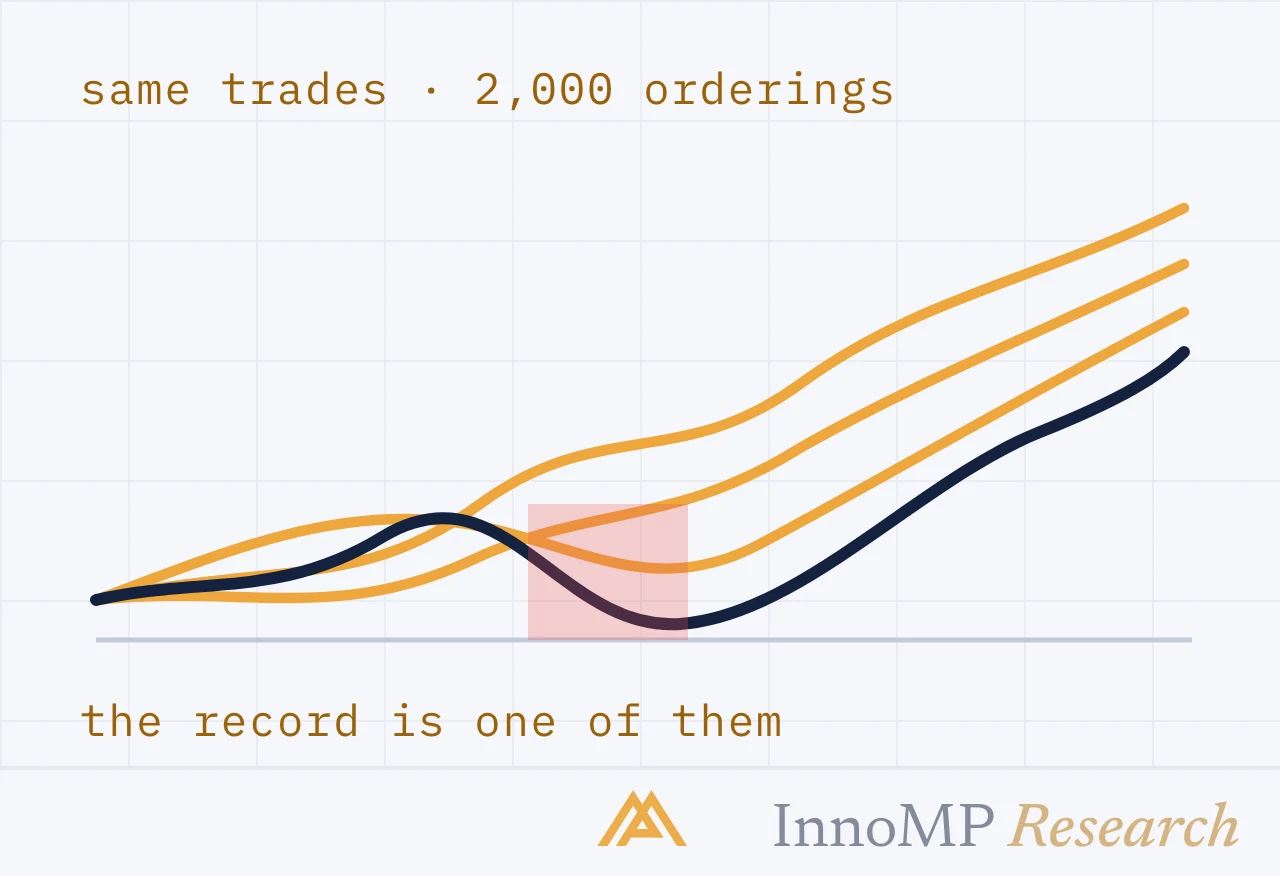
At 1% risk, an eight-loss streak is an unpleasant month. At 10%, the same streak — the same trades, the same strategy, the same market — requires the account to more than double just to get back to even. The strategy did not fail. The sizing did.
The asymmetry in that last column is the entire argument. Losses compound against you faster than gains compound for you, and the gap widens with every increment of risk per trade.
Where this breaks in practice
Three failure modes account for most of the damage:
Sizing off the margin, not the stop. “I have 2,000 USD of free margin, so I will open a position that uses it.” This lets the broker’s margin requirement set your risk, which is not what it was designed for.
Holding size constant while the stop moves. Trading 0.5 lots regardless of whether the stop is 15 pips or 90 pips means the account is risking six times more on one trade than the other, usually without the trader noticing.
Adding to a loser without resizing. Averaging down converts a planned 1% risk into an unplanned 3% one. If the plan permits scaling in, the total risk across all tranches has to fit the original budget.
Before your next entry
Work in this order and the rest follows:
- Where does this idea become wrong? That is the stop, and it comes from the chart, not from the size you wanted to trade.
- What is 1% of the account today? That is the risk budget.
- Divide. That is the position size.
- Check the margin required. If it exceeds free margin, the trade is too large for this account — that is leverage doing its only useful job, telling you no.
Leverage is a tool for capital efficiency. Position sizing is what keeps you in the market long enough for a strategy’s edge to show up. Set the second one first.
- Leverage changes the margin reserved for a position, not the position's profit and loss.
- Position size = (account × risk %) ÷ (stop distance in pips × pip value per lot).
- A 10,000 USD account risking 1% with a 25-pip EUR/USD stop trades 0.4 lots; a 50-pip stop halves it to 0.2 lots.
- At 1% risk per trade, eight consecutive losses leave 92.3% of the account; at 10% they leave 43%.
- InnoMP offers 1:100, 1:200, 1:500 and, with customer-service approval, 1:1000 on major forex pairs.