Skip to content
Research / Education / Candlesticks

TA · Foundations · Part 12 of 20

Continuation patterns: when a pause is not a reversal

Inside bars, flags and pennants. How to tell a trend catching its breath from a trend running out of it — and why the two look similar for the first few candles.

InnoMP Research Published 30 Aug 2026 · Updated 02 Sept 2026 6 min read
In short

A continuation pattern is a brief consolidation within a trend that resolves in the trend's original direction. The common forms are the inside bar (a candle contained within the previous candle's range), the flag (a short counter-trend drift) and the pennant (a small symmetrical narrowing). They show reduced participation rather than a change of control, which is what distinguishes them from reversal patterns.

A continuation pattern is a pause inside a trend that resolves in the trend’s original direction. Trends do not run continuously; they advance, consolidate while some participants take profit and others enter, and advance again.

The difficulty is that the first few candles of a consolidation and the first few candles of a reversal look identical. Distinguishing them is what this part is about.

The inside bar

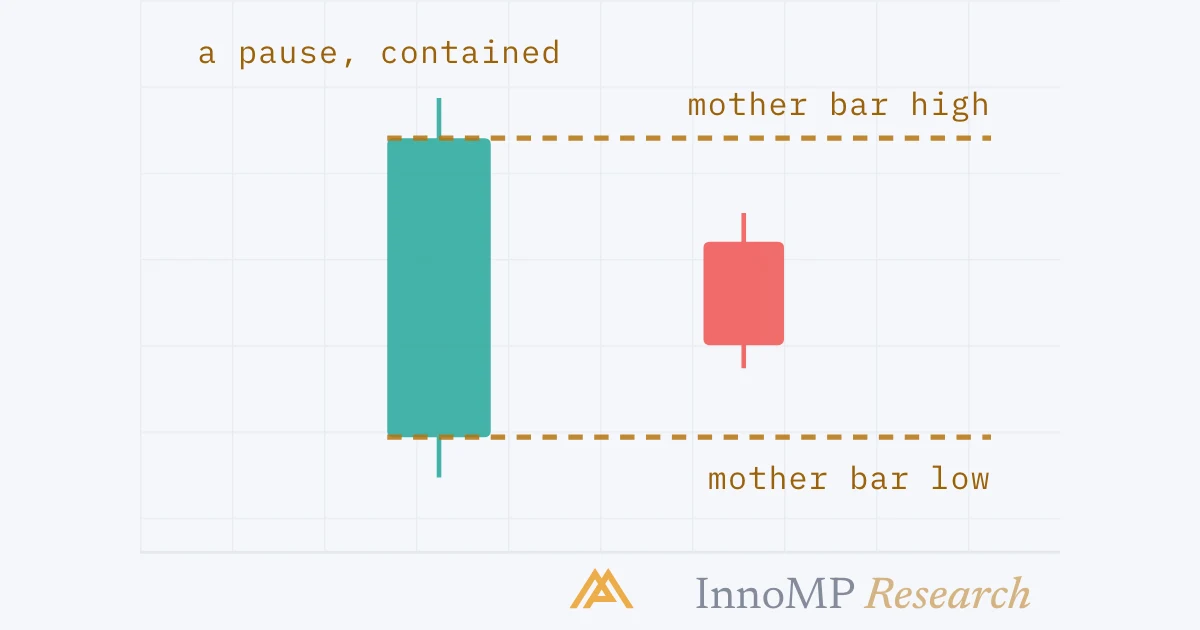
A candle whose entire range sits within the previous candle’s range — a lower high and a higher low.

An inside bar contained within the range of the previous candle A large up candle followed by a smaller candle whose entire range fits inside it. Two horizontal lines extend from the large candle's high and low, labelled mother bar high and mother bar low, showing the smaller candle sits between them. mother bar highmother bar lowInside barparticipation narrowed InnoMP Research
Nothing extended in either direction. The previous candle's boundaries contained the whole period — that is what consolidation looks like at its smallest scale.

The information is simple: the market did not extend in either direction. That means participation narrowed, which is the definition of consolidation.

Inside bars are most interesting in two situations. After a large directional candle, an inside bar shows the market absorbing the move rather than reversing it. And a series of consecutive inside bars — each contained within the last — describes progressive compression.

Three consecutive inside bars compressing before an expansion A large candle followed by three progressively smaller candles, each contained within the one before it, then a large candle breaking out upward. The compressing candles are enclosed by two converging guide lines. CompressionExpansion InnoMP Research
Each candle sits inside the last. Ranges narrowing this way describe a market winding up, not a market going quiet.

The trade structure is unusually clean: enter on a break of the mother bar (the larger containing candle) in the trend direction, stop on the opposite side of it. Both levels are objective.

Flags and pennants

After a strong directional move, price drifts against it on smaller candles before resuming.

A bull flag drifting shallowly after a steep advance A steep upward price move, followed by a shallow downward drift inside a narrow parallel channel made of small candles, then a resumption upward out of the channel. steep advanceshallow driftsmaller candlesresumes InnoMP Research
A steep move made of large candles, then a shallow drift made of small ones. The size difference is the evidence.

A flag drifts in a narrow channel sloping gently against the trend. A pennant narrows symmetrically into a small triangle. Functionally they are the same thing: a shallow, low-energy pause.

A genuine flag compared with a drift that gives back most of the move Two panels. The left shows a rise followed by a shallow pullback on small candles, marked flag. The right shows the same rise followed by a deep decline on large candles that erases most of the advance, marked not a flag. Flaggives back a littleNot a flaggives back most of it InnoMP Research
Depth and candle size separate them. A drift that gives back most of the advance is not a pause — it is a fight, and the other side is winning.

Two properties distinguish a genuine flag from the beginning of a reversal.

The drift is shallow. A bull flag retraces a modest portion of the preceding advance. A drift that gives back most of the move is not a flag — it is a fight.

The candles are smaller. The move up was made of large candles; the drift is made of small ones. That size difference is the evidence that the counter-trend move has less behind it.

Volatility contraction

The unifying idea beneath all continuation patterns is that ranges narrow before they expand.

When candle ranges compress, fewer participants are willing to transact at current prices. Positions accumulate on both sides while nobody forces the issue. That state is unstable — when one side is finally squeezed out, the accumulated imbalance releases at once.

This is why compression is worth watching regardless of pattern name. A market whose candles have been shrinking for several periods is a market approaching a decision. It does not tell you which way, which is why the trade is normally taken in the direction of the existing trend rather than guessed.

Key takeaway A continuation pattern that breaks the wrong way is a reversal signal, and often a strong one. Traders who positioned for continuation are immediately offside, and their exits fuel the move against them. Never treat a continuation setup as though only one outcome exists — the stop is not a formality.

Telling a pause from a turn

Four checks, in descending order of reliability:

The four checks that separate a pause from a turn Four stacked rows, each with a label and two contrasting outcomes: structure held or broken, depth shallow or deep, counter-trend candles smaller or larger, and duration short or unusually long. checkpauseturnStructurelow heldlow brokenDepthshallownear the lowCandlessmallerlargerTimeas usualdragging onmost reliable at the top InnoMP Research
Read them top to bottom. They usually agree — and when they do not, the disagreement itself is a reason to trade smaller.
  1. Structure. Has the pullback held above the prior swing low in an uptrend? If yes, it remains a pause by definition. If no, it is a break of structure.
  2. Depth. Shallow suggests continuation; a retracement approaching the prior low suggests weakening.
  3. Candle size. Counter-trend candles smaller than trend candles suggest a pause. Counter-trend candles that are larger suggest genuine selling.
  4. Time. A pause that goes on much longer than previous pauses in the same trend is losing its character as a pause.

None of these is decisive alone. Together they usually agree, and when they do not, that disagreement is itself a reason to reduce size.

Next: Head and shoulders, double tops and bottoms — the multi-candle chart patterns and what they measure.

Key facts
  • An inside bar's entire range sits within the previous candle's range.
  • A flag is a shallow counter-trend drift after a strong directional move.
  • Continuation patterns show contracting volatility, which often precedes expansion.
  • A continuation pattern that breaks against the trend becomes a reversal signal.
Frequently asked questions

What is an inside bar?

A candle whose entire range — high to low — sits inside the previous candle's range. It shows the market traded within the prior period's boundaries, meaning participation narrowed and neither side extended the move.

What is a bull flag?

A strong upward move followed by a shallow downward drift on smaller candles, then a resumption higher. The drift is profit-taking rather than a change in control, which is why the pattern usually resolves in the original direction.

How do I know a pause is a continuation and not a reversal?

By depth and character. A continuation pause is shallow, drifts rather than falls, and holds above the prior swing low in an uptrend. A reversal breaks that swing low and produces larger counter-trend candles.

Why does volatility contract before big moves?

Narrowing ranges mean fewer participants are willing to transact at current prices while positions build on both sides. When one side is finally forced out, the accumulated imbalance releases at once, which produces expansion.

InnoMP Research

Market research, trading education and platform guides from the InnoMP research desk — covering forex, metals, indices and stock CFDs.

Published 30 Aug 2026 · Updated 02 Sept 2026 · Reviewed by InnoMP Compliance

Disclaimer: This content is provided for general informational purposes only and does not constitute investment advice, an offer, or a solicitation to buy or sell any financial instrument. It has been prepared without regard to your individual financial circumstances or objectives. Trading CFDs involves a high risk of loss.

Related notes