A candlestick reversal pattern is a one- or two-candle formation suggesting that control is passing from buyers to sellers or the reverse. The most useful are the pin bar (long wick rejecting a level), the engulfing candle (a body that covers the previous candle's body entirely), and the morning or evening star. All of them require a level or a trend extreme to be meaningful; in mid-range they are noise.
A reversal pattern is a one- or two-candle formation suggesting control is changing hands. There are dozens with names. Four carry enough information to be worth the space in your head, and all four work the same way underneath: they show an attempt in one direction being decisively rejected.
The pin bar
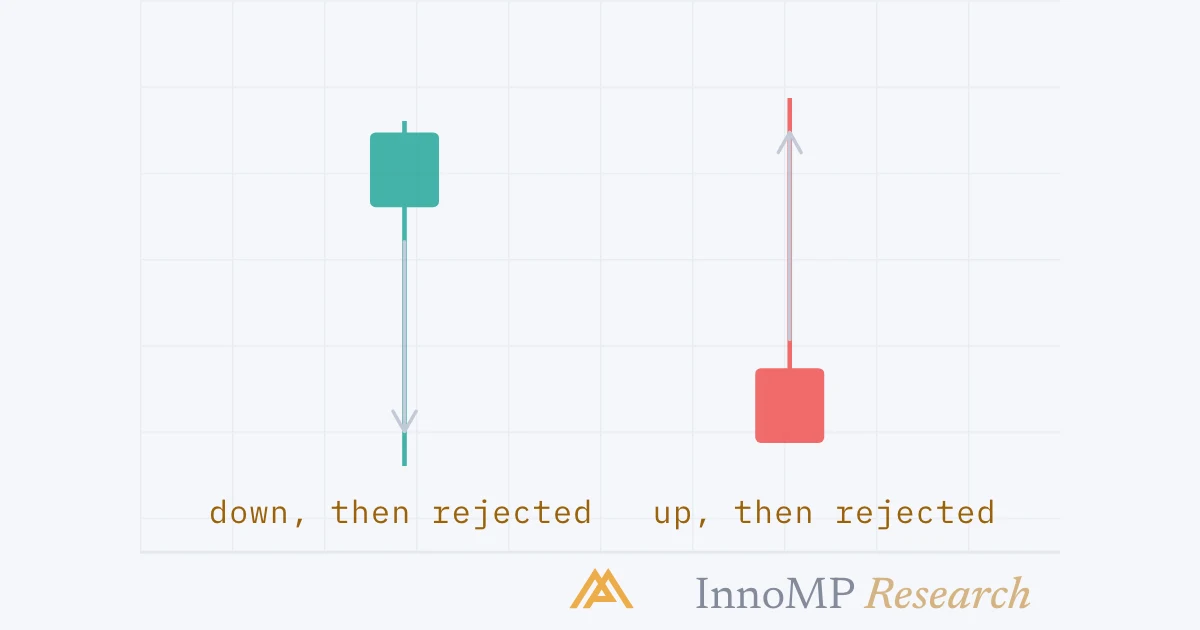
Small body, long wick on one side, little or no wick on the other. The long wick is the story: price went there and was pushed back.
A bullish pin bar has a long lower wick — sellers drove price down through a level and buyers rejected it, closing near the high. A bearish pin bar mirrors this with a long upper wick.
The pin bar is the most useful single-candle pattern because its invalidation is unambiguous: beyond the wick’s tip, the rejection failed. Stop placement becomes mechanical rather than a judgement, which is exactly the property stop-loss placement asks for.
Two quality filters are worth applying.
The wick should be at least twice the body, and the candle should be reasonably large relative to recent candles.
The engulfing candle
Two candles. The second’s body completely covers the first’s body in the opposite direction.
A bullish engulfing is a down candle followed by an up candle whose body swallows it. Sellers controlled one full period; buyers took the next period back entirely and then some. That is a visible transfer of control.
Bodies are what must engulf, not wicks. A candle that engulfs the previous body is showing that the settled range of the prior period was fully reversed — wicks are rejected prices and matter less here.
The star patterns
Three candles. A strong candle in the trend direction, then a small indecisive candle, then a strong candle in the opposite direction.
The evening star appears at a top: a strong up candle, a small-bodied candle that stalls, then a decisive down candle. The morning star is its mirror at a bottom.
The information is in the middle candle. Momentum ran, then stopped — that is where the trend visibly ceased making progress. The third candle confirms who took over.
The rule that governs all of them
Location decides whether the pattern means anything.
A bullish pin bar at a support level that has held twice before, after an extended decline, at a point where the swing structure suggests a higher low should form — that is a confluence of reasons, and the candle is its timing signal.
The identical pin bar in the middle of a range, with no level nearby, is a candle that happened.
This is why this series covers levels and structure before patterns. The pattern is never the reason for a trade. It is confirmation that something is happening at a place you had already identified as important.
Key takeaway Do not scan for patterns. Mark your levels first, set an alert, and read what price does when it arrives. A pattern found by scanning is a pattern found without context — and context is the entire difference between a signal and a shape.
Trading one
Entry. Either on the close of the pattern, or on a small pullback into it. The second is tighter but risks missing the move.
Stop. Beyond the pattern’s extreme — the wick tip of a pin bar, the low of an engulfing pair — plus a buffer for normal movement.
Size. From the stop distance, via the calculator. A large pin bar produces a wide stop and therefore a small position; that is the arithmetic working correctly, not a problem to be solved by tightening the stop inside the pattern.
Target. The next structural level, so the risk-reward ratio is known before entry rather than hoped for after.
Next: Candlestick continuation patterns — what candles look like when a trend is pausing rather than turning.
- A pin bar has a small body and a long wick rejecting one direction.
- An engulfing candle's body fully covers the previous candle's body in the opposite direction.
- Reversal patterns only carry information at a level, a trend extreme, or a structural point.
- A pattern's invalidation point is beyond its own extreme, which makes stop placement mechanical.