Skip to content
Research / Education / Trading emotions

Trading Psychology · Part 7 of 20

Greed and target creep: how winning trades become losing ones

The target was 60 pips. At 55 you decided to hold for 90. How a plan quietly becomes a hope, and the exits that prevent it.

InnoMP Research Published 31 Aug 2026 · Updated 31 Aug 2026 6 min read
In short

Target creep is moving a profit target further away while a trade is running, usually because the position is winning and the move looks strong. It converts a planned risk-reward ratio into an open-ended bet and is the main mechanism by which profitable trades end as losses. Resting take-profit orders and pre-planned partial exits prevent it.

Target creep is moving a profit target further away while the trade is running. It is greed’s practical form, and it is more common than any dramatic version of the emotion.

Nobody experiences it as greed. It is experienced as recognising that the move is stronger than expected.

How it happens

The plan: enter at 1.0850, stop at 1.0830, target at 1.0890. Twenty pips of risk for forty of reward — a clean 1:2, computed before entry.

A trade that reaches its target, has the target cancelled, and reverses to the stop A price line rising from an entry level almost to a dashed target line, where an annotation marks the target being cancelled. The line then reverses, falls back through the entry level and continues down to the stop level. target +2Rentrystop −1Rcancelled here”it looks strong” InnoMP Research
The analysis was right. The entry was right. The exit was removed at the exact moment it was about to pay.

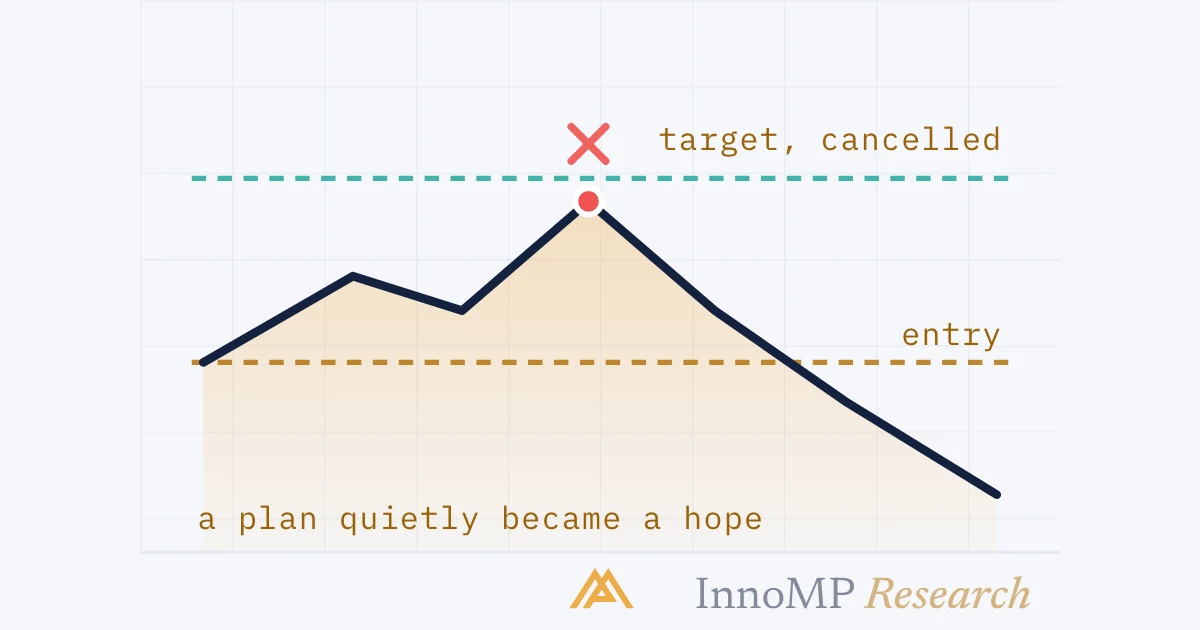
Price reaches 1.0885 — five pips from target. You cancel the target and let it run. Price reaches 1.0895, stalls, and retraces. It passes your original target on the way down. It passes your entry. It hits your stop.

A trade that was 95% of the way to a planned win is recorded as a full loss.

Why the arithmetic punishes it so hard

The risk-reward ratio is fixed at entry, because that is when the risk is committed. Extending the target after entry changes only one side of a calculation whose other side is already locked.

Expectancy before and after target creep converts one in four winners into losses Two bar comparisons. The first shows forty percent wins at plus two R against sixty percent losses at minus one R, netting plus zero point two R per trade. The second shows thirty percent wins against seventy percent losses, netting minus zero point one R. As planned40% win · +2R60% loss · −1R= +0.2R per tradeWith target creep30% win · +2R70% loss · −1R= −0.1R per trade InnoMP Research
Ten percent of trades changed category. No entries changed, no analysis changed, and the strategy went from profitable to unprofitable.
Where the ratio is fixed and what extending the target changes A timeline with the risk committed and locked at entry on the left, and an arrow later in the trade attempting to extend only the reward side, with a note that the other side cannot be changed. entryrisk — locked herereward — plannedextended laterone side moved · the other side never could InnoMP Research
The ratio is fixed at entry, because that is when the risk is committed. Extending the target changes one side of a calculation whose other side is already locked.

Trailing is planned; creeping is not

There is a legitimate version of holding for more, and the difference is entirely about when the method was chosen.

A trailing stop compared with a cancelled target Two panels showing the same rising then reversing price move. In the first a trailing stop line follows price upward and the position exits partway down, keeping most of the gain. In the second the target is simply removed and the position runs all the way back to the original stop. Trailing stopkeeps most of the gainTarget cancelledall the way back to the stop InnoMP Research
One is a method. The other is a hope with the safety removed.

A trailing stop is a rule decided in advance: the stop follows price at a defined distance, so gains are progressively protected while the position stays open.

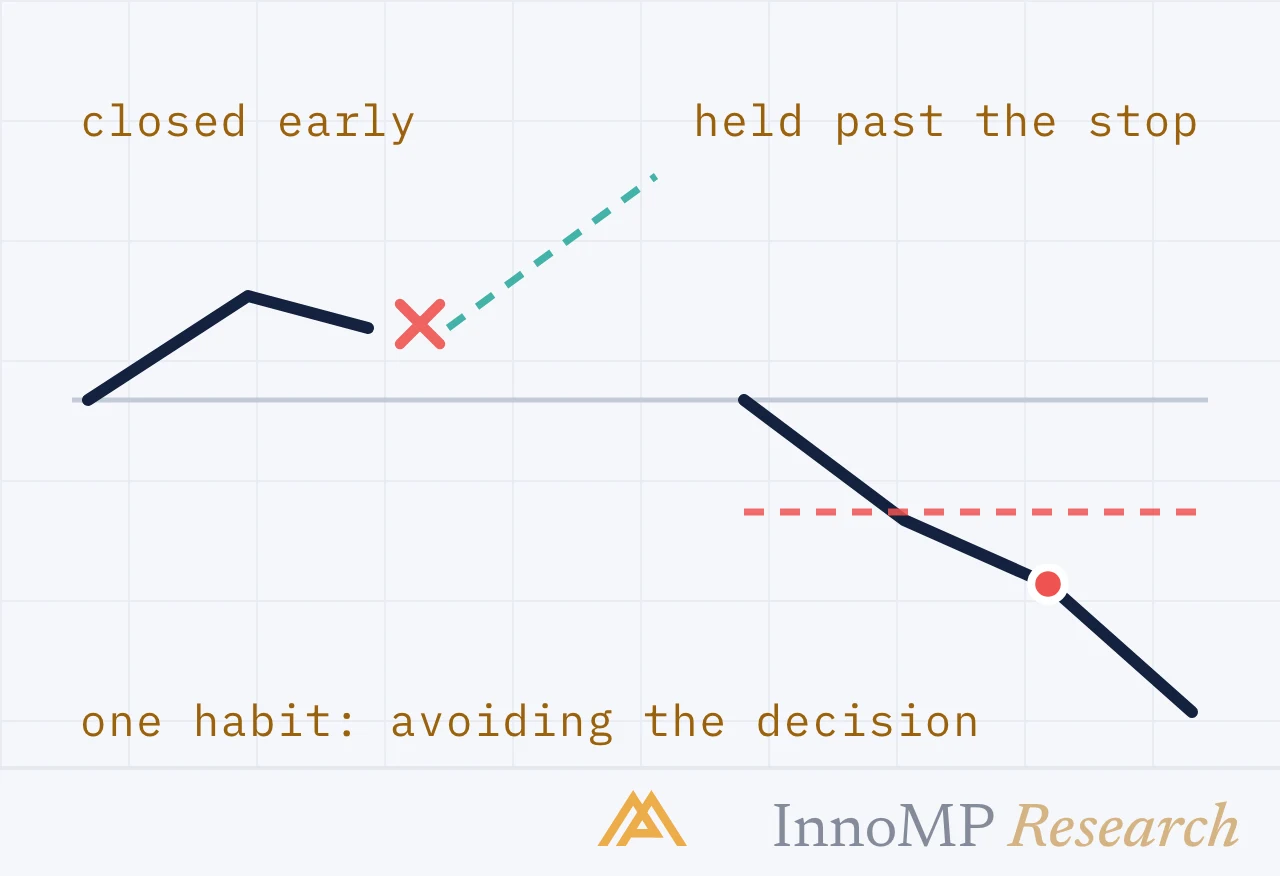
Target creep is cancelling a defined exit with no replacement rule, leaving the outcome to be decided later by a person watching an unrealised profit.

Key takeaway Any decision made while a position is running is made by someone with money on the outcome. That is the least objective moment available — so put the exits in the market as resting orders at entry, and let them execute without asking you.

The three defences

Three defences against target creep Three rows. The first shows a take-profit attached at order entry as a resting order. The second shows a written scaling plan taking a portion at target and trailing the rest. The third shows a journal column recording what the planned exit would have produced. 1 · Resting take-profit at entrya resting order does not get talked out of2 · Written scaling planportion at target, trail the rest — consistently3 · Journal the counterfactualwhat the planned exit would have produced InnoMP Research
All three work by moving the decision to a moment when no position is open.

Resting take-profit at entry. Attach it to the opening order. It works while you are asleep.

A written scaling plan. If you want exposure to larger moves, decide the method beforehand: take a portion at target, trail the remainder behind structure. Consistent, so the journal measures one method.

Journal the counterfactual. When you do extend a target, record what the planned exit would have produced. After a dozen entries, the aggregate tells you whether extending has been profitable or expensive — and for most traders it is expensive, which is far more convincing as your own number than as general advice.

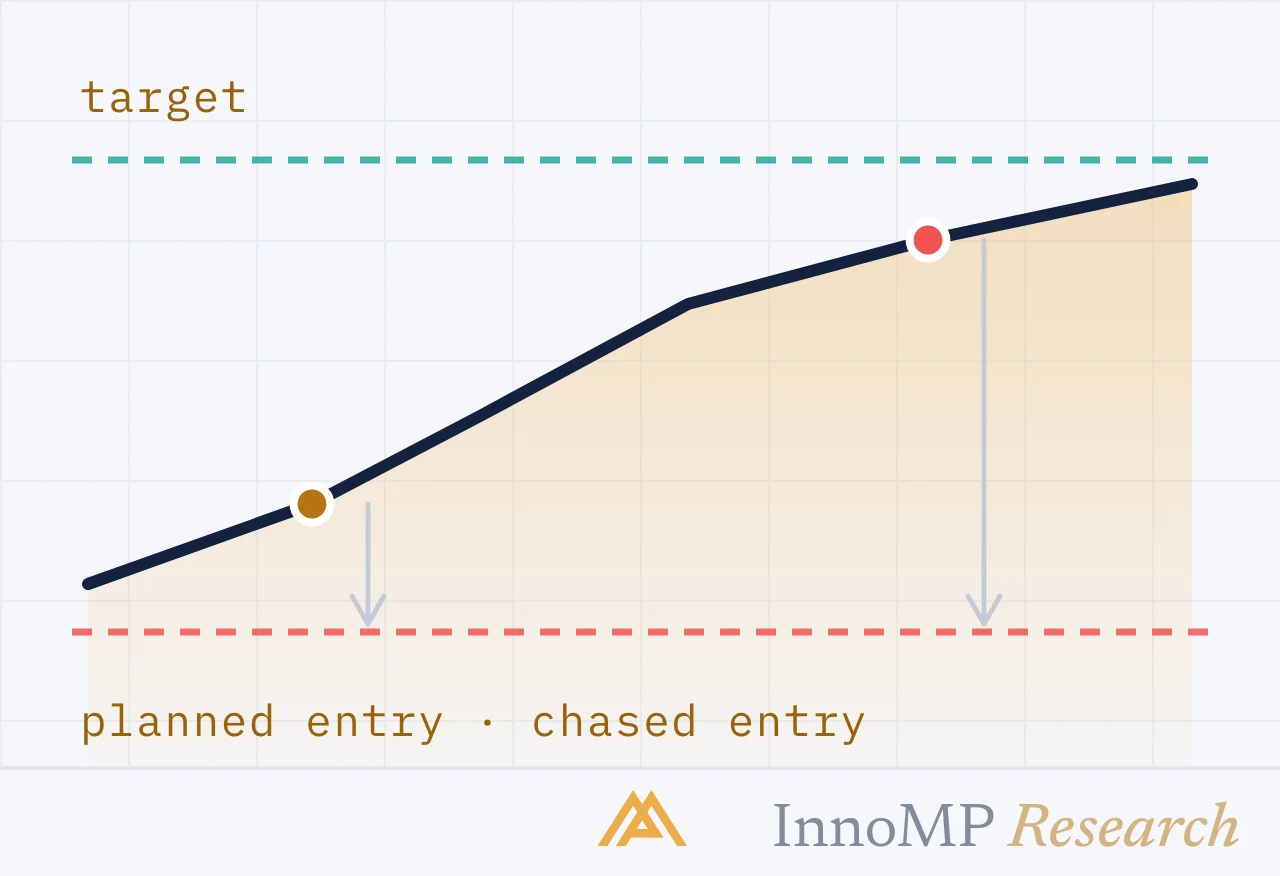
Next: FOMO explained — the version of greed that operates before you have a position at all.

Key facts
  • Target creep changes a trade's risk-reward ratio after the risk has already been taken.
  • A position that reaches 90% of target and reverses to the stop is a full loss, not a small one.
  • Trailing stops are a planned method; moving a target mid-trade is not.
  • Resting take-profit orders remove the decision from the moment greed is strongest.
Frequently asked questions

What is target creep in trading?

Extending a profit target while a trade is open because the move looks stronger than expected. It feels like maximising a good trade but it removes the defined exit the plan was built around, and often ends with the position retracing past the original target.

Is it always wrong to hold beyond my target?

Not if the method was decided in advance. A trailing stop is a planned way of holding for more while protecting gains. Extending a fixed target in the moment, with no mechanical rule, is a different thing — that is a decision made under the influence of an open profit.

How do I stop being greedy in trading?

Place the take-profit as a resting order when you enter, and decide any scaling plan before the trade. Greed operates on decisions made while a position is running, so moving those decisions earlier removes most of its influence.

Why do my winning trades turn into losses?

Usually because the exit was never fixed. Without a resting target, every price becomes a judgement call, and the judgement is made by someone watching an unrealised profit — which is the least objective moment available.

InnoMP Research

Market research, trading education and platform guides from the InnoMP research desk — covering forex, metals, indices and stock CFDs.

Published 31 Aug 2026 · Updated 31 Aug 2026 · Reviewed by InnoMP Compliance

Disclaimer: This content is provided for general informational purposes only and does not constitute investment advice, an offer, or a solicitation to buy or sell any financial instrument. It has been prepared without regard to your individual financial circumstances or objectives. Trading CFDs involves a high risk of loss.

Related notes

Trading emotions

FOMO: chasing the move you already missed

The setup came and went without you. Then price runs, and entering late feels urgent. Why chased entries carry the worst risk-reward on the chart.

5 min read