Loss aversion is the tendency for losses to feel roughly twice as significant as equivalent gains. In trading it produces two specific errors: taking profits too early to secure a win, and holding losses too long to avoid realising them. Both damage the risk-reward ratio a strategy depends on, and both are better fixed by pre-committing to exits than by trying to feel differently.
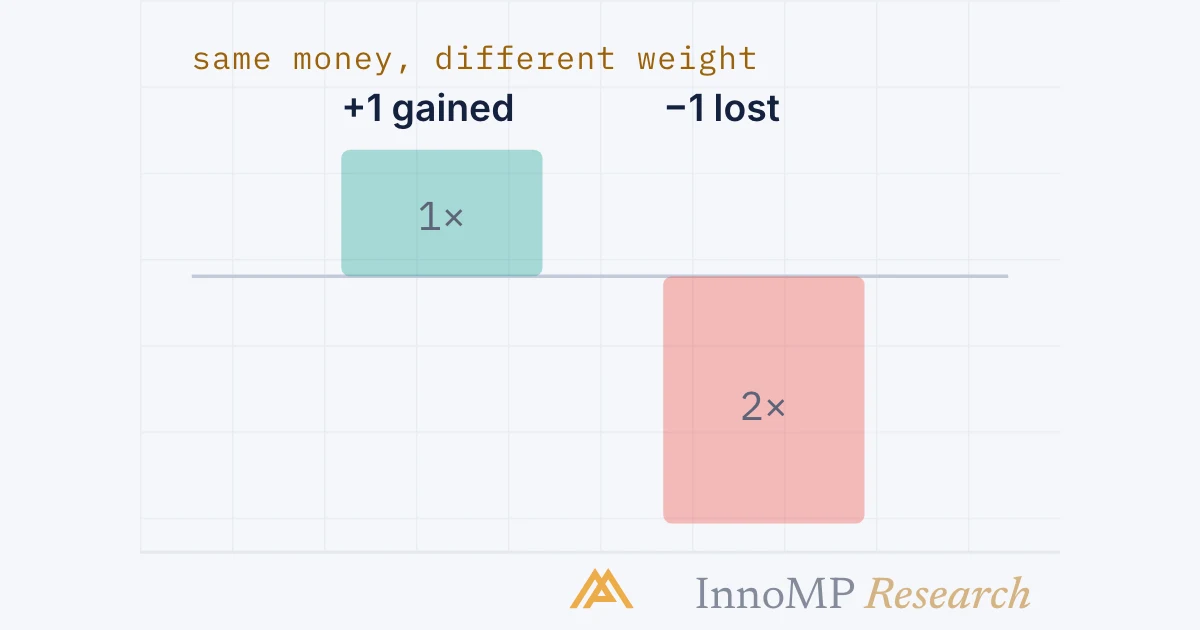
Loss aversion is the tendency for losses to feel roughly twice as significant as equivalent gains. Losing 100 dollars hurts about twice as much as gaining 100 dollars feels good.
This is a well-documented feature of how humans evaluate outcomes, and in trading it produces one specific, expensive pattern.
The disposition effect
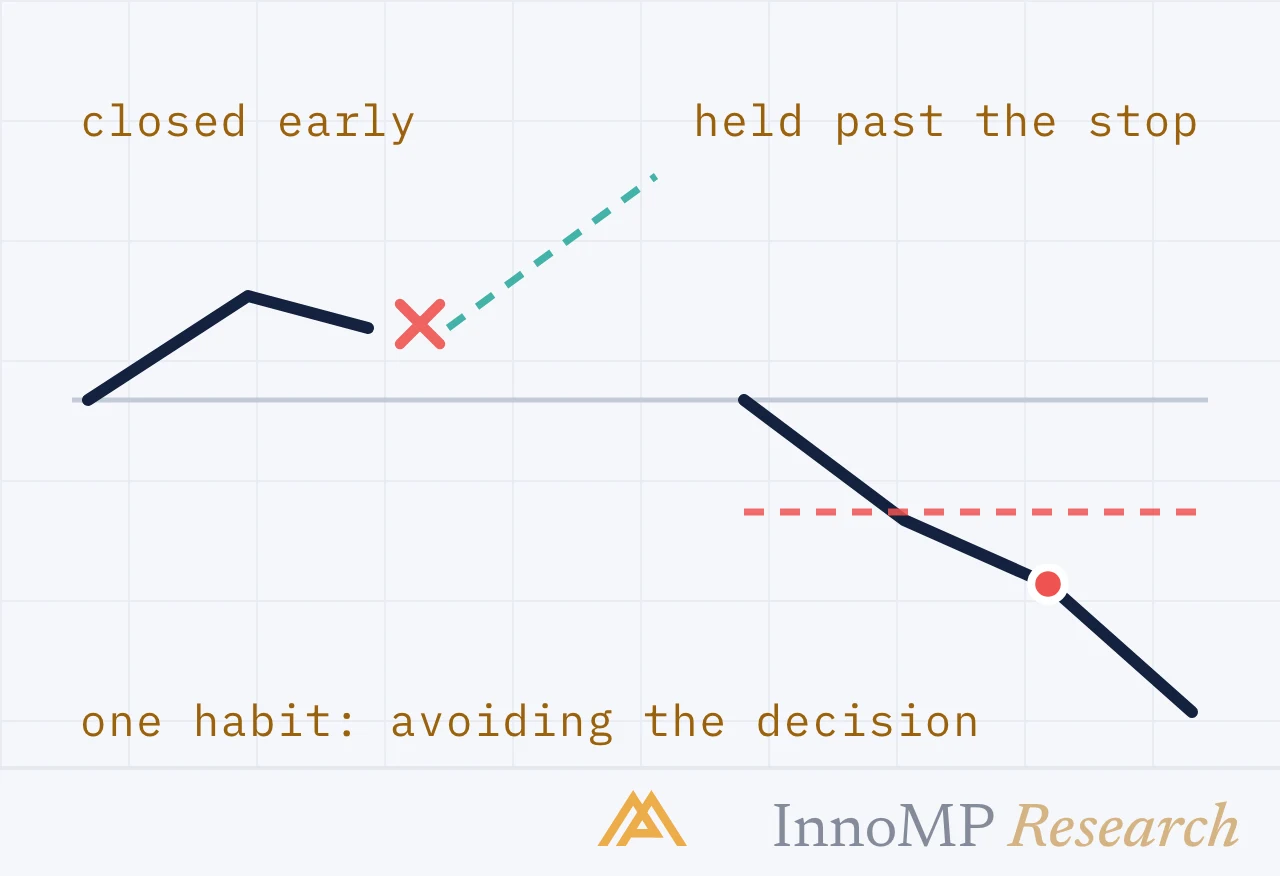
Loss aversion expresses itself in trading as the disposition effect: the tendency to sell winners too early and hold losers too long.
Why winners get cut. An open profit is not yet safe. It can still evaporate, and watching it shrink would be a loss in the emotional accounting even though the position remains profitable. Closing converts an uncertain gain into a certain one.
Why losers get held. A loss is not real until you realise it. While the position remains open, recovery is possible and the discomfort of being wrong can be deferred.
What it does to the arithmetic
The damage is precise. Every strategy depends on a relationship between the size of its average winner and its average loser — the risk-reward ratio.
A strategy planned at 1:2 with a 40% win rate has positive expectancy. Execute it with winners cut to 1:1 and losers averaging 1.5× the planned stop, and the same trade selection loses money. The signals were fine. The exits were emotional.
Why “just be disciplined” fails here
Loss aversion is not a belief you can argue with. It operates before deliberate reasoning and is strongest exactly when a position is open and moving.
Telling yourself to hold the winner does not work, because at the moment of decision the discomfort is real and the reasoning is abstract. You will find a justification — the market looks toppy, better to be safe — and the justification will be indistinguishable from analysis.
The fix is to move the decision to a moment when no position is open.
The structural fixes
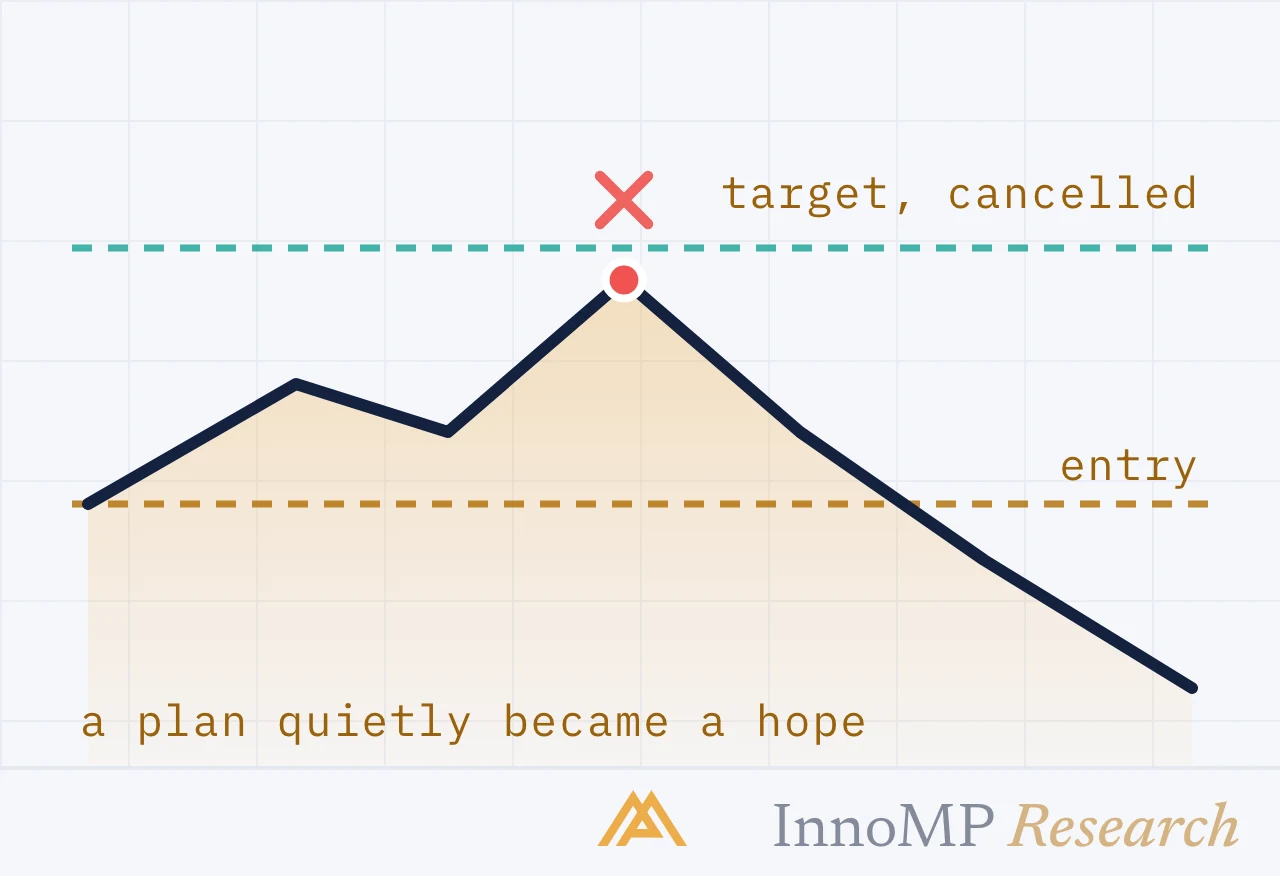
Set the stop and target before entry. Both. Deciding a target after entering means deciding it while loss aversion is active. This is also what makes the risk-reward ratio computable, so it serves two purposes.
Use bracket orders. Attach the stop and take-profit at order entry so both are resting in the market. A resting order does not get talked out of.
Journal in R-multiples. Record every trade as a multiple of initial risk. A journal full of +0.4R exits from 1:2 plans makes the pattern impossible to deny.
Reduce size. Position sizing again. A position small enough that a full stop-out is unremarkable produces a weaker loss-aversion response.
Key takeaway You cannot stop losses from feeling worse than gains. You can stop that asymmetry from touching your exits, by deciding them in advance and putting them in the market as orders rather than intentions.
The partial-exit compromise
For traders who cannot hold a full position to target, scaling out is a legitimate middle path: take a portion at a defined level, let the remainder run with a trailing stop.
Two conditions make it honest. It must be planned before entry, not improvised when the position is up. And it must be consistent, so the journal measures one method rather than a series of improvisations.
Done that way, it banks enough certainty to quiet loss aversion while keeping exposure to the moves that make the strategy work. Done in the moment, it is cutting winners with extra steps.
Next: Confirmation bias in trading — how the analysis itself gets distorted, before any trade is open.
- Research on loss aversion finds losses are weighted roughly twice as heavily as equivalent gains.
- It produces early profit-taking and delayed loss-realisation — the opposite of what most strategies require.
- The disposition effect is the documented tendency to sell winners and hold losers.
- Pre-set stops and targets remove the decision from the moment when loss aversion is strongest.