Overconfidence in trading is overestimating the accuracy of your own judgement, usually after a run of wins. Because short-term results are dominated by variance, a winning streak is weak evidence of skill — yet it reliably produces larger position sizes and looser rules. This is why substantial losses often follow a trader's best period rather than their worst.
Overconfidence is overestimating the accuracy of your own judgement. In trading it arrives after wins, which makes it the mirror of the recency bias covered in Part 4 — the same distortion, running in the direction that feels good.
It is more expensive than pessimism, because pessimism makes you trade too little and overconfidence makes you trade too much at exactly the wrong moment.
Why a winning streak proves little
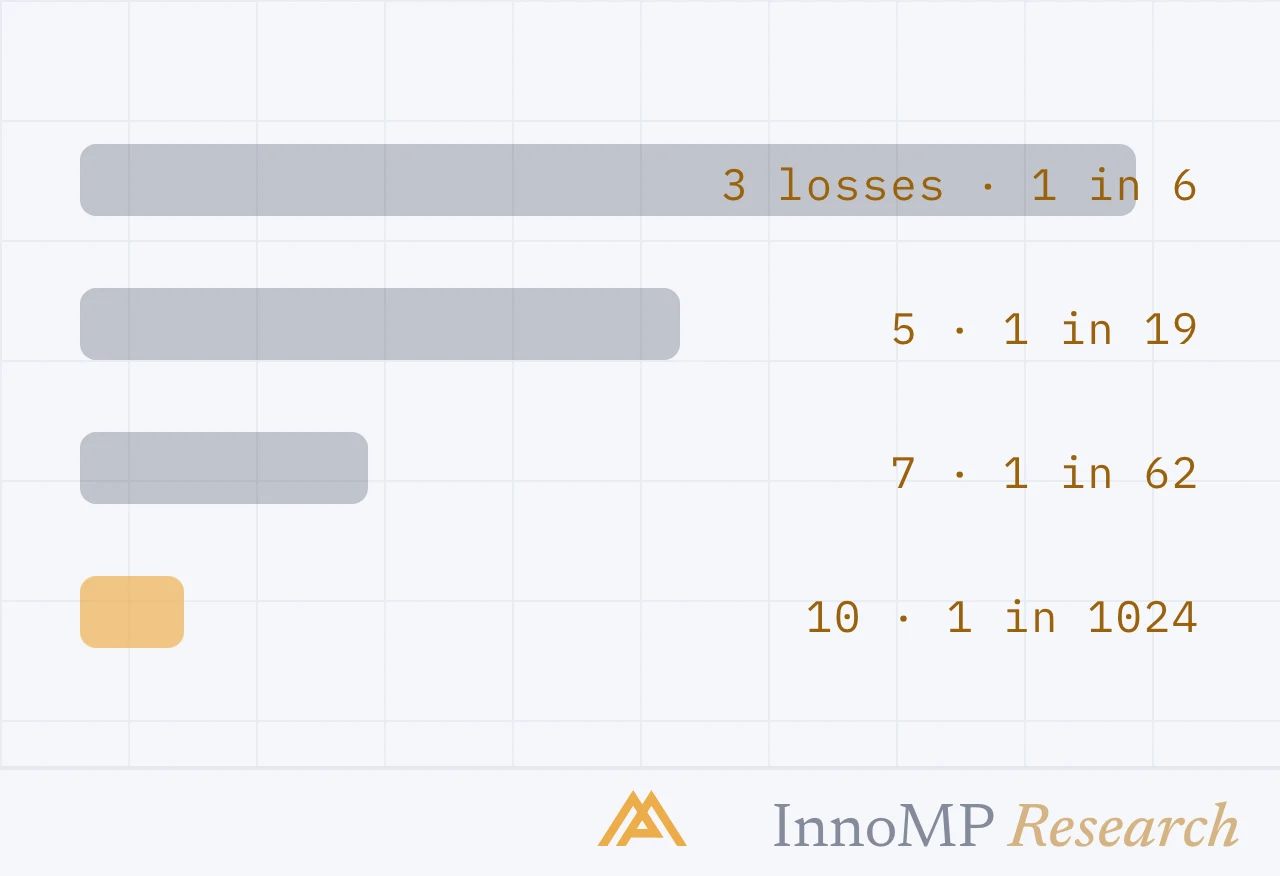
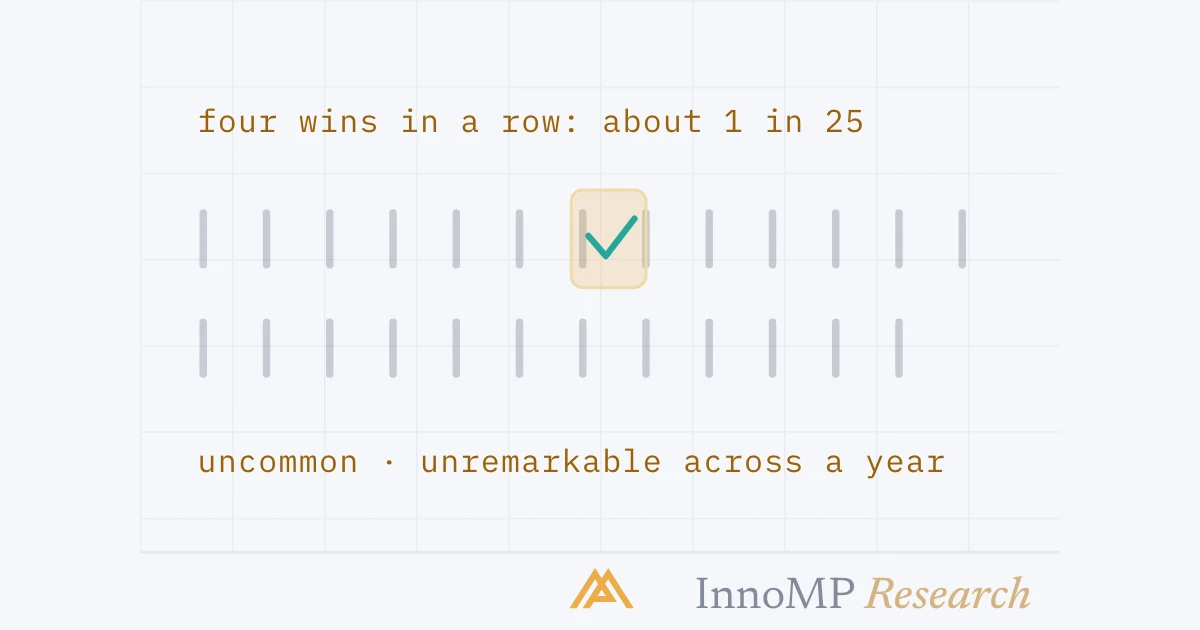
Take a strategy that wins 45% of the time. Four consecutive wins happens roughly once in every twenty-five sequences.
That run feels categorically different from the inside. And the response is predictable: size increases, criteria loosen, trades that would have been skipped now look acceptable. The strategy has not changed. Only the confidence has — and it is now attached to larger positions.
This is why the largest single losses in many trading records arrive shortly after the best week rather than during the worst one.
Outcome bias
The mechanism that makes this durable is outcome bias: judging a decision by its result instead of by its quality at the time.
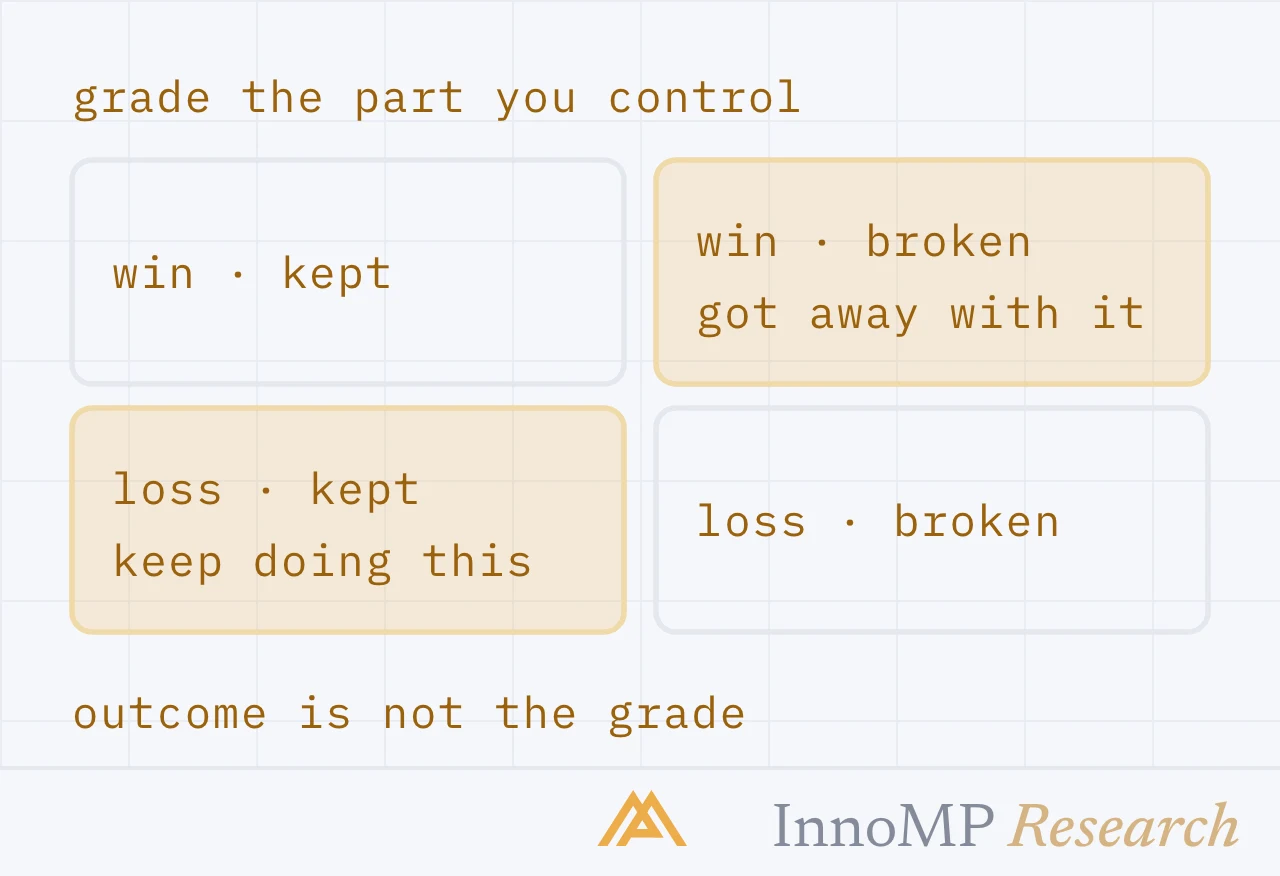
A trade taken outside your rules that happens to profit gets filed as skill, and the behaviour is reinforced. A trade taken correctly that loses gets filed as a mistake, and correct behaviour is discouraged.
The tell is size, not speech
Overconfidence rarely announces itself. Very few traders think “I am invincible now.” What happens is quieter.
Key takeaway Fix your risk percentage in advance and do not vary it with recent results. Overconfidence acts almost entirely through position size — so a size that does not respond to a winning streak removes most of the damage without requiring you to feel less confident.
Practical defences
Constant risk per trade. Whatever your percentage, it does not move with recent performance. Use the calculator every time rather than sizing by feel — the arithmetic does not get overconfident.
Grade the process, not the result. In your journal, record whether each trade met your written criteria as a separate field from whether it profited. A rules-compliant loss is a good trade; a rule-breaking win is a bad one that got lucky.
Notice the feeling as a signal. The sense that the market has become readable is itself information — reliably, that variance has been kind. Treat it as a prompt to check your recent position sizes rather than as a reason to increase them.
Set a size ceiling in advance. A maximum risk per trade and a maximum total exposure, written down while calm. Overconfidence negotiates well in the moment; it cannot negotiate with a number you wrote last month.
Next: Fear in trading — the emotion that keeps traders out of good trades and, occasionally, saves them.
- Short-run results are dominated by variance, so a winning streak is weak evidence of skill.
- Outcome bias is judging a decision by its result rather than by the quality of the decision.
- Overconfidence typically expresses itself as increased position size rather than as a stated belief.
- A fixed risk percentage removes the main channel through which overconfidence causes damage.