Skip to content
Research / Education / Trading emotions

Trading Psychology · Part 9 of 20

Revenge trading and tilt: the loss that becomes four losses

One bad trade produces an emotional state in which the next decisions are worse. How tilt escalates, and the only intervention that reliably stops it.

InnoMP Research Published 31 Aug 2026 · Updated 31 Aug 2026 6 min read
In short

Revenge trading is entering a position primarily to recover a recent loss rather than because a setup exists. Tilt is the emotional state that produces it — frustration after a loss that degrades subsequent decisions. The pattern escalates because each recovery attempt is larger and less selective, and the only reliable intervention is a hard stop rule that removes the ability to continue trading that day.

Revenge trading is entering a position mainly to recover a recent loss. The setup is secondary; the motive is to undo what just happened.

Tilt — borrowed from poker — is the state that produces it. Not rage, usually. A low, urgent frustration that makes waiting intolerable and makes marginal setups look acceptable.

The escalation

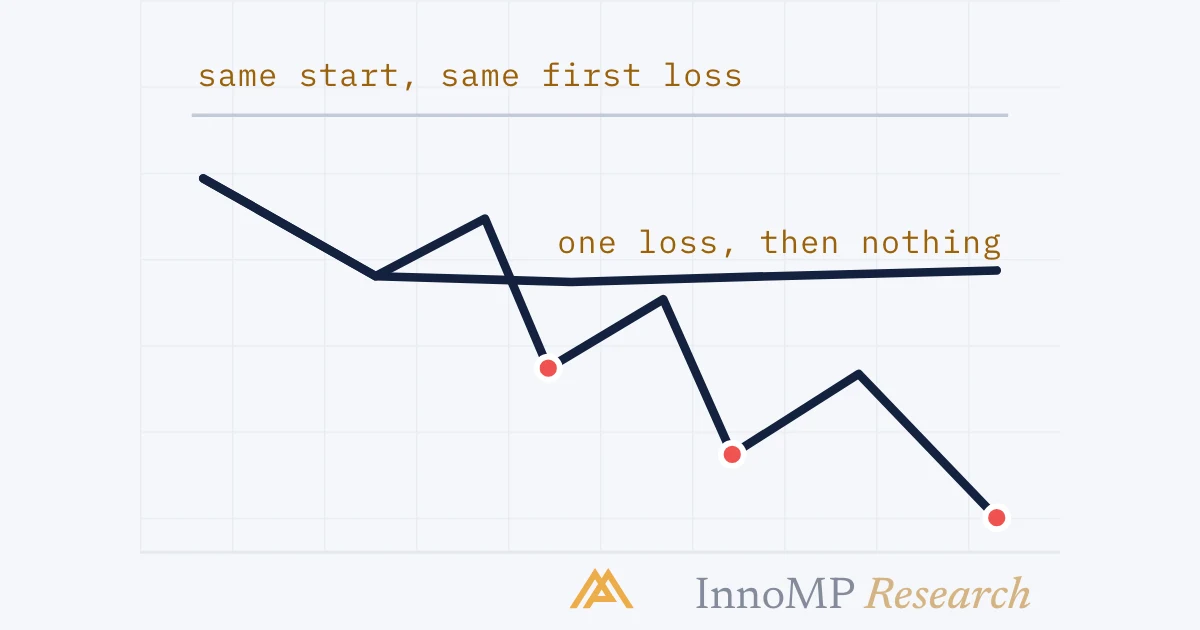
Losses cluster because one loss changes the person taking the next decision.

A tilt sequence against a normal trading day Two equity paths across one day from the same starting line. The upper path shows one loss followed by a flat stretch. The lower path shows the same first loss followed by three progressively larger losses, each marked with a growing position size, ending far lower. start of dayplan followed−1% planned−2% “make it back”−3% faster, looser−6% on the day InnoMP Research
Same first trade. The difference is everything after it — three decisions, each made by a slightly worse version of the same trader.

No single decision in that sequence looks insane from the inside. Each is a slightly worse version of the last, and the deterioration is gradual enough to be invisible while it happens.

The important observation: the first loss was the plan working. Everything after it was the plan being abandoned by someone whose judgement had already degraded.

How to recognise a revenge trade

The one question that identifies a revenge trade A single question in a box reading would I take this trade if my last one had won, with two branches. A yes branch leads to a setup. A no branch leads to a recovery attempt, marked regardless of how the chart looks. Would I take this tradeif my last one had won?Yes → a setupevaluate it normallyNo → recoveryhowever good it looksmarkers: bigger size · faster entry · unfamiliar instrument· the words “make it back” InnoMP Research
Motive is the distinguishing feature, and motive is checkable in five seconds.

The distinguishing feature is motive: Would I take this trade if my last one had won? If no, it is not a setup — it is a recovery attempt, and everything else about it may be superficially fine.

Why willpower fails here specifically

Tilt degrading the same faculty that would resist it Two declining lines across a session. Judgement quality falls after each loss. The urge to trade rises across the same span. A shaded region marks where the two cross, labelled the point at which self-policing stops working. judgementurge to tradepast this point, self-policing stops working InnoMP Research
Telling yourself to stay disciplined while on tilt asks the impaired system to police itself.

Tilt degrades exactly the faculty that would resist it. This is why the intervention has to be structural and pre-committed — a rule that operates without requiring good judgement in the moment, because good judgement is precisely what is unavailable.

Key takeaway Set a daily loss limit before you need one, and make it a stopping rule rather than a warning. Two full stop-outs, or a fixed percentage — the number matters less than the fact that reaching it ends the session, without negotiation and without exception.

The rules that work

Four pre-committed rules that operate without in-the-moment judgement Four rows: a daily loss limit that ends the day, a cooling-off period after any loss, a three-question pre-trade check on paper, and a journal field recording emotional state before entry. Daily loss limit ends the daytwo full stop-outs, or 3% — no negotiationCooling-off after any losstwenty minutes before the next trade existsThree questions on papercriteria? · would I take it after a win? · normal size?Journal the state, not only the trade InnoMP Research
Each one runs without asking how you feel — which is the requirement, because how you feel is the problem.

A daily loss limit that ends the day. On reaching it, positions are closed, the platform is closed, and the day is over. This single rule prevents most catastrophic days.

A cooling-off period after any loss. It costs a few setups a month and prevents the entire escalation pattern, which is a trade worth making.

A pre-trade check written on paper. Three questions, fifteen seconds. Physical enough to interrupt momentum.

Journal the state, not only the trade. Reviewed later, the correlation between “frustrated” and “loss” is usually stark.

A cooling-off period interrupting the escalation Two sequences after an identical first loss. In the first, three trades follow immediately and each is larger. In the second, a fixed cooling-off block sits after the loss and the next trade returns to normal size. No intervaleach one larger20-minute intervalcooling offnormal size resumesthe rule runs without asking how you feel InnoMP Research
It costs a few setups a month and prevents the entire escalation pattern. That is a trade worth making.

The drawdown article makes the related point: most drawdowns become serious not through the strategy’s own losses but through the trades taken around them. Tilt is the mechanism.

Next: Why rules break under pressure — and how to write ones that do not.

Key facts
  • Revenge trades are identifiable by their motive: recovering a loss rather than a setup being present.
  • Tilt escalates because each attempt is larger and less selective than the last.
  • The largest single-day losses in most trading records come from tilt sequences, not single trades.
  • A daily loss limit that ends the session is the only intervention that works reliably.
Frequently asked questions

What is revenge trading?

Taking a trade mainly to win back money just lost, rather than because a setup meeting your criteria has appeared. The motive is emotional recovery, and it typically comes with larger size and looser entry standards.

What is tilt in trading?

A state of frustration or agitation after a loss in which judgement is measurably worse. Decisions made on tilt tend to be faster, larger and less selective, which is why losses cluster rather than arriving evenly.

How do I stop revenge trading?

A daily loss limit that ends the session — not a target you aim to respect, but a rule you follow without negotiation. Willpower fails on tilt precisely because tilt degrades the faculty willpower depends on.

Why do losses cluster together?

Because one loss changes the state of the person taking the next decision. The second trade is taken by someone frustrated, the third by someone more so. This is why a single bad day can cost more than several ordinary bad trades.

InnoMP Research

Market research, trading education and platform guides from the InnoMP research desk — covering forex, metals, indices and stock CFDs.

Published 31 Aug 2026 · Updated 31 Aug 2026 · Reviewed by InnoMP Compliance

Disclaimer: This content is provided for general informational purposes only and does not constitute investment advice, an offer, or a solicitation to buy or sell any financial instrument. It has been prepared without regard to your individual financial circumstances or objectives. Trading CFDs involves a high risk of loss.

Related notes

Trading emotions

FOMO: chasing the move you already missed

The setup came and went without you. Then price runs, and entering late feels urgent. Why chased entries carry the worst risk-reward on the chart.

5 min read