A weekend gap is the difference between Friday's closing price and Monday's first print, created because the news that moves markets does not stop while CFD markets are closed. A stop-loss cannot execute in a closed market, so across a gap it becomes an instruction to exit at the reopening price. InnoMP raises its forced-liquidation threshold from 30% margin level on weekdays to 100% over the weekend; size positions for a 2–5% gap, confirm margin headroom against the 100% line before Friday's close, or flatten.
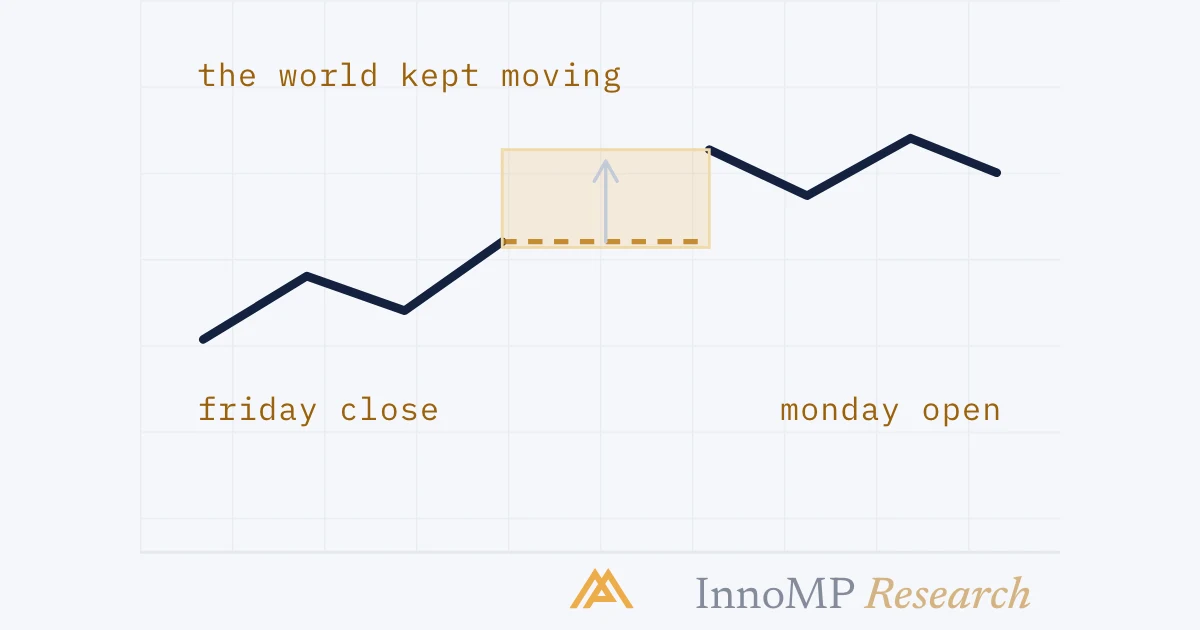
From Friday’s close to Monday’s open, most CFD markets are shut — forex and gold trade 24/5, index and stock CFDs follow their market sessions. The world that prices them, though, runs straight through: elections happen on Sundays, geopolitics does not keep office hours, and companies announce when they announce.
Everything that happens during the break is compressed into one number: the first print at the reopen. That is the gap.
The mechanics
A CFD tracks an underlying market. Closing the CFD for the weekend does not pause the forces moving the underlying — it only removes your ability to react to them.
If EUR/USD closes at 1.0850 and weekend news moves fair value to 1.0790 by Sunday, the pair reopens near 1.0790. A long position took the full 60-pip loss with no opportunity to exit anywhere in between, because there was no market to exit into.
Key takeaway A stop-loss cannot execute in a closed market. Across a gap, it becomes an instruction to exit at the reopening price — whatever that is. This is not a failure of the order; it is what a stop has always been.
Why the platform treats weekends differently
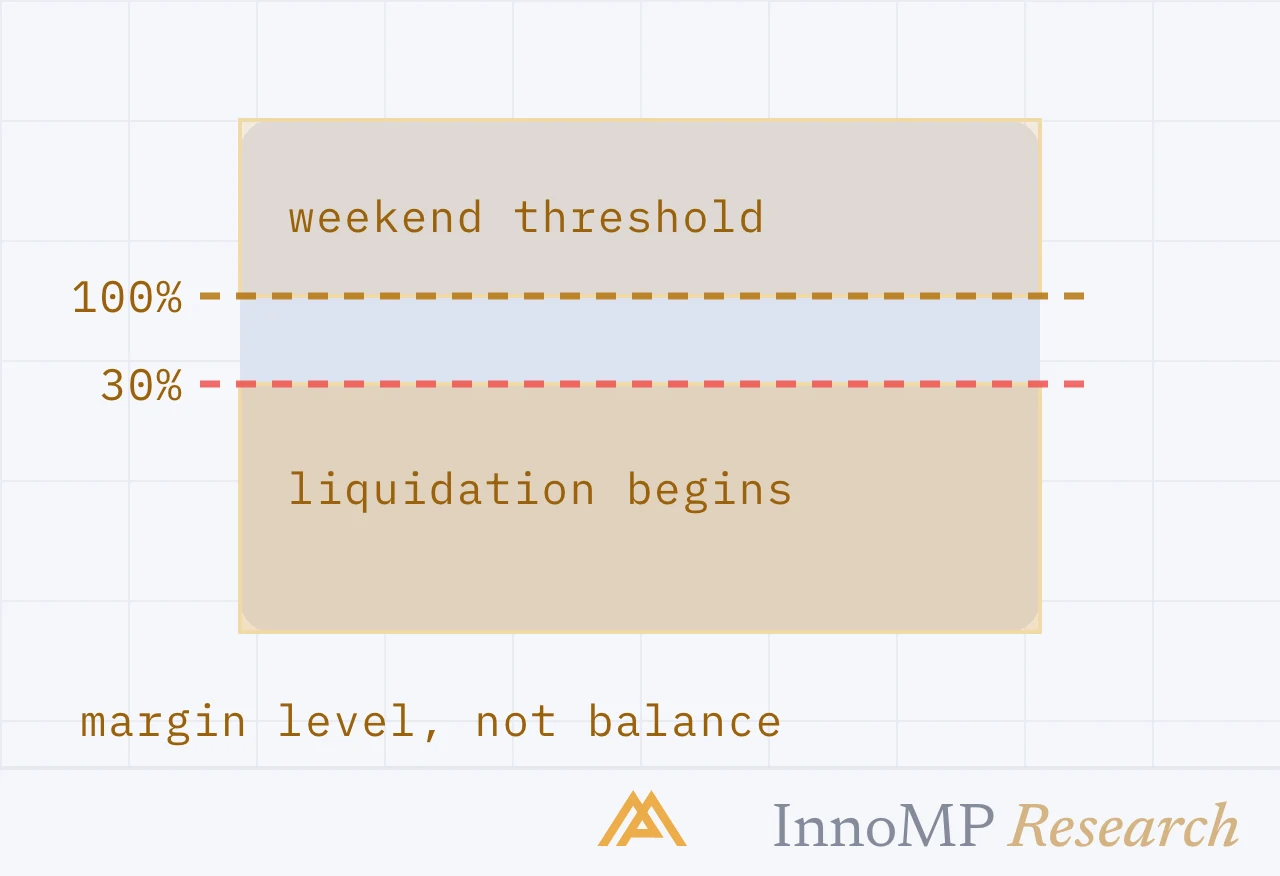
InnoMP’s forced-liquidation threshold makes the risk explicit. During the trading week, automatic liquidation begins when margin level falls to 30%. Over the weekend, the threshold rises to 100%.
Read that as the platform pricing the same reality you should: a position that cannot be managed for two days needs far more equity behind it. An account that sails through the week at a 90% margin level — three times the weekday threshold — is comfortable on Wednesday and below the liquidation threshold on Saturday. The margin arithmetic is covered in margin calls and stop-outs — the weekend rule is the part of it most traders discover late.
Which instruments gap hardest
Index and stock CFDs carry the most structural weekend risk: they follow exchange sessions, so the closed window is longest, and single-company news — earnings leaks, downgrades, deals — lands with the market shut.
Forex majors usually reopen close to Friday’s close, but political weekends are the exception that matters: the gaps, when they come, are the largest and least predictable.
Gold sits in between — it trades 24/5, closes the weekend, and is exactly the asset that responds to the geopolitical surprises weekends produce.
Practical handling
Size the position for the gap, not the stop. The question is not where your stop sits but what the position costs if Monday opens 2–5% away. If that number is unacceptable, reduce before Friday’s close. The position-sizing arithmetic applies — with the gap distance in place of the stop distance.
Check margin headroom against the weekend threshold. Before the close, confirm the account’s margin level clears 100% with room to spare, not 30%. The margin calculator reports that headroom in both dollars and pips.
Consider flattening. For intraday and short-swing strategies, carrying gap risk over a weekend to hold a position that would have been closed Monday anyway is uncompensated risk.
Do not park orders inside the gap. A limit order at a price the market jumps over does not fill on the way past.
Remember the financing. Positions held across the break accrue swap for the non-trading days — Wednesday’s triple swap exists for this reason, as covered in the real cost of a trade.
The reasonable default
For most short-horizon traders: reduce or close before the weekend, re-establish after Monday finds its price. That gives up the occasional favourable gap — and removes an exposure no stop-loss can manage, on a schedule published in advance. Few risks in trading can be sidestepped by looking at a calendar. This is one.
- A gap is the difference between Friday's close and Monday's first print; everything that happened in between is compressed into one price.
- A stop-loss cannot fill in a closed market; across a gap it executes at the reopening price.
- InnoMP's liquidation threshold is 30% margin level during the week and 100% over the weekend.
- Index and stock CFDs carry the longest closed window and the most structural weekend gap risk; forex majors gap hardest on political weekends.
- Positions held over the weekend accrue swap for the non-trading days.