Most trading plans are documents nobody reads twice. What a usable one contains, and the test that separates a plan from a wish list.
IRInnoMP Research · Education Desk Published 31 Aug 2026 · Updated 31 Aug 2026 4 min read
In short
A trading plan is a written specification of what you trade, when you enter, where you exit, how much you risk, and what stops you trading. A usable plan is specific enough that another person could execute it from the document alone, short enough to be recalled during a live trade, and reviewed on a fixed schedule rather than under pressure.
A trading plan is a written specification of what you trade and under what conditions. Most plans fail one of two tests: they are too vague to execute, or too long to remember.
The useful standard is a single question: could another trader execute this from the document alone, without asking you anything?
The one-page plan
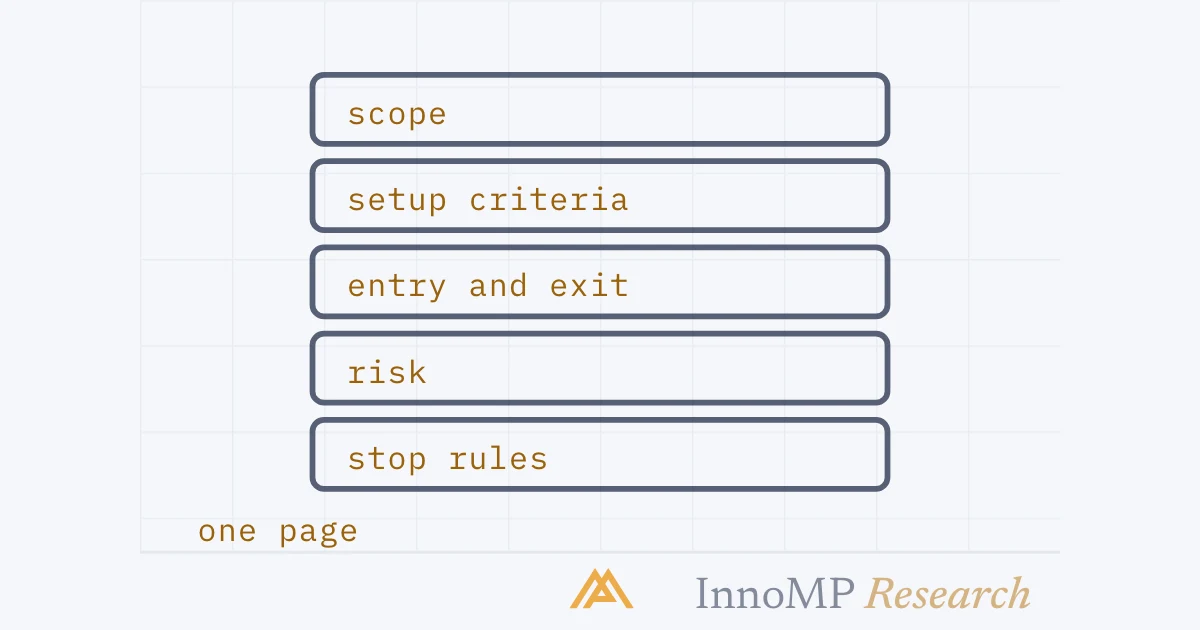
One page, five blocks. Anything that does not fit here belongs in the journal — the plan is what you need to recall while a position is moving.
Scope. Which instruments, which timeframes, which sessions. “Forex” is not scope.
Setup criteria. The exact conditions that constitute a trade. Not “buy pullbacks in an uptrend” but three testable conditions.
Entry, stop and target. The trigger price, the invalidation derived from structure, and how the target is determined — a level, a measured move, or a defined trailing method.
Risk. Percentage per trade, daily loss limit, maximum concurrent positions, maximum total exposure.
Stopping conditions. What ends the session, and what ends the week.
The specificity test
Every question they ask is a place where you were relying on unwritten judgement — and unwritten judgement is where emotion enters.
Undefined spaces are where emotion enters, because something has to fill them and in the moment the filler is whatever you feel. Specificity is not pedantry; it is the removal of surfaces that bias can attach to.
Keep it to one page
The plan is the operational layer. Everything that explains why lives in the journal, where length costs nothing.
A plan you cannot recall during a live trade is not operating when it matters. Long plans feel thorough and function as documents.
Key takeaway
Write the plan when flat and calm, because that is the only condition in which it can be written honestly. Its purpose is to let a rested version of you make the decisions that a stressed version will merely execute.
Could another trader execute this from the document alone? Every question they ask is a gap you were filling from memory.
Revising it
A revision made during a losing run is a rationalisation with a paper trail.
Reviewing after 15 trades measures variance, not the plan. Change what the record says needs changing, not what memory says. And apply the diagnostic in the drawdown article before touching anything during a losing run.
A plan must be specific enough that a second person could execute it without asking questions.
It should fit on one page so it can be recalled while a position is open.
Risk per trade, daily loss limit and maximum open positions belong in every plan.
Plans are revised on a schedule when flat, never during a losing session.
Frequently asked questions
What should a trading plan include?
Which instruments and timeframes you trade, the exact criteria that define a setup, entry and exit rules, risk per trade, a daily loss limit, maximum open positions, and the schedule on which you review the plan itself.
How long should a trading plan be?
One page. A plan you cannot recall during a live trade is not operating when it matters most. Detail belongs in your journal and review notes, not in the document you rely on in the moment.
How do I know if my trading plan is specific enough?
Hand it to someone who trades and ask whether they could execute it without asking you anything. Every question they ask marks a place where you were relying on judgement you had not written down.
When should I change my trading plan?
On a fixed schedule — monthly or quarterly — while flat, with your journal in front of you, changing one variable at a time. Never during a drawdown or with a position open, when a revision is usually a rationalisation.
IR
InnoMP Research · Education Desk
Trading education from first principles — position sizing, risk, market structure and the habits that keep accounts alive. Written for someone who has never opened a chart, with a diagram at every step.
Published 31 Aug 2026 · Updated 31 Aug 2026
Disclaimer: This content is provided for general informational purposes only and does not constitute investment advice, an offer, or a solicitation to buy or sell any financial instrument. It has been prepared without regard to your individual financial circumstances or objectives. Trading CFDs involves a high risk of loss.
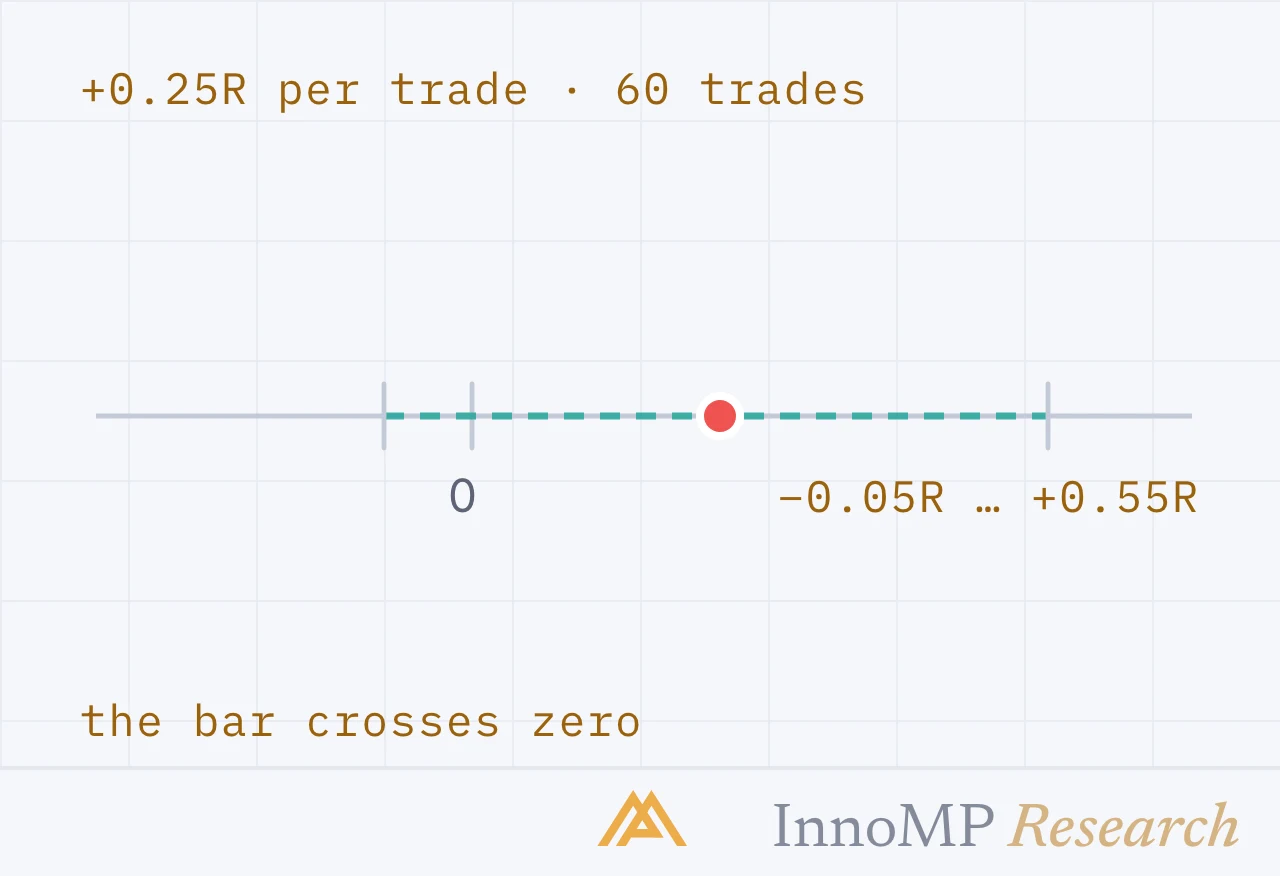
A record says +0.25R per trade. The question is how far from that the truth could be. How to put a standard error and a confidence interval on expectancy, and how many trades it takes to tell an edge from zero.
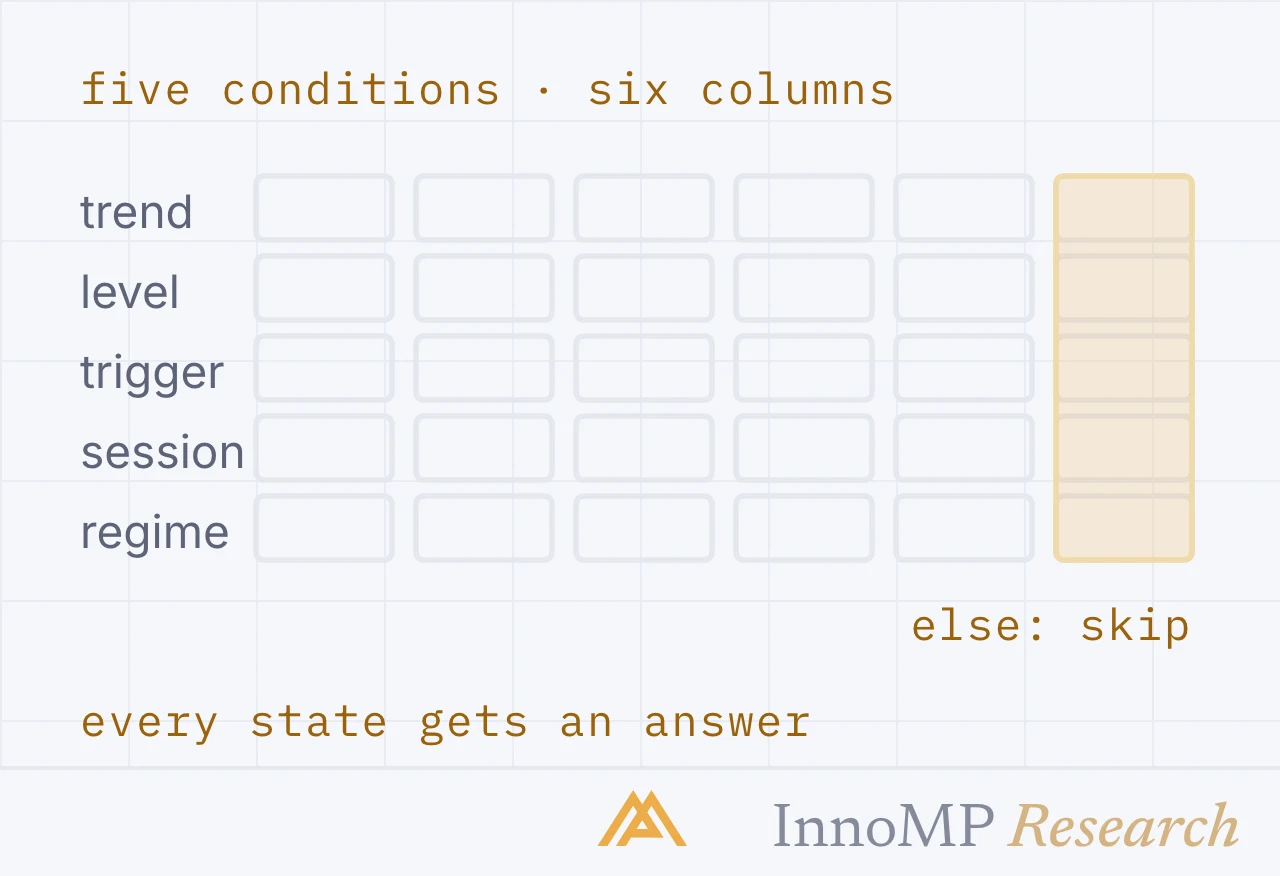
A written setup still leaves gaps: market states its prose never mentioned. How to lay the rules out as a decision table — conditions down the side, a column per rule — and find the gaps and contradictions first.
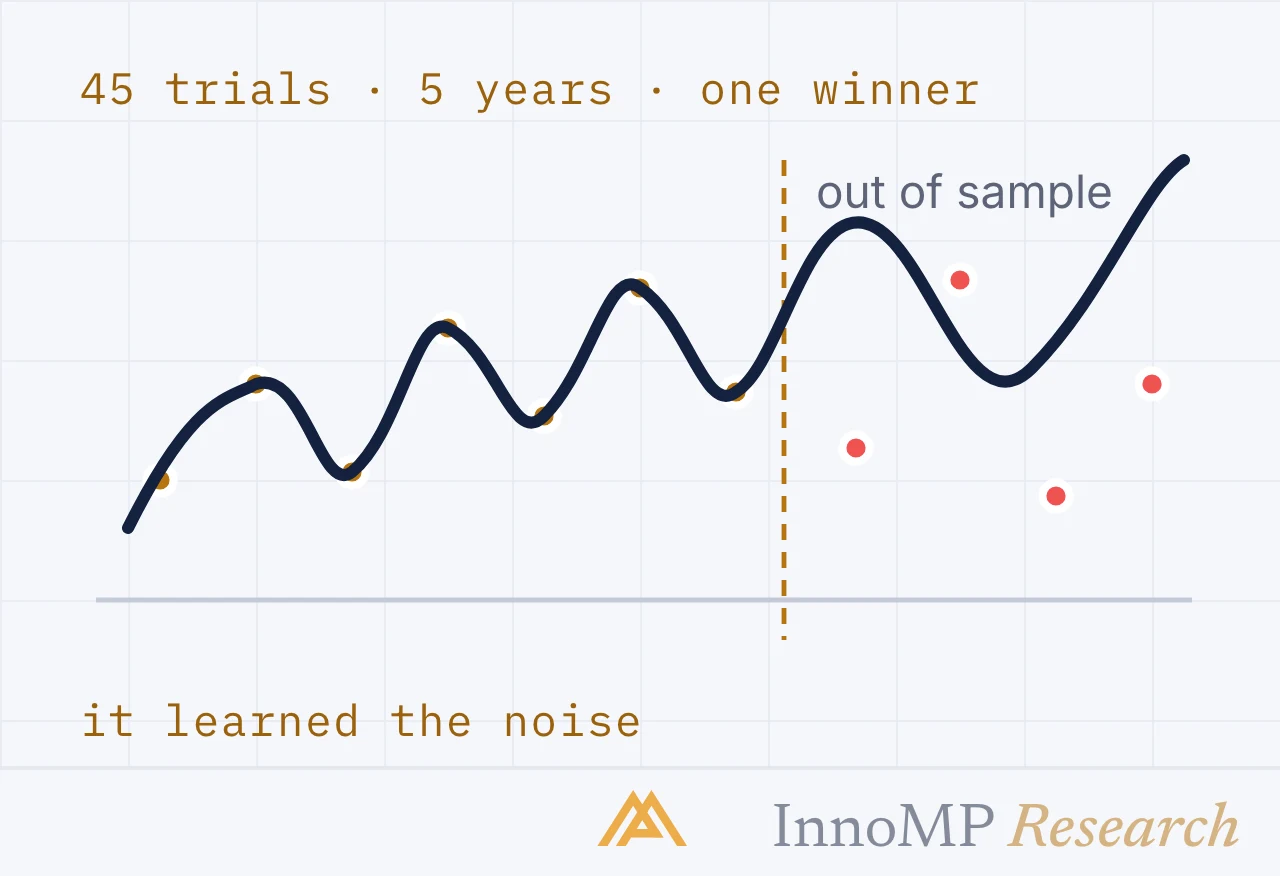
Try enough versions of a rule and one will shine on the past by chance. What overfitting is, why the trial count matters more than the winner's numbers, and how held-out data and walking forward tell fit from luck.