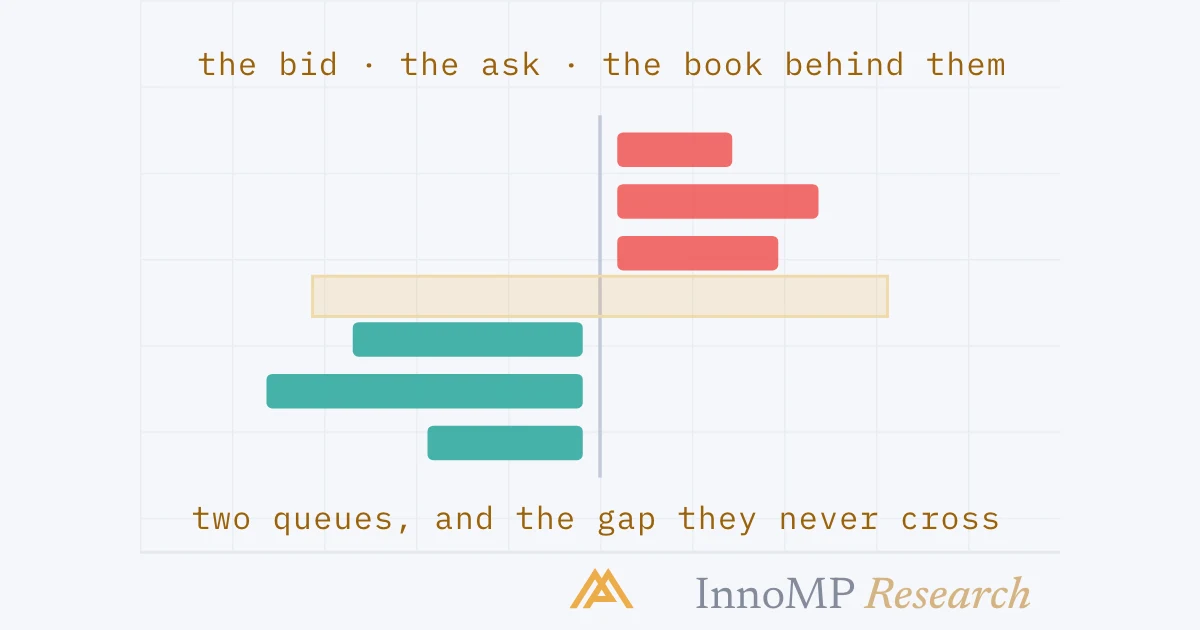
A price is made by two queues of orders. The bid is the highest price a resting buyer will pay, the ask is the lowest a resting seller will accept, and the gap between them is the spread. A trade happens when someone crosses the spread: a buyer pays the ask, a seller hits the bid. Behind each best price sits more resting volume at worse prices — the book — and an order's size against that book decides whether it fills at the quote or walks through it. On a chart this is one line; on the ticket it is the whole cost.
A price is made by two queues of orders: the bid, which is the highest price a resting buyer will pay, and the ask, which is the lowest price a resting seller will accept. The gap between them is the spread, and a trade happens only when someone crosses it.
Two levels of this course have read charts. This level starts underneath the chart, at the thing the line is drawn from — because every entry, every stop and every cost the earlier levels counted is decided by a mechanism the line does not show.
Two queues and the gap between them
At any moment an instrument has buyers who have said what they will pay and sellers who have said what they will accept. Those statements are orders, resting until something meets them. Sort them by price and the picture is a ladder.
The bid is the top of the buyers’ queue. The ask — also called the offer — is the bottom of the sellers’. Together they are the best bid and offer, and they are the two numbers a quote shows. Everything else on the ladder is the order book: the resting volume at worse prices, waiting its turn.
Nothing in this picture is moving. Resting orders do not trade with each other, because the best buyer is below the best seller by construction. For a trade to happen, someone has to cross.
Crossing the spread
A trade occurs when a participant stops waiting and takes the other side’s price. A buyer who wants to trade now pays the ask. A seller who wants to trade now hits the bid. That is what a market order is — the next part is about order types — and it is the only way the spread ever closes.
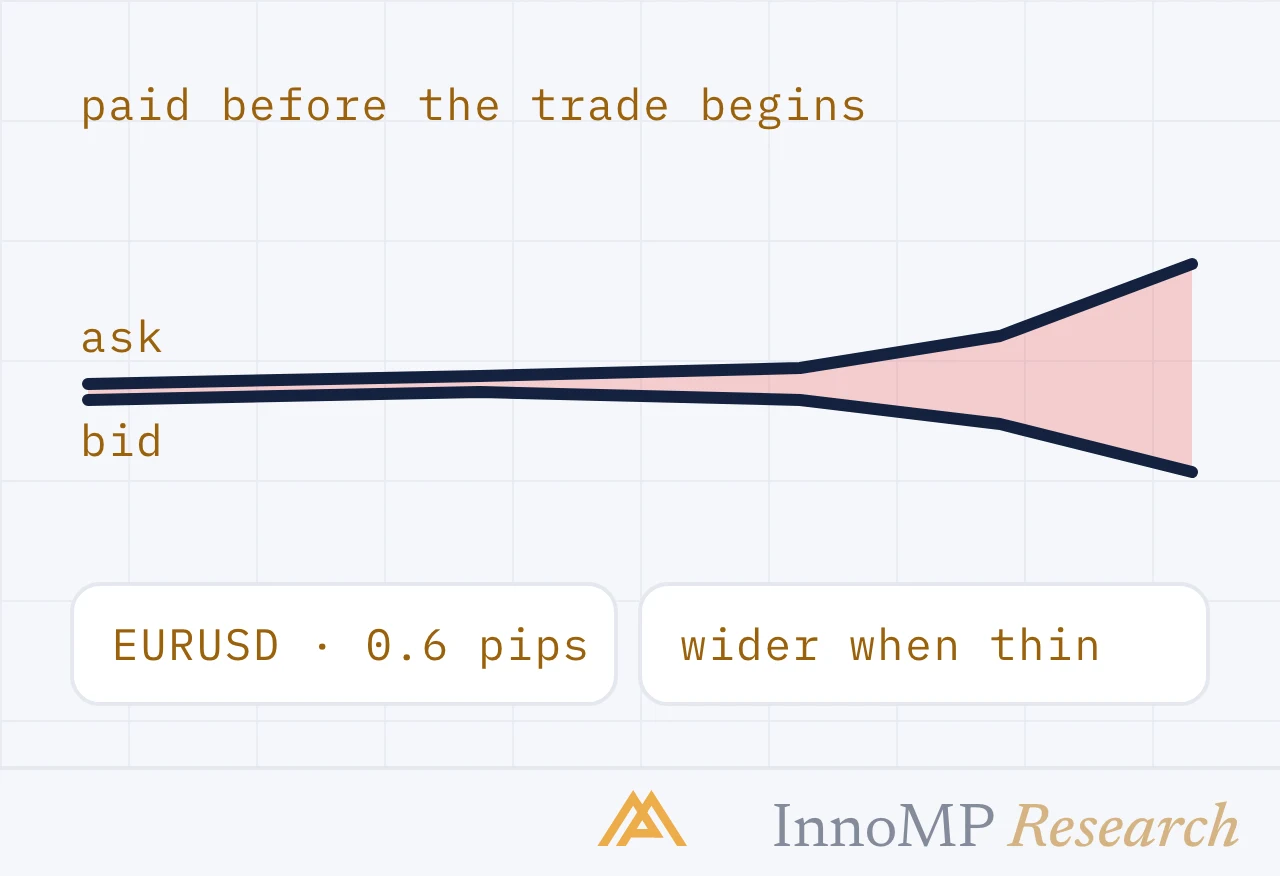
This is the mechanism behind the real cost of a trade from CFD Foundations. A position is opened at the ask and closed at the bid, or the reverse, so the spread is paid in full on every round trip before the price has moved at all. MetaTrader’s own definitions say the same thing from the order’s side: a buy executes at the Ask, a sell at the Bid.
Behind the best price
The quote is a price for a quantity — the volume resting at the best level — not a price for any size. An order larger than that volume takes the best level and then the next one, and the next, until it is filled.
The numbers are illustrative; the shape is not. How far an order walks depends on its size relative to the book, and the book is thinner in the Asian hours, at the rollover, and around news — the same windows the Intermediate level flagged for volume and spread. Part 3 of this level prices this walk properly, as market impact and slippage. For now the point is simpler: a quote is a price for the first lot, and every lot after that is a negotiation with the rest of the ladder.
Key takeaway The bid and ask are the two prices at the front of two queues. A trade is one side stepping across to the other. Everything about execution — cost, fill, slippage — is a consequence of how deep those queues are behind the front.
What the chart shows, and what it hides
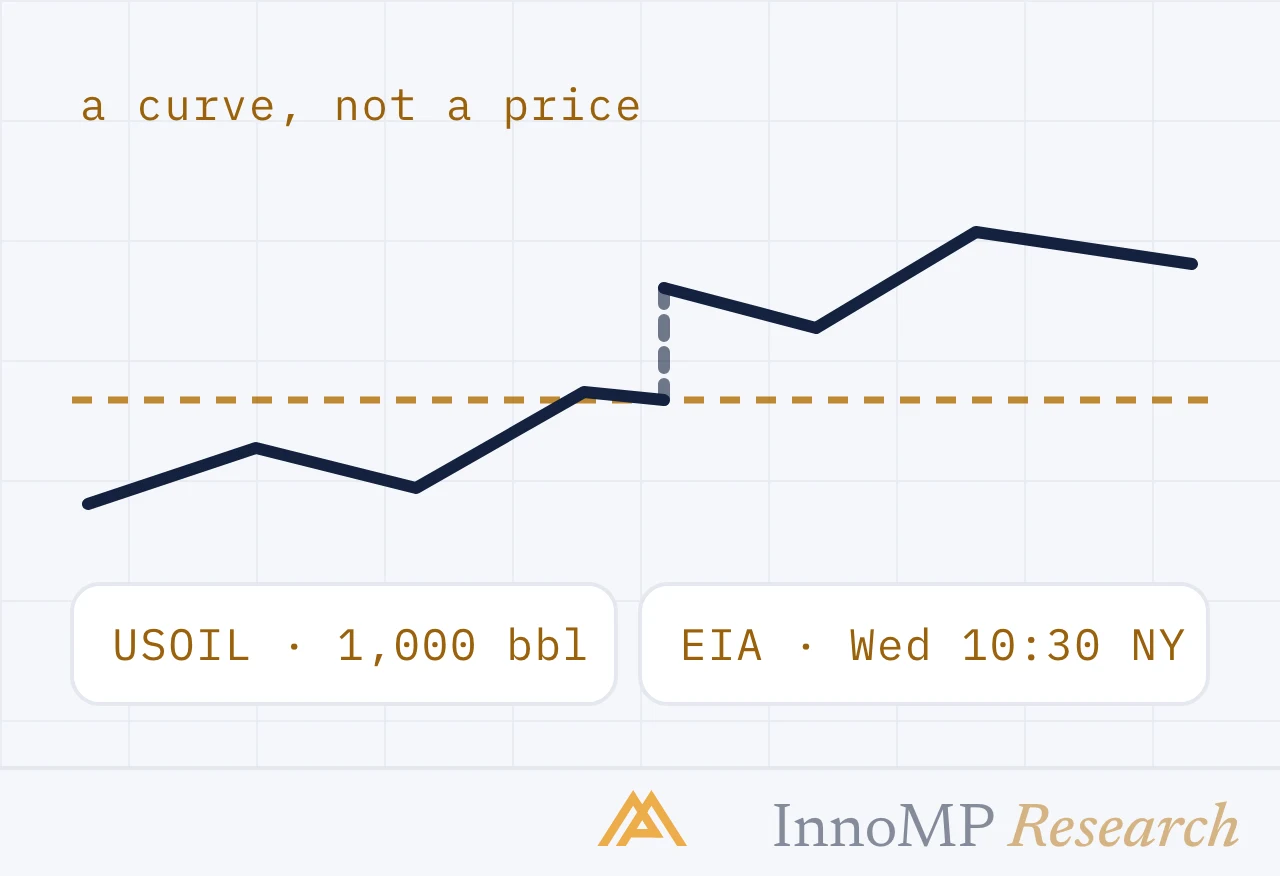
A chart draws one line. It is the bid, the mid-point, or the last traded price, depending on the platform; MetaTrader draws the bid by default. Whichever it is, it is not the price a trade pays.
Two consequences the earlier levels described from the outside now have a mechanism.
A stop can be hit by the spread alone. A sell stop on a long position triggers on the bid. If the chart is drawn on the bid the line has to touch it; but a buy stop on a short triggers on the ask, which the bid-drawn chart never shows, and a widening spread at the rollover can put the ask through the stop while the line sits above it.
A level is a level on one side of the book. Support at a price is bids resting there. When price “tests” it, what is being tested is whether those bids are still in the book — and whether sellers crossing the spread take them all. Part 2 of the Intermediate level drew that as a zone; this is why it is one.
An exchange book and a dealer’s book
On a stock exchange the ladder above is a single shared queue: everyone’s resting orders, in one place, matched by one rule. Forex is not that market. The BIS survey used throughout the Intermediate level describes it as over-the-counter: dealers trade with each other and with clients directly, and there is no central book.
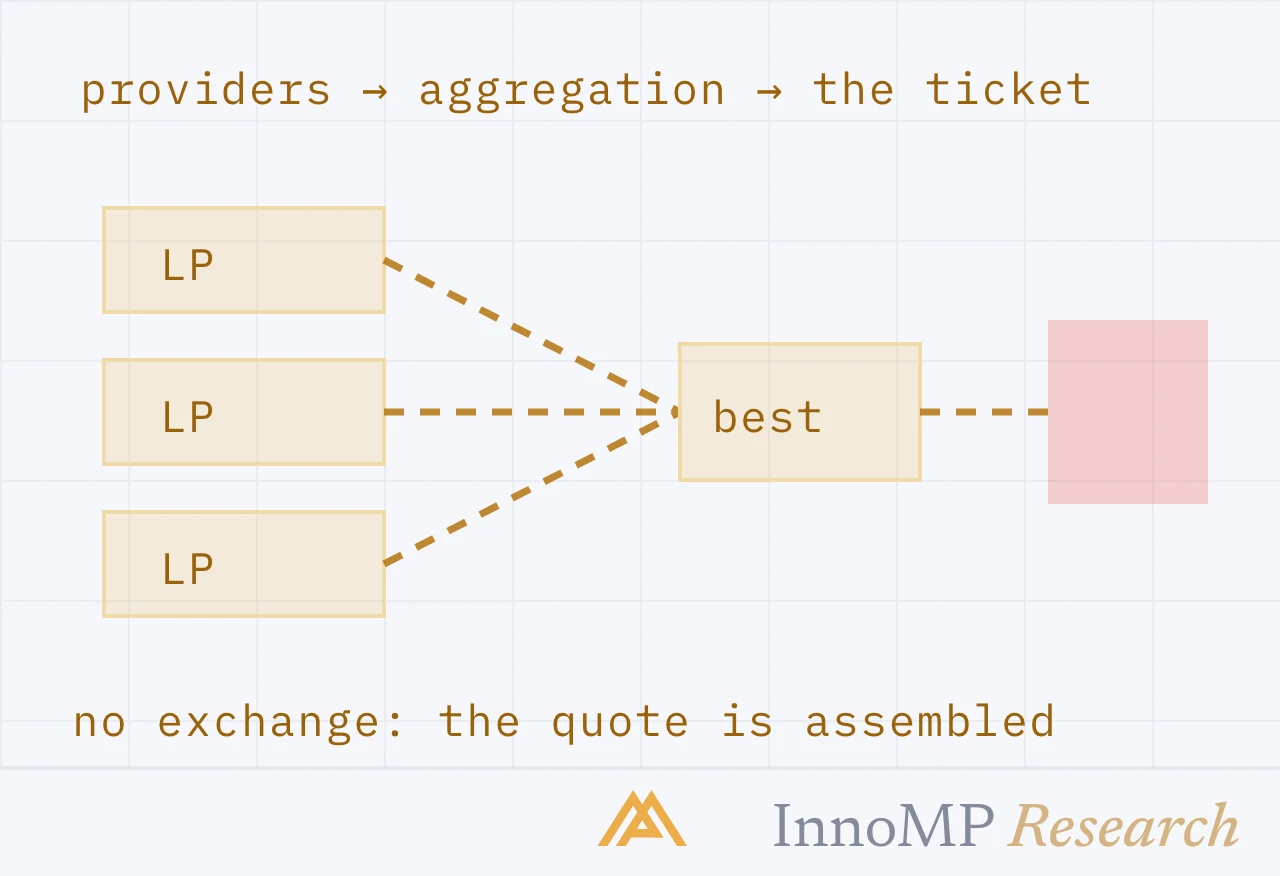
A CFD on a currency pair is priced against the dealer’s book: the broker’s quote, assembled from the streams its liquidity providers send it. The ladder still has a bid, an ask and depth, and everything in this part applies to it. But it is the broker’s ladder, it differs from the next broker’s, and how it is assembled is the subject of Part 4.
Between here and there are two parts about what a trader can do to that ladder: which queue an order joins, and what it costs to be at the front of it.
Next: Market, limit and stop orders — which queue each order type joins, why a stop-loss is a market order in waiting, and who pays the spread.
- The bid is the best resting buy price; the ask is the best resting sell price; the spread is the difference.
- A market buy pays the ask and a market sell hits the bid: crossing the spread is what makes a trade happen.
- Behind each best price sits resting volume at worse prices; an order larger than the best level fills through several.
- A chart's single line is the bid, the mid or the last trade, and hides the spread that every trade pays.
- In an over-the-counter market the book is the dealer's, assembled from its liquidity providers, not one exchange queue.