Skip to content
Research / Education / Trading costs

TA · Professional · Part 3 of 16

Spread, depth and slippage: what execution actually costs

The spread is the visible cost. Depth decides whether that spread is available for your size, and slippage is the gap between the price you saw and the price you got. Why an edge is measured after all three.

InnoMP Research · Education Desk Published 24 Sept 2026 · Updated 24 Sept 2026 8 min read
InnoMP Research cover art — the edge is what is left
In short

Execution cost has three parts. The spread is the gap between bid and ask, paid on every round trip. Depth is how much resting volume sits at and near the best prices; an order larger than the best level fills through worse ones, and that cost is market impact. Slippage is the difference between the expected fill and the actual one, and it grows where depth is thin — at news, at the rollover, in thin hours. A setup's edge is what remains after all three, which is why a backtest filled at the mid overstates it.

Execution cost is what a trade pays beyond the mid price, and it has three parts: the spread, which is always paid; market impact, which is paid when an order is larger than the best level; and slippage, which is the gap between the fill that was expected and the fill that happened. A setup’s edge is what is left after all three.

Part 1 drew the book and Part 2 placed orders in it. This part puts a price on being there — the price the earlier levels called “costs” in one word, now separated into the three things it is.

Three costs on one trade

Take one round trip: in, and out. Between the mid price at entry and the mid price at exit lies whatever the market did. Between the mid and the fills lies the cost.

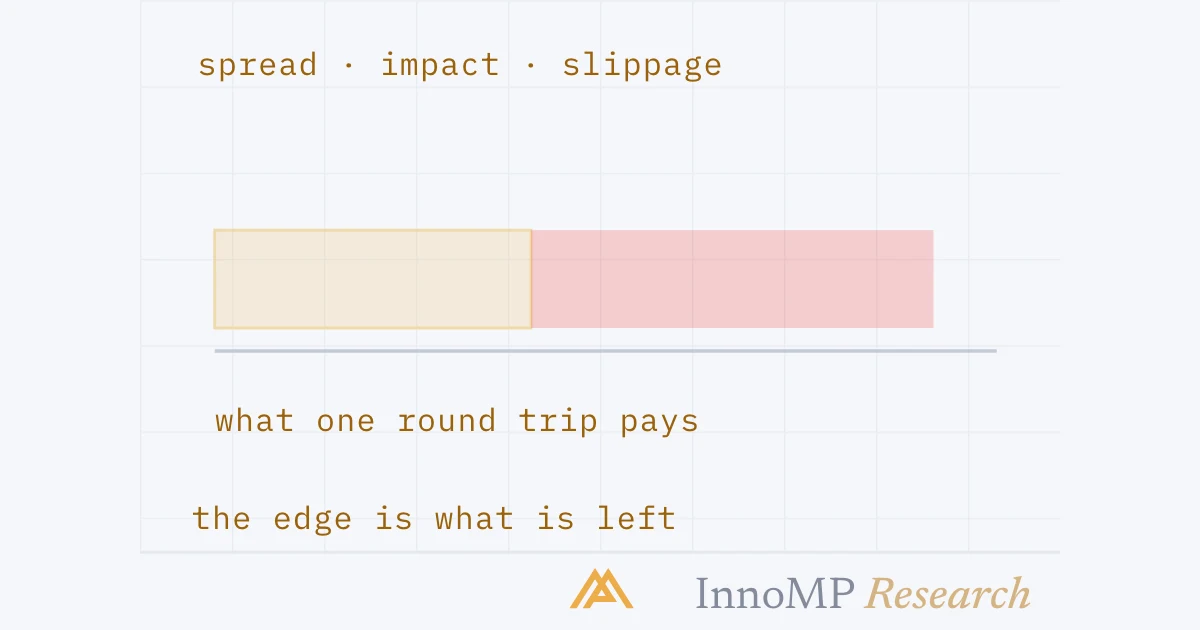
Three costs on one trade A single horizontal bar divided into three segments: the spread, the widest and shaded gold; market impact, red; and slippage, a deeper red. Labels under each segment name it, and a note says the edge is what is left after the bar. what one round trip paysspreadimpactslippagethe edge is what’s left after the bar InnoMP Research
One round trip, its cost drawn as a bar. The first segment is known before the trade. The second depends on size. The third depends on the hour. The setup's edge has to be longer than the whole bar.

The spread is the gap between bid and ask at the moment of the trade. It is visible in the quote, it is paid by whichever side crosses, and a round trip crosses twice. CFD Foundations counted it; Part 1 explained it.

Market impact is the cost of an order larger than the volume at the best price. It takes the best level and walks to the next, and its average fill is worse than the quote by the distance walked.

Slippage is the difference between the price an order was expected to fill at and the price it did. Foundations defined it; this part explains where it comes from — the book changing between the decision and the fill, or being too thin to absorb the order at the quote.

The first is a fact about the quote. The second is a fact about size. The third is a fact about time.

Depth: the same order in two books

Depth of market is the resting volume at each price near the touch, both sides. It is the thing the quote does not show and the thing that decides whether the quote is available for any particular size.

Depth: the same order in a deep book and a thin one Two panels. Left, deep book: three long bars of resting asks, with a ten-lot order consuming half of the first bar only, noted fills at the ask, impact none. Right, thin book: three short bars, with the same ten-lot order consuming all three, noted walks three levels, impact real. Deep booksame 10-lot orderfills at the askimpact: noneThin booksame 10-lot orderwalks three levelsimpact: real InnoMP Research
The same ten lots, two books. On the left the order is smaller than the best level and fills at the quote. On the right it is larger than three levels together, and its average is three prices deep.

Depth is why “the spread is two pips” is an incomplete statement. It is two pips for the volume at the touch. For a retail-sized order in a major pair during London that is nearly always enough and impact is nearly always zero. For the same order at 03:00, in a cross, or on a CFD whose underlying is illiquid, it is not — and the cost appears not as a wider quoted spread but as a fill a level or two past it.

The tick-volume rhythm the Intermediate level drew is, underneath, a depth rhythm: participation by hour is resting volume by hour.

Slippage: the cost of the hour

Slippage is measured after the fact, and it has a clock.

Slippage on the same stop, by window Four horizontal bars, one per window, showing relative slippage on the same stop order: the London–New York overlap, very short; the Asian hours, moderate; the rollover, long; the news minute, longest. A note says relative, on one feed, measure yours. slippage on the same stop, by windowoverlapAsian hoursrollovernews minuterelative, on one feed · measure yours InnoMP Research
One stop, four hours of the day. The bars are relative, not measured, and they are the order the Intermediate level's session parts already implied: where participation thins, the next available price is further away.

The mechanism is Part 2’s: a stop is a market order sent when its trigger is reached, and it fills at the next available price. In the overlap the next available price is at the touch. In the rollover hour, when providers withdraw quotes and the book is briefly a fraction of itself, it is not. In the minute after a release it may be many pips away, because the book that existed before the number has been pulled and re-priced.

None of the bars carries a number, deliberately. Slippage is a property of one broker’s feed at one hour on one instrument, and the only honest figure is the one measured on the account that will pay it — which is what the forward test is for. What can be said in general is the ordering, and the ordering is enough to keep a stop out of the windows where it is worst.

Key takeaway The spread is a price. Impact is a function of size. Slippage is a function of time. A setup that trades small, in liquid hours, on a major pair pays almost only the first. A setup that trades size, or thin hours, or thin instruments, pays all three — and its replay does not know.

Depth of Market on the platform

MetaTrader 5 has a Depth of Market window, and it is worth knowing exactly what it shows. Its documentation says it displays bids and asks at the best prices, closest to the market; that the number of levels shown is set by the broker’s symbol parameters; and that availability for exchange instruments depends on the broker.

Depth of Market on an exchange symbol A ladder in the style of the Depth of Market window: resting ask volumes as bars above a shaded spread band, resting bid volumes as bars below it, with price labels in the middle column. A note says that on OTC symbols the quotes shown are the broker's own. Depth of Market · an exchange symbol5614.45614.35614.25614.05613.95613.8on OTC symbols the quotes are the broker’s own InnoMP Research
On an exchange-traded instrument this is the market's own resting volume, where the broker passes it through. On a currency pair it is the broker's book, which is real but not the market's.

So the window is a genuine read of depth on an index or stock CFD whose underlying is exchange-traded and whose feed the broker carries. On a currency pair it is the broker’s ladder from Part 1 — the dealer’s book, assembled from providers — and what it says about depth is what the broker’s book says, not what the market’s would. Both are useful. They are not the same measurement, and Part 7 is about the difference.

The cost line in the record

Everything above has one consequence for the Intermediate level’s last part. A replay that fills every trade at the mid — the chart’s line — has paid no spread, no impact and no slippage. Its expectancy is the setup’s edge before execution.

The same trades, filled two ways Two horizontal bars. At the mid: the longer bar, plus 0.30 R per trade. After costs: a much shorter bar, plus 0.12 R per trade. A note says the difference is the execution cost. same trades, filled two waysat the mid+0.30Rafter costs+0.12Rthe difference is the execution cost InnoMP Research
Illustrative, but the direction is not. The replay's expectancy and the forward test's differ by the cost line, and for a short-timeframe setup the cost line can be most of the edge.

The correction is mechanical. Every replayed trade is charged the spread at the hour it would have traded — not the average spread, the spread then. Every trade whose size is large against the instrument’s depth is charged an estimate of impact, and the estimate is revised from the live fills. And slippage is taken from the forward test, per window, because it cannot be taken from anywhere else.

What survives that correction is the setup’s edge. What does not survive it was never an edge; it was the mid price, which no one has ever traded at.

Next: How a CFD price is formed — liquidity providers, aggregation, mark-up and last look: the pipeline behind the quote on the ticket.

Key facts
  • The spread is paid on every round trip; a strategy's average trade has to clear it before it has an edge.
  • Depth is the resting volume at and near the best prices; an order larger than the best level fills through worse ones.
  • Slippage is the gap between the expected fill and the actual fill, and it widens where depth thins.
  • Depth of Market in MetaTrader 5 shows the resting bids and asks nearest the market where the broker provides it; on OTC instruments the quotes are the broker's.
  • A backtest filled at the mid price overstates the edge by the spread plus the average slippage.
Frequently asked questions

What is the difference between spread and slippage?

The spread is the gap between the bid and the ask at the moment of the trade — a known cost, visible in the quote, paid by crossing. Slippage is the gap between the price the order was expected to fill at and the price it actually filled at — an unknown cost, visible only afterward, caused by the book changing or being too thin for the order. A round trip pays the spread always and slippage sometimes.

What is market depth?

The resting volume at each price near the touch, on both sides. A deep book has a lot of volume at and just behind the best prices, so an ordinary order fills at the quote. A thin book has little, so the same order takes the best level and then worse ones. The quote is a price for the volume at the best level, not for any size.

What is market impact?

The extra cost an order pays for being larger than the volume resting at the best price. It fills through the next levels as it walks the book, and its average price is worse than the quote by however far it walked. It is a function of the order's size relative to depth, which is why the same size costs nothing in London and something in the Asian hours.

Does Depth of Market show real orders on forex?

Only where the instrument trades on an exchange and the broker passes the feed through — MetaTrader 5's own documentation says availability for exchange instruments depends on the broker. On over-the-counter instruments such as currency pairs the window shows the broker's quotes, which are the broker's book rather than a market-wide one.

How much should I subtract from a backtest for costs?

At least the spread on every trade, measured at the hour the setup trades, plus the slippage the forward test on a demo account actually recorded. A replay that fills at the mid has paid nothing; the live record pays both. The gap between the two is not noise — it is the cost line, and a setup whose edge is smaller than it does not have one.

Sources

  1. MetaTrader 5 Help — Depth of Market: bids and asks at the best prices; availability for exchange instruments depends on the brokermetatrader5.com
InnoMP Research · Education Desk

Trading education from first principles — position sizing, risk, market structure and the habits that keep accounts alive. Written for someone who has never opened a chart, with a diagram at every step.

Published 24 Sept 2026 · Updated 24 Sept 2026

Disclaimer: This content is provided for general informational purposes only and does not constitute investment advice, an offer, or a solicitation to buy or sell any financial instrument. It has been prepared without regard to your individual financial circumstances or objectives. Trading CFDs involves a high risk of loss.

Related notes

InnoMP Research cover art — the day starts in London
Market structure

How to trade GBPUSD: a framework for cable

The fourth most traded currency, a day that starts at 08:00 London, a 07:00 inflation print into a thin book, a noon Bank of England. Drivers, contract, sizing.

7 min read