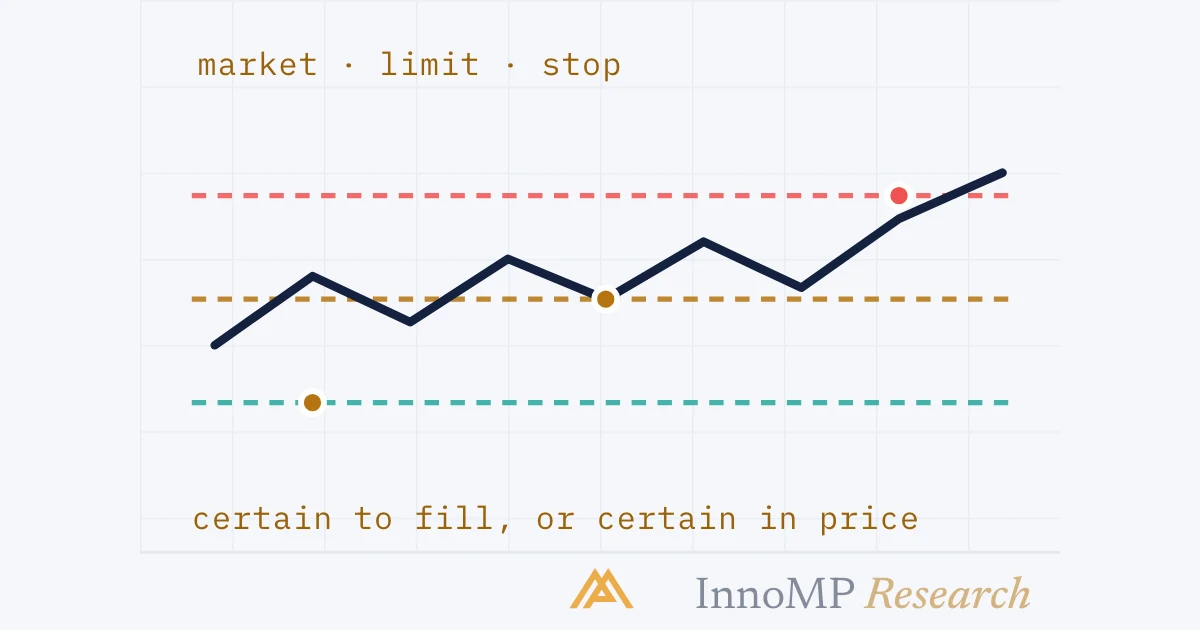
A market order fills now at whatever the book offers — the ask to buy, the bid to sell — so it is certain to fill and uncertain in price. A limit order rests in the book at a chosen price and fills only if the market comes to it: certain in price, uncertain to fill. A stop order rests off the book and becomes a market order at its trigger, which is why a stop-loss fills at the next available price, not the stop price. The choice is which uncertainty the setup accepts, and it decides who pays the spread.
A market order takes what the book offers now, a limit order rests in the book and waits to be taken, and a stop order waits off the book and becomes a market order at its trigger. Each is a different place in the queue Part 1 drew, and each pays a different price for being there.
The Intermediate level chose entries by what they proved — limit, close or retest. This part is the same choice seen from inside the book: what each of those entries is as an order, and what the book does with it.
Three orders, three places in the book
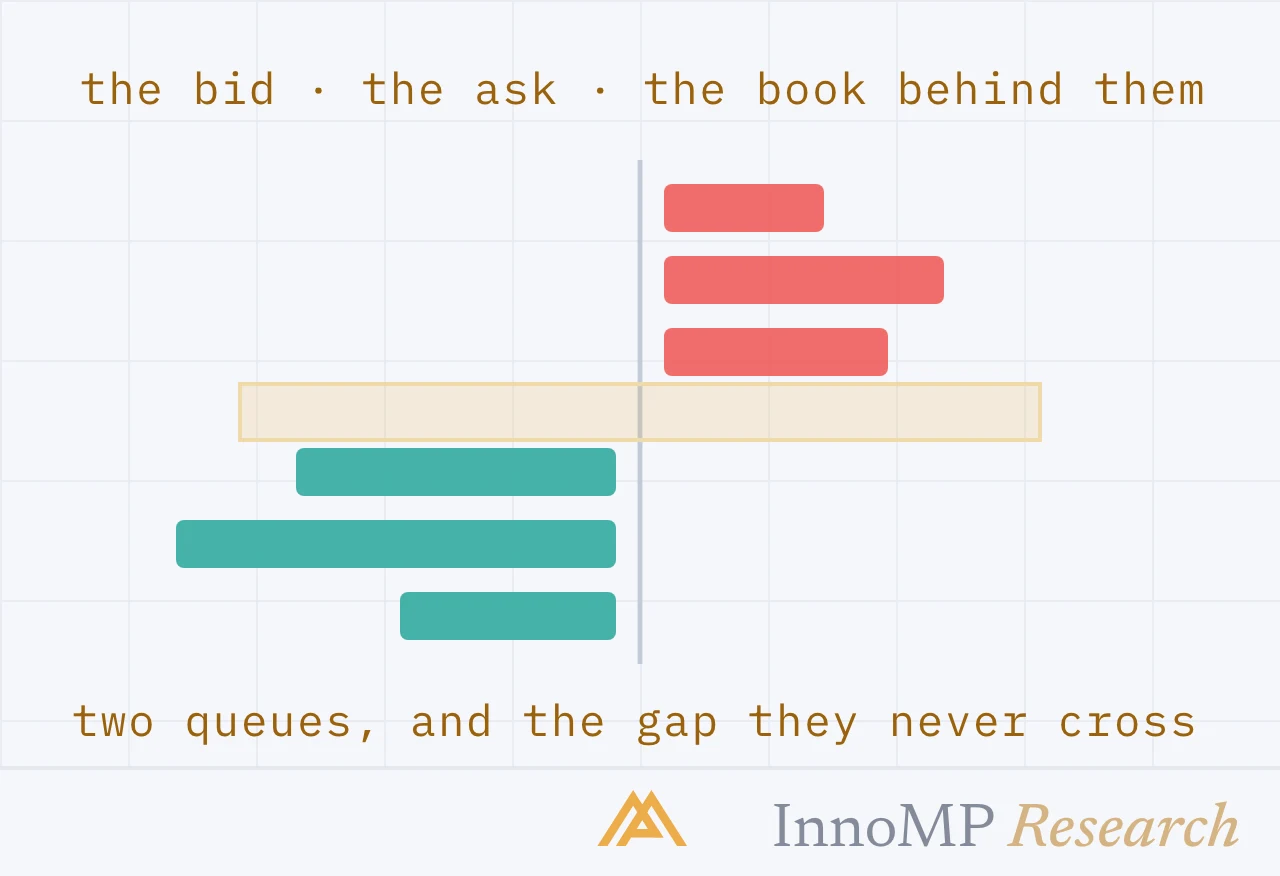
Take the ladder from Part 1 — asks above the spread, bids below — and place the three order types on it.
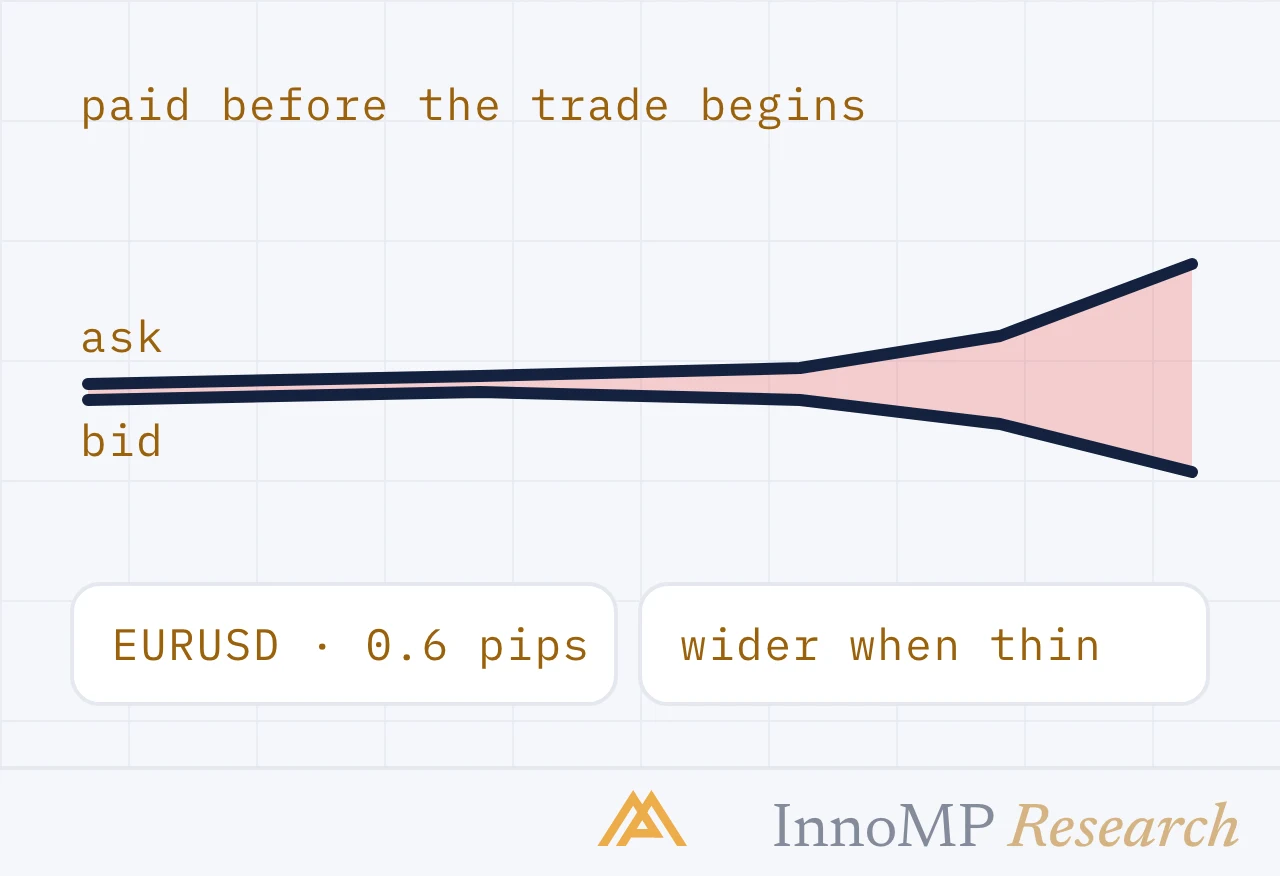
The market order is an instruction to trade now. It goes to the front of the other side’s queue and takes what is there: the ask to buy, the bid to sell. It always fills — the book always has some price — and it always pays the spread, because crossing is what it does.
The limit order rests in the book on its own side, at a price of the trader’s choosing. A buy limit sits below the current price among the bids; a sell limit sits above it among the asks. It fills only if the market comes to it, and then at its price or better. It never crosses, so it never pays the spread; it is paid by whoever crosses to it.
The stop order is not in the book at all. It rests with the broker, beyond the current price — a buy stop above, a sell stop below — and when price reaches its trigger it becomes a market order. It is the mechanism under every stop-loss and every breakout entry that says “buy if it goes through.”
Certain to fill, or certain in price
Two of the three are opposites, and the opposition cannot be escaped.
This is the price-against-proof trade-off of the Intermediate level, restated at the level of the book. The limit entry’s “best price, no evidence, often not filled” is a limit order’s nature, not a strategy choice; the close entry’s “worse price, confirmed, always filled” is a market order’s. A setup that names its trigger has named its order type, and inherited that order type’s bargain with the book.
Key takeaway Every order chooses which uncertainty to carry: fill or price. The choice is made when the setup names its trigger, and it cannot be unmade at the ticket — a limit that does not fill was working exactly as designed.
A stop-loss is a market order in waiting
The stop is the order most often misunderstood, because its name promises something it does not do. A stop-loss does not stop the loss at the stop price. It waits until price reaches the trigger and then sends a market order, which fills at the next available price — and “next available” is a property of the book at that moment, not of the trigger.
In an ordinary hour the next available price is a pip or two past the trigger, and the difference is the slippage Foundations already priced. At a news release, at the Sunday open after a weekend gap, or in a thin session, the next available price can be far past it — the book that was there when the stop was placed has been withdrawn, and the market order is filled against whatever remains.
Two things follow. The buffer Foundations put beyond the invalidation is protection against the trigger, not against the fill; nothing in the stop’s design protects the fill. And a stop resting through a known thin window — the rollover, a scheduled release — is a market order that has pre-agreed to trade in the worst book of the day. The Intermediate level’s advice not to hold tight stops through those windows was about this.
MetaTrader 5’s pending orders
MetaTrader 5 calls every order placed for later a pending order, and it has six of them, defined by where they sit relative to the current price.
| Order | Where it rests | What it does when reached |
|---|---|---|
| Buy Limit | Below the current price | Buys at the Ask at its price or lower |
| Sell Limit | Above the current price | Sells at the Bid at its price or higher |
| Buy Stop | Above the current price | Becomes a market buy |
| Sell Stop | Below the current price | Becomes a market sell |
| Buy Stop Limit | Above, with a limit attached | When the stop is reached, places a Buy Limit |
| Sell Stop Limit | Below, with a limit attached | When the stop is reached, places a Sell Limit |
The stop-limit pair is the one worth a second look, because it is the answer to the previous section. A stop that becomes a limit rather than a market order will not fill at any price — it will fill at its limit or not at all. For an entry that is sometimes the right bargain: a breakout order that refuses to chase. For a stop-loss it is almost never the right bargain, because a stop-loss that does not fill is a position still open on the wrong side of a move.
The trigger names the order
Put this part beside the Intermediate level’s three entries and each has an order type it was always going to be.
A is a limit order resting at the level: no spread paid, no evidence, and a fill only if price comes all the way. B is a market order sent after the entry timeframe closes beyond the level: the spread paid, the evidence in hand, a fill guaranteed at whatever the book then offers — which, right after a break, is often a wider spread than usual. C is a limit resting at the broken level from the new side, with B’s evidence and A’s price, and A’s chance of never filling.
The record the Intermediate level built was made with one of these. A replay that assumed fills at the mid for all three overstated each of them by a different amount, and the next part is about how much.
Next: Spread, depth and slippage — the three parts of execution cost, how each is measured, and why a backtest filled at the mid overstates the edge.
- A market order is certain to fill and uncertain in price; a limit order is certain in price and uncertain to fill.
- A market buy fills at the ask, a market sell at the bid; the spread is paid by the side that crosses it.
- A stop order becomes a market order at its trigger, so a stop-loss fills at the next available price, which may be worse than the stop.
- MetaTrader 5's pending orders are Buy Limit and Sell Limit on the near side of the market, Buy Stop and Sell Stop beyond it, and a stop-limit pair that combine the two.
- The Intermediate level's limit, close and retest entries are different order types with different execution costs.