A forex trading day has a structure set by its session opens. The Asian hours, with the thinnest participation, usually build a narrow range. The London open brings the day's first heavy participation and typically resolves that range by leaving it. The New York open, overlapping London, either extends the London move or reverses it. Reading the day this way turns the volume group's 'norm for the hour' into a map: where the range is, which open is due, and what a break means at each of them.
A session open is the hour a major financial centre begins its business day, and the trading day is structured by three of them in sequence: Tokyo, London and New York. The Asian hours build a range; London decides which side of it to leave; New York extends that decision or reverses it.
The volume group kept saying the norm for the hour. This group is about where that norm comes from. Forex market sessions in CFD Foundations described the three centres; this part turns them into a map of the day that a chart read can follow.
One day, three opens
The market trades around the clock, but participation follows the sun. Each centre works its own local business hours — roughly 09:00 to 18:00 in Tokyo, 08:00 to 17:00 in London and in New York — and the weight of each is not equal.
| Location of the sales desk | Share of global FX turnover, April 2022 |
|---|---|
| United Kingdom | 38% |
| United States | 19% |
| Singapore | 9% |
| Hong Kong SAR | 7% |
| Japan | 4% |
The BIS figures from Part 5 explain the shape of the day. London and New York between them intermediate more than half of everything traded, so the hours they are open — and above all the hours they are both open — are where the day happens.
The edges move. Each centre keeps its local hours, but the United States, United Kingdom and Australia change their clocks on different dates and Japan does not change at all, so the overlaps stretch and shrink for a few weeks each spring and autumn. Think in centres, as Foundations said; the market-hours tool does the conversion to your clock.
The Asian range
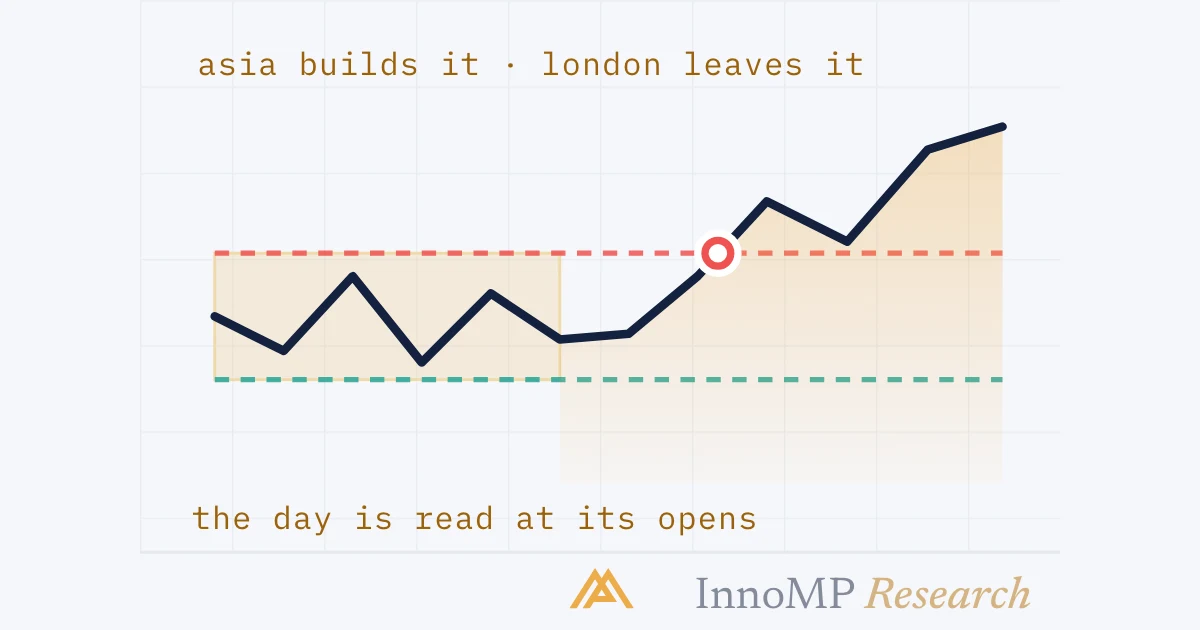
Asia is the quietest of the three, and the thin market reading from Part 7 describes it: a small amount of trading moves price further than it deserves, and little is decided. What Asia usually leaves behind is a range — a high and a low, set on a thin book, that the rest of the day will have to deal with.
Drawing it is mechanical. Two lines, at the highest high and the lowest low between the Tokyo open and the London open, extended to the right. It is the first opening range of the day — the range a session sets before the next one arrives — and it is worth drawing even by a trader who never trades Asia, because it is the level London will be judged against.
The yen pairs are the standing exception. Japanese data and Bank of Japan decisions land in these hours, so USDJPY can be genuinely active while EURUSD sleeps, and its “Asian range” is a real session rather than a lull.
The London open: leaving the range
London is the largest single centre and the first heavy participation of the day. What it does to the Asian range is the day’s first event, and there are two ways it goes.
The left panel is the false breakout from Foundations, happening where it is most likely to: an obvious range with stops resting just beyond both edges, and the first heavy participation of the day arriving to reach for them. The sweep takes the stops, and the day then goes the other way.
The right panel is a break with participation behind it, retested and held.
Telling them apart is not a session skill. It is the breakout evidence from Foundations — a close beyond the level, follow-through, a retest that holds, higher-timeframe context — with Part 6’s fifth piece added: was the break traded, against the norm for the London hour? The Asian range is simply where that evidence is most often needed.
Key takeaway The London open does not make a break more reliable. It makes a break more likely — participation has arrived and the range is obvious. Reliability still comes from the close, the retest and the bar, exactly as it does at any other level.
The New York open: extend or reverse
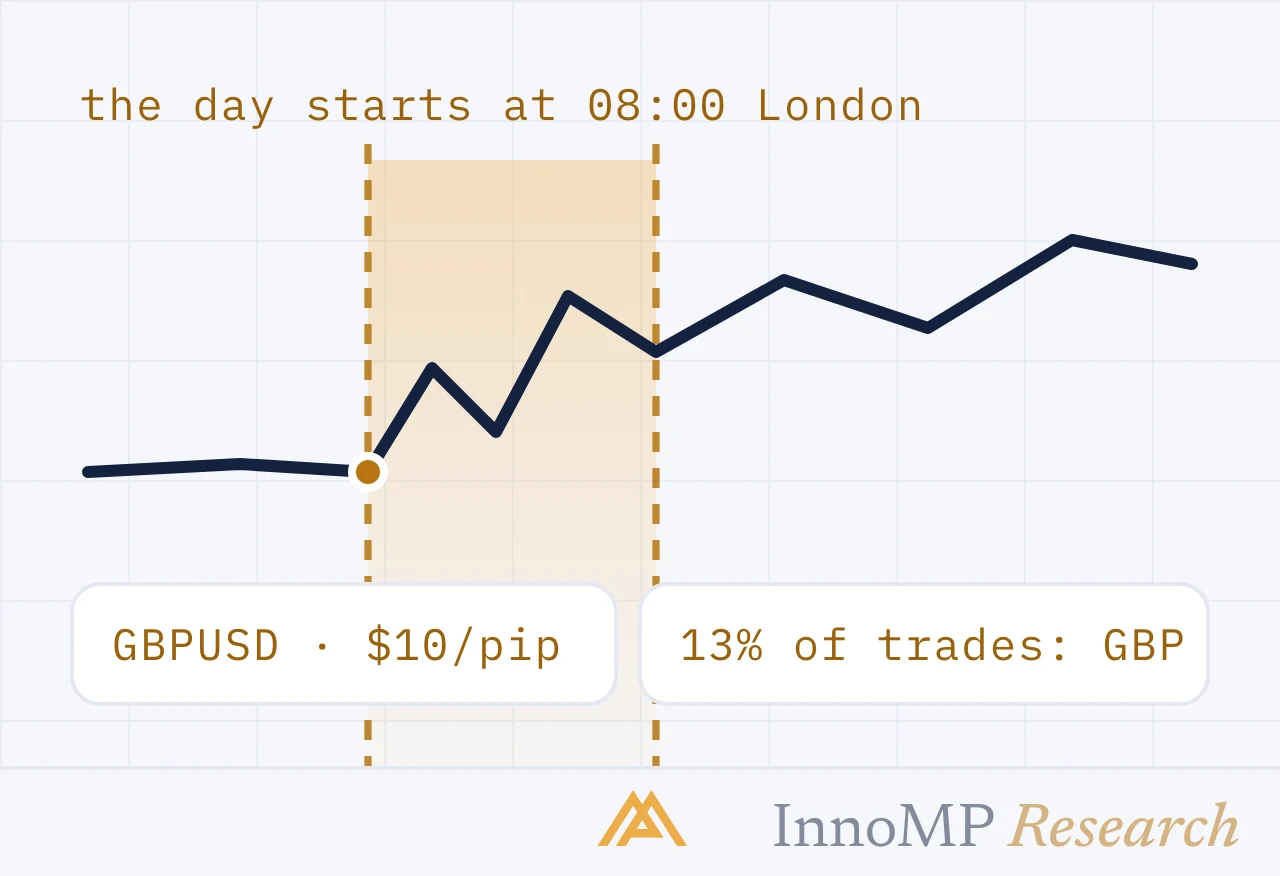
New York opens into London’s afternoon, and for a few hours — roughly 08:00 to 12:00 New York time — both centres trade at once. That overlap is where the day’s heaviest participation sits, and the US data calendar is aimed at it. What New York does with the move London made is the day’s second event.
Two things follow for the procedure.
The London high and low are New York’s reference. Whatever London made, the overlap will either take it out or defend it, so those two prices are drawn as soon as London’s move has formed — they are the second opening range of the day, and Part 9 puts them on the list.
A London move that the overlap reverses is the day’s most common failed trend. Not because London was wrong, but because the participation that could confirm or deny it had not arrived yet. A trader who reads the top-down procedure only in the London hours, without waiting to see what the overlap does with it, is reading Step 2 without Step 3.
Reading the day as a map
Put the three opens together and the day has a procedure of its own, nested inside the one from Part 1.
Asia. Draw the range. The higher-timeframe bias and levels from Steps 1 and 2 are already known; nothing Asia does changes them, and a thin-market move that reaches a daily level is not yet a reaction.
London open. The first question with an answer: which side of the range, and with what evidence. If the break is toward a daily level, in the direction of the bias, it is the setup Step 2 was waiting for; the 1-hour trigger from Step 3 follows. If it is a sweep and reverse, the reverse may be the setup instead — a false break at a range edge is a signal too, as Foundations said.
New York open. The overlap confirms or denies. A trade taken at the London break is either extended, and managed, or reversed, and the London high or low was the day’s turning point.
The rest of the day — late New York, the rollover hour, early Sydney — is where Foundations told you the spreads widen and the book thins. It is not where the map has anything on it.
Next: Session reference levels — the prices each day and week leave behind, why they act as support and resistance, and how they rank against the levels structure gave you.
- The Asian session usually builds the day's narrowest range, because participation is thinnest there.
- The London open brings the first heavy participation of the day and often decides which side of the Asian range the day leaves.
- Five centres intermediate 78% of FX turnover, led by the United Kingdom at 38% and the United States at 19% (BIS, April 2022).
- A break of the Asian range at the London open is judged by the same evidence as any breakout: close, follow-through, retest, participation.
- The London–New York overlap, roughly 08:00 to 12:00 New York time, carries the day's heaviest participation.