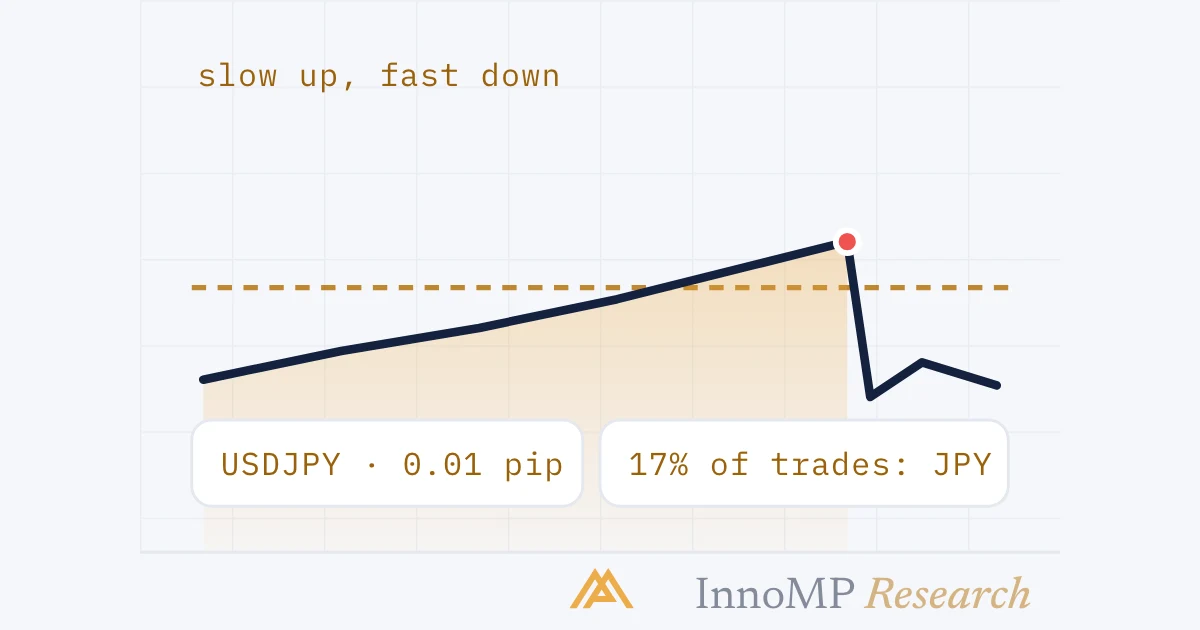
USDJPY is the US dollar priced in Japanese yen, between the first and third most traded currencies. Its persistent driver is the gap between US and Japanese rates, which makes the yen the funding currency for carry trades — so the pair climbs slowly while the trade is on and falls fast when it unwinds. The pip is the second decimal and its dollar value changes with the rate, and Japan's Ministry of Finance intervenes at times. Size from the stop and the pip value at today's rate.
USDJPY is the pair traders reach for when they want the dollar without the euro, and it is the one whose behaviour differs most from EURUSD under the same label. It carries the largest rate gap among the majors for long stretches, which makes it the classic carry pair; it has a central bank with no fixed announcement time and a finance ministry that intervenes directly; and its pip is worth a different number of dollars every day. This is a framework for trading it deliberately.
What actually moves the pair
The rate differential, magnified. Like every pair, USDJPY is a bet on which of two interest rates will be higher. What sets it apart is the size of the gap — Japanese rates have sat far below US rates for long stretches — so the pair tends to move with US yields more than with anything on the Japanese side. When US rate expectations rise, the pair rises; when they fall, it falls. The EURUSD framework covers the mechanism; here it runs with a larger gap.
The carry trade. A wide, durable rate gap makes the yen the classic funding currency: sell or borrow yen, hold dollars, collect the difference. While that trade is on, the yen tends to weaken gradually. When it unwinds — usually in a burst of risk aversion, when the positions are closed at once — the yen strengthens sharply. The pattern this produces on a chart is the one thing to memorise about USDJPY: it climbs slowly and falls fast.
Risk appetite, in reverse. For most dollar pairs, stress is a dollar bid. For USDJPY it is a yen bid — the unwind above — so the pair often falls when equities fall, even as the dollar rises elsewhere. A trader carrying EURUSD instincts into USDJPY has this sign backwards.
Intervention. Japan’s Ministry of Finance intervenes directly in the market at times, buying yen to strengthen it. The moves are large, fast and unannounced; the amounts are published only afterwards, monthly, in a dataset that runs back to 1991. No other major pair carries this. It is not forecastable, but it is a reason the pair’s risk is not symmetric near levels the ministry has defended before.
The practical use is unchanged across this series: drivers filter, they do not forecast. A technical setup aligned with the direction of US yields deserves more confidence than one fighting it — and a long position deserves a wider stop than the same setup in EURUSD, because of what the fast side looks like.
The contract, and the pip that moves
USDJPY quotes yen per dollar to two decimals, with a third for fractional pips. The specifics that matter before the first order:
-
Contract size — one standard lot is 100,000 US dollars, the forex standard and the size the calculators here use. Confirm it in your platform’s contract details.
-
The pip — one pip is 0.01, the second decimal, not the fourth. On a standard lot that is 1,000 yen. In dollars it is 1,000 divided by the rate: about 6.75 USD at 148 and about 6.25 USD at 160. This is the pair’s quiet trap — the pip value is not fixed, and a sizing habit built on EURUSD’s 10 USD per pip is wrong here by a third. The pip arithmetic and the pip calculator both handle the conversion; the calculator is pre-loaded with the pair.
-
Leverage — major pairs carry the highest tier on InnoMP, up to 1:1000 with the top tier subject to approval. Leverage sets the margin a position ties up; the stop sets what it can lose — the distinction in position sizing before leverage.
-
Swap — the overnight rate reflects the interest differential, and on USDJPY it has been large for long stretches. Which side receives depends on which rate is higher; the arithmetic is in the real cost of a trade.
Sessions and the calendar
Tokyo matters here. For most dollar pairs the Asian session is thin and ranged. USDJPY is the exception: Japanese data lands in Tokyo hours, Japanese institutions trade their own currency then, and the pair can be genuinely active while EURUSD sleeps. The session clock shows which window you are in; for this pair, the Tokyo window is a real one.
The Bank of Japan. The BoJ holds eight scheduled meetings a year — the 2026 dates are on the economic calendar — and, unlike the Fed or the ECB, publishes no fixed release time for its decision. The statement lands when the meeting ends, typically around midday Tokyo, which spreads the event risk across the session rather than concentrating it in a minute. On decision days, the whole Tokyo session carries it.
US data still dominates. Because the pair moves with US yields, CPI and payrolls at 08:30 New York move it at least as much as anything from Japan. The calendar playbook applies.
Intervention has no calendar. It is the one event on this pair that cannot be scheduled around. The ministry publishes what it did after the fact.
Key takeaway USDJPY’s two sides are not the same size. The climb is a grind funded by the rate gap; the fall is an unwind, sometimes helped by a ministry buying yen. A stop that is adequate for the climb is inside the noise of the fall. Size for the fast side, and re-check the pip value at today’s rate before every trade — it moved since yesterday.
Sizing for the pair
The position-sizing arithmetic is unchanged; what changes is that the pip value is an input, not a constant. A worked example on a 10,000 account risking 1%, with the pair at 148.20:
- Risk budget: 100
- Stop distance from the chart: say 40 pips
- Pip value at 100,000 per lot: 1,000 yen ÷ 148.20 ≈ 6.75 USD per pip
- Size: 100 ÷ (40 × 6.75) = 0.37 lots
Run it in the position size calculator — USDJPY is pre-loaded and the conversion is done for you. Then change the price to 160 and watch the pip value fall to 6.25 and the size rise to 0.40 lots for the same stop. That is the pair telling you its sizing depends on where it is trading.
Two additions specific to the yen. Long positions sit on the slow side and need a stop that respects the fast one — the unwind does not give a second chance to exit at the level. And near a level the ministry has defended before, a stop just beyond it is a stop placed where an intervention would fill it far from the price; stop placement covers the general case, and this pair supplies the sharpest example of it.
A closing framework
Trade USDJPY with four questions on every idea. Which way are US yields moving, and does the setup agree? Is the carry trade being put on or taken off — is this the slow side or the fast one? What is the pip worth at today’s rate, and what size does the stop permit at that value? Is price near a level someone other than the market has defended? The pair rewards the trader who remembers it is asymmetric, and it collects from the one who sizes it like EURUSD with a different name.
- The Japanese yen was on one side of 17% of all FX trades in April 2022, the third most traded currency after the dollar and the euro, per the BIS.
- One pip on USDJPY is 0.01; on a standard 100,000-dollar lot it is 1,000 yen, which is about 6.75 USD at a rate of 148 and less at a higher rate.
- The Bank of Japan holds eight scheduled policy meetings a year and publishes no fixed release time for its decision.
- Japan's Ministry of Finance publishes its foreign-exchange intervention amounts monthly, with a dataset running from April 1991.
- As the funding side of carry trades, the yen tends to weaken gradually while the trade is on and strengthen sharply when it unwinds.