GBPUSD is the pound sterling priced in US dollars, known as cable. It moves on the gap between Federal Reserve and Bank of England rate expectations, on UK data — which lands at 07:00 London, before the session opens — and on risk appetite. Its day begins at the London open and it tends to range more widely than EURUSD. One standard lot is 100,000 pounds and one pip is a fixed 10 USD, because the quote currency is the dollar. Size from the stop distance, and treat 07:00 and the noon Bank of England as events.
GBPUSD is the pair with a nickname — cable, after the transatlantic telegraph line that once carried the rate between London and New York — and a reputation for moving further in a day than EURUSD. Both are earned. It shares EURUSD’s arithmetic exactly, which makes it easy to pick up, and then behaves differently enough to catch a trader who assumed the two were interchangeable. This is a framework for trading it deliberately: what moves it, the contract, the clock, and sizing for a wider pair.
What actually moves the pair
The rate differential. As with every pair, the persistent driver is the gap between two central banks’ expected paths — here the Federal Reserve and the Bank of England. When UK rate expectations rise faster than US ones, the pound tends to gain and the pair rises; when the reverse, it falls. The EURUSD framework covers the mechanism and it applies without change.
UK data, and when it lands. The Office for National Statistics publishes its market-sensitive releases — inflation above all, then wages, employment and growth — at 07:00 London time, an hour before the London session opens. That timing is a feature of the pair: the number arrives while the book is thin, so the first minutes of the reaction are often larger than the number alone justifies, and some of it retraces once London is properly open.
Risk appetite. In stress the dollar is bid and the pound, as a risk-sensitive currency, tends to fall. Sterling also reacts more sharply to domestic fiscal and political news than most majors do to their equivalents — a budget, a leadership change or a bond-market wobble can move it on a scale that the same news elsewhere would not.
The euro leg. Because sterling and the euro share a trading day and a region, GBPUSD often moves in the same direction as EURUSD; the difference between them is the cross pair, EURGBP. When cable and EURUSD diverge, EURGBP is moving — and that is where the sterling-specific story usually shows up first.
The practical use is the same throughout the series: drivers filter, they do not forecast. A technical setup aligned with the direction of the rate differential deserves more confidence than one fighting it.
The contract
GBPUSD quotes dollars per pound to four decimals, with a fifth for fractional pips. The specifics that matter before the first order:
- Contract size — one standard lot is 100,000 pounds, the forex standard and the size the calculators here use. Confirm it in your platform’s contract details.
- The pip — one pip (0.0001) is a fixed 10 USD per lot, exactly as on EURUSD, because the quote currency is the dollar. On a USD account there is no conversion — the opposite of USDJPY, where the pip value moves with the rate. The pip arithmetic covers both cases.
- Leverage — major pairs carry the highest tier on InnoMP, up to 1:1000 with the top tier subject to approval. Leverage decides the margin a position holds; the stop decides what it can lose — position sizing before leverage.
- Spread — wider than EURUSD’s on average and, like every pair, wider still around 07:00, at noon on decision days and in the rollover hour. The cost arithmetic is in what is the spread and the real cost of a trade.
Sessions and the calendar
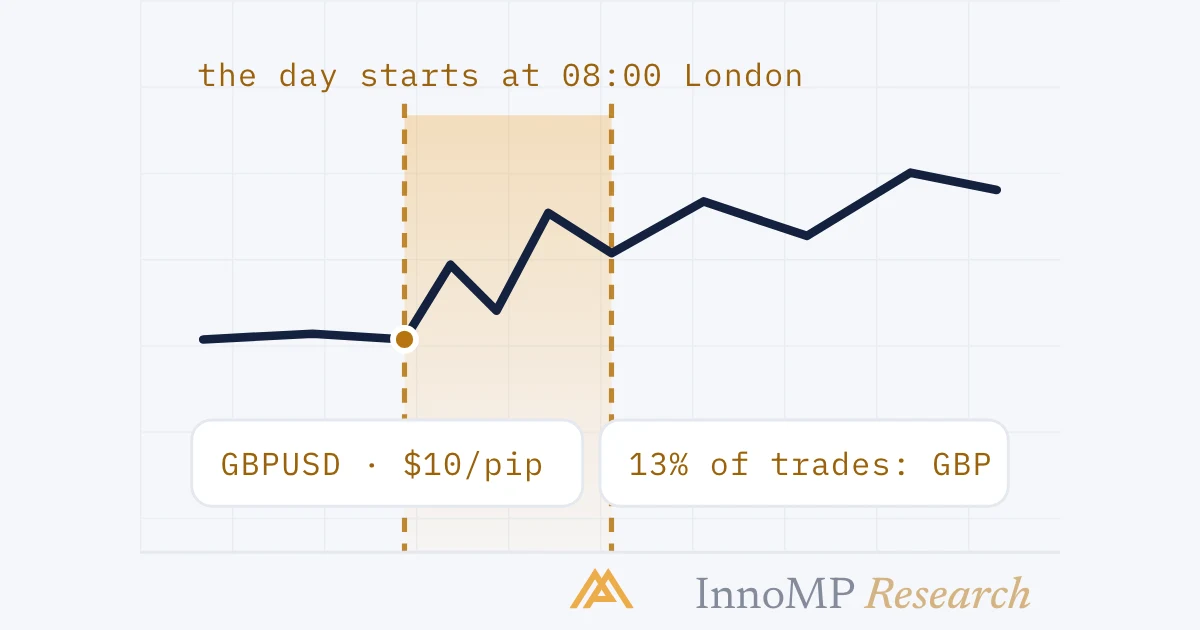
The day starts at 08:00 London. The pound’s own flows arrive with the London open, and the London–New York overlap adds the dollar side. Between them is the pair’s real day. The Asian session is thin for cable and tends to range; the session clock shows which window you are in.
07:00 London. The hour before the open is when UK data lands. It is a scheduled event with an unscheduled character, because of the thin book it arrives into. Treat it exactly as the calendar playbook treats a release, with extra room in the stop.
12 noon London, usually a Thursday. The Bank of England publishes its decision and minutes at noon at eight scheduled announcements a year — the dates are on the economic calendar. The vote split is published with the decision, and a divided committee can move the pair as much as the rate itself.
US data at 08:30 New York — CPI and payrolls — moves cable through the dollar leg, inside the London afternoon. The Fed’s 14:00 New York decisions land in the overlap.
Key takeaway Cable’s arithmetic is EURUSD’s; its range is not. A stop that is adequate on EURUSD is inside the noise on GBPUSD, and a stop placed to survive the London session is inside the noise at 07:00. Size from the wider stop the pair needs, not from the sizing habit the pip value invites you to carry over.
Sizing for a wider pair
The position-sizing arithmetic in its simplest form, because the pip value is fixed. A worked example on a 10,000 account risking 1%:
- Risk budget: 100
- Stop distance from the chart: say 35 pips — wider than the 25 used in the EURUSD example, because the pair moves more
- Pip value at 100,000 per lot: 10 USD per pip
- Size: 100 ÷ (35 × 10) = 0.29 lots
Run it in the position size calculator — GBPUSD is pre-loaded. The point of the comparison with EURUSD is not the specific numbers but the direction: the same risk budget buys a smaller position in cable because an honest stop is wider. Traders who keep EURUSD’s stop and EURUSD’s size on GBPUSD are, in effect, risking more than they wrote down.
Where the stop goes follows the sessions. A level made in the London session deserves a stop just beyond it; a level made in the Asian range is weaker. And a stop that sits within a normal 07:00 move of price, on a morning with UK data, is a stop that will be tested by the release rather than by the market — stop placement covers the general case.
A closing framework
Trade cable with three questions on every idea. Which way is the Fed–Bank of England gap moving, and does the setup agree? What time is it in London — is the session open, is it 07:00 with data due, is it a Thursday noon? What size does a stop wide enough for this pair permit at 10 USD a pip? GBPUSD rewards the trader who treats it as its own market with EURUSD’s maths, and it charges the one who treats it as EURUSD with a different name.
- The pound sterling was on one side of 13% of all FX trades in April 2022, the fourth most traded currency, per the BIS.
- One standard lot of GBPUSD is 100,000 pounds; one pip (0.0001) is a fixed 10 USD per lot.
- The Bank of England publishes its rate decision at 12 noon London time, usually on a Thursday, at eight scheduled announcements a year.
- UK consumer price inflation is published at 07:00 London time, an hour before the London session opens.
- GBPUSD is called cable after the transatlantic telegraph cable that once carried the rate between London and New York.