EURUSD is the euro priced in US dollars, the pair between the world's two most traded currencies. It moves on the gap between US and euro-area rate expectations, on the data that shapes them, and on risk appetite, which favours the dollar in stress. One standard lot is 100,000 euros, so one pip is 10 USD per lot. It is the deepest market in the series and the one where liquidity is most often mistaken for safety: size from the stop distance, and treat both central-bank calendars as events.
EURUSD is where most traders start, and for good reason: it is the deepest market there is, it trades on a clean set of drivers, and its spread is the tightest a retail account will see. It is also where a specific mistake is made most often — reading its liquidity as calm. The pair is liquid; it is not quiet. This is a framework for trading it deliberately: what moves it, the contract, the two calendars that matter, and sizing for a market whose smooth surface hides ordinary volatility.
What actually moves the pair
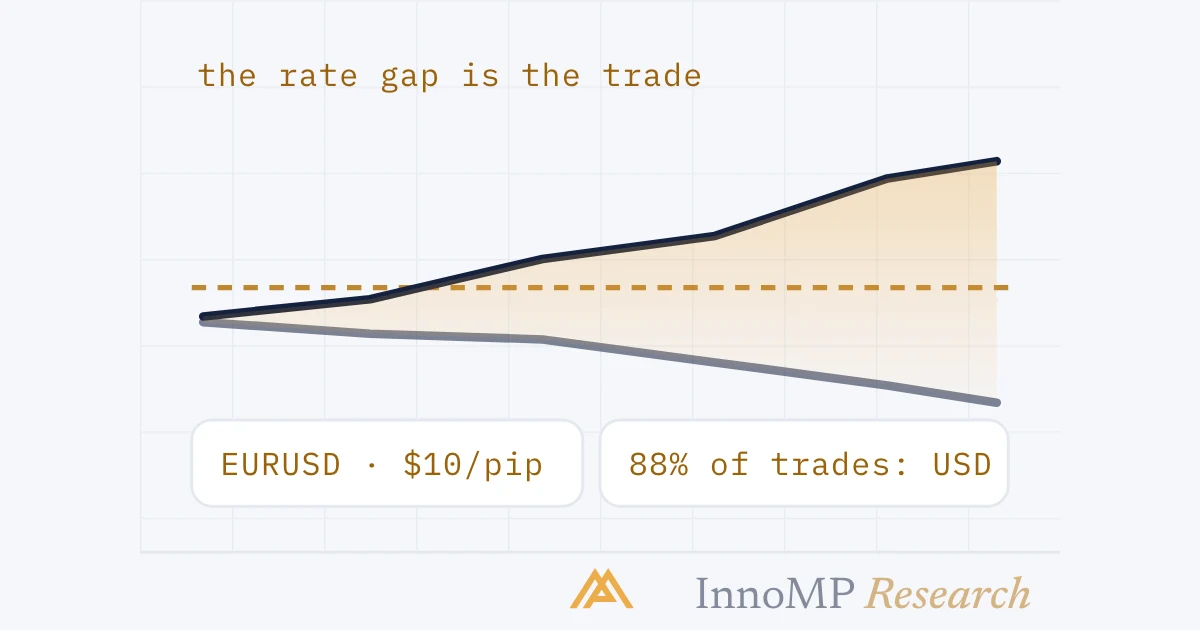
The rate differential. A currency pair is, at bottom, a bet on which of two interest rates will be higher in future. The gap between where markets expect the Federal Reserve and the European Central Bank to set policy — the interest-rate differential — is the pair’s persistent driver. When US expectations rise faster than euro-area ones, the dollar tends to gain and the pair to fall, and vice versa. Most large EURUSD moves are a repricing of this gap.
The data behind it. Rate expectations move on data, and for EURUSD the US side dominates: inflation and payrolls above all, then growth and the Fed’s own words. Euro-area inflation and the ECB’s guidance matter, but the dollar is the world’s vehicle currency — on one side of 88% of all FX trades, per the BIS — so US data moves every dollar pair at once and EURUSD with them.
Risk appetite. In stress, money moves to the dollar. This is not a rule the pair always obeys, but it is a bias worth knowing: an equity sell-off is more often a dollar bid than a euro one.
The practical use is the same throughout this series. Drivers filter; they do not forecast. A technical setup aligned with the direction of the rate differential deserves more confidence than one fighting it.
The contract
EURUSD quotes dollars per euro to four decimal places, with a fifth for fractional pips. The InnoMP specifics that matter before the first order:
- Contract size — one standard lot is 100,000 euros, so one pip (0.0001) is 10 USD per lot, 1 USD on a mini lot and 0.10 USD on a micro lot. The quote currency is the dollar, so on a USD account there is no conversion — the reason the pair is the cleanest one to learn pip arithmetic on.
- Leverage — major forex pairs carry the highest tier on InnoMP, up to 1:1000 with the top tier subject to approval. Higher leverage lowers the margin a position ties up; it does not change what the position can lose. The distinction is the whole of position sizing before leverage.
- Spread — the tightest in a retail account, which is the pair’s real advantage: the cost hurdle a strategy has to clear is lowest here. It widens around data and in the rollover hour like every pair.
- Swap — the overnight rate reflects the interest differential between the two currencies. Which side pays and which receives depends on which rate is higher, and it changes as policy changes; the arithmetic is in the real cost of a trade.
Sessions and the two calendars
Sessions. The pair has two home markets, and it is most alive when both are open. London — 08:00 to 17:00 local — is where the euro’s own flows arrive, and the London–New York overlap is where the day’s largest moves disproportionately happen. The Asian session is thin for the pair and tends to range; a breakout there earns scepticism. The session clock shows which window you are in.
Two central banks. The Fed announces at 14:00 New York on the second day of each of its eight scheduled meetings; the ECB announces at 14:15 Frankfurt time on its decision days, with a press conference half an hour later. Both calendars are published a year ahead and both are on the economic calendar. The decision is often priced in; the guidance is where the move comes from.
Data. US CPI and payrolls land at 08:30 New York — inside the London session, before New York’s open — and move the pair more than any euro-area release. The euro-area inflation flash estimate is the one European number that reliably matters. The calendar playbook covers how to be positioned, or not, around them.
Key takeaway A tight spread lowers the cost of a trade; it does not lower the risk of one. EURUSD’s daily range is smaller than gold’s, but a stop sized for the spread instead of for the chart is still inside the noise. The pair’s liquidity is an advantage on entry and exit — it is not a reason to size larger.
Sizing for the pair
The position-sizing arithmetic in its simplest form, because no conversion is needed. A worked example on a 10,000 account risking 1%:
- Risk budget: 100
- Stop distance from the chart: say 25 pips
- Pip value at 100,000 units per lot: 10 USD per pip
- Size: 100 ÷ (25 × 10) = 0.40 lots
Run it in the position size calculator — EURUSD is the default instrument. Notice that the available leverage never entered the calculation: at 1:1000 or 1:100, the position that risks 100 USD on a 25-pip stop is 0.40 lots. Leverage decides how much margin the position holds; the stop decides how much it can lose.
Stops in EURUSD belong beyond a level, not at a round number — 1.0800 and 1.0850 attract orders from every participant, and a stop parked on one is the first to go. The round-number entry and stop placement cover why.
A closing framework
Trade EURUSD with three questions on every idea. Which way is the rate differential moving, and does the setup agree? Which session made this level, and is the pair in a live window now? What size does a stop beyond a real level permit at 10 USD a pip? The pair will not punish carelessness as fast as gold or silver do; it will do it just as surely, over more trades, and the tight spread will make it harder to see in the costs column.
- The US dollar was on one side of 88% of all FX trades and the euro on one side of 30.5% in April 2022, per the BIS Triennial Survey.
- Global FX turnover was 7.5 trillion USD a day in April 2022.
- One standard lot of EURUSD is 100,000 euros; one pip (0.0001) is 10 USD per lot.
- The pair's persistent driver is the interest-rate differential — the gap between Federal Reserve and ECB policy expectations.
- The ECB announces at 14:15 Frankfurt time and the Fed at 14:00 New York; both calendars are published a year ahead.