At a breakout, volume shows whether the move was traded. A break on participation well above the norm for its hour has buyers behind it and someone to defend the retest; a break on thin activity has neither. At the end of a move the reading inverts: participation that surges as price accelerates after an extended run is a climax — the last buyers arriving — and the next candle's failure to extend is the signal. Confirmation and exhaustion look alike on the bar. Where in the move they appear separates them.
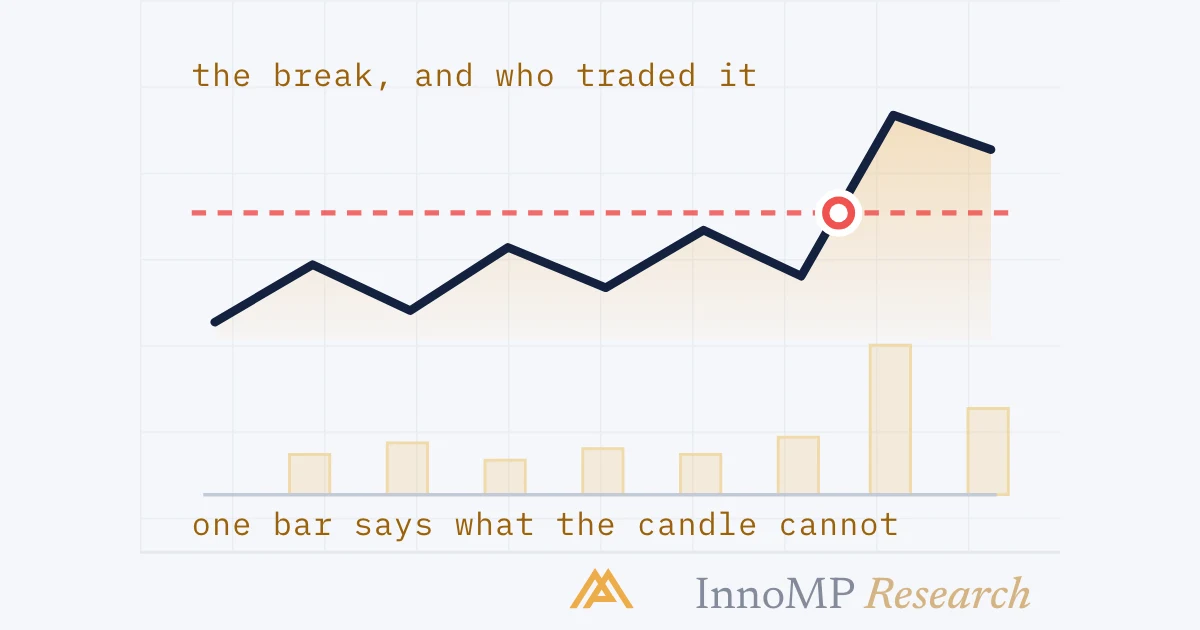
Volume confirms a breakout when the break was traded — when the candle that leaves the range carries participation well above the norm for its hour. A climax is the opposite moment: participation peaking as a move runs out.
Part 5 established what the bar under a currency chart actually counts and how to read it relative to the hour. This part applies it at the two places it earns its keep: the edge of a range, and the end of a trend.
The fifth piece of evidence
Breakouts and false breakouts in Foundations gave four pieces of evidence for a real break: a close beyond the level, follow-through, a retest that holds, and higher-timeframe context. Volume is the fifth, and it answers a question the other four cannot — was anyone there?
The reading is relative, as Part 5 insisted: the break bar is compared with the bars of the same hour on recent days, not with the quiet range candles just before it. A London-open break will always tower over the Asian range that preceded it. That is the clock, not confirmation.
Why thin breaks fail
The mechanism is the level flip. A resistance level becomes support when the participants who bought the break come back to defend it on the retest. That requires there to be such participants.
So the bar at the break predicts something about the retest, which is the piece of evidence Foundations rated most highly. A traded break tends to produce a retest with rising participation on the bounce — the defenders showing up. An untraded break produces a retest with nothing on the bounce, because there is nobody to show up.
Neither is a guarantee. It is one more reading, and it is counted as one reason in the confluence of Part 3 — a reason from a different source than structure or level, which is what makes it worth counting.
The baseline is the hour
The mistake that undoes this reading is comparing the wrong things. Part 5’s rule — same hour, recent days — matters more at a breakout than anywhere, because breaks cluster at session opens, exactly where the baseline shifts.
The practical form: before calling a break confirmed, look at the same hour on the previous three or four days and ask whether this bar is clearly above them. “Clearly” is deliberately not a number. Tick volume is noisy enough that a threshold invites false precision; what is wanted is a bar that stands out from its own hour without squinting.
Volume through a trend
Between the break and the end of the move, volume has a shape too, and it is one of the oldest readings in technical analysis. Dow Theory’s version: in a rising market, volume should be heavier on advances than on corrections, and in a falling market heavier on declines than on rallies.
The reason is the same as at the breakout. An advance on heavy participation is being bought; a pullback on light participation is a pause in which nobody much wants to sell. That is the healthy pullback Foundations described, now with a measurement attached.
The violation is the useful part. A pullback that attracts rising volume is being sold into, and an advance on falling volume is running on fewer buyers than the last one. Neither ends the trend by itself — Part 4 already settled that only structure ends a trend — but both are warnings that arrive before structure does.
Key takeaway Volume never overrules structure. It arrives earlier. A pullback being sold on volume is the reason to watch the higher chart for the lower high; it is not the lower high.
The climax
At the end of a move the reading inverts, and this is where volume is most often misread — because the bar looks like the best confirmation of the whole trend.
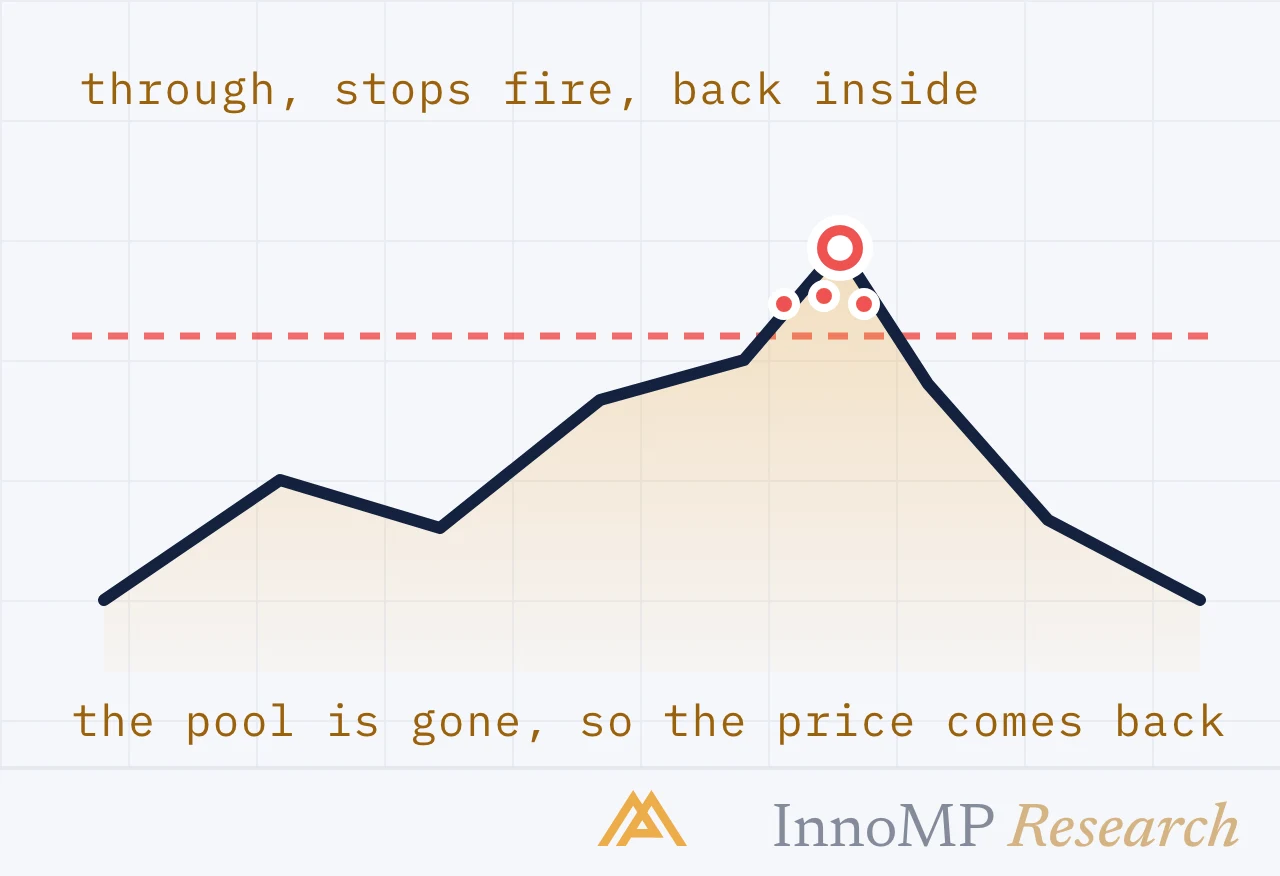
A buying climax is a wide, high-volume advance near the end of a rise, after which price fails to extend. The Wyckoff method names it and places it at the top of its distribution schematic. The surge is not new buyers arriving at the start of something; it is the last buyers arriving at once — the late entrants Foundations described in FOMO, all at the same moment. Once they are in, the supply of further buyers is gone, and the first sellers meet no one.
A selling climax is the mirror: a wide, heavy decline at the end of a fall, after which price stops making progress.
The signal is not the tall bar. It is the tall bar and then the failure — the candle after it that does not extend the move. A tall bar followed by continuation was not a climax, whatever it looked like at the time, which is why the climax is read one candle late and not at the moment of the surge.
Position in the move decides
Put the two halves of this part on one chart and the rule is visible.
| Where the surge appears | What it usually is | What it changes |
|---|---|---|
| Leaving a range, at a level | Confirmation — buyers arriving | One more reason for the trade; expect a defended retest |
| Mid-trend, on an advance | Healthy — the trend being paid for | Nothing. Hold the plan |
| Mid-trend, on a pullback | Warning — the dip being sold | Watch the higher chart for a lower high |
| After an extended run, on acceleration | Climax — the last buyers | Wait one candle. A failure to extend confirms it |
None of these readings is a trade by itself. Each is a reason, counted once, in a setup that structure and levels have already justified — the discipline from Part 3. What volume adds is a source of evidence the price chart does not contain, and this part’s two moments are where that source is loudest.
Next: Effort versus result — the general form of all of this: when heavy participation moves price very little, and when light participation moves it a long way.
- Volume confirms a breakout when the break candle's participation is well above the norm for its hour.
- A breakout on thin volume has fewer participants to defend the retest, which is why the level tends not to hold.
- Dow Theory holds that in a rising market volume should be heavier on advances than on corrections, and the reverse in a falling one.
- A climax is participation peaking as a move ends: a wide, high-volume candle after an extended run, followed by a failure to extend.
- The same surge in volume reads as confirmation at the start of a move and as exhaustion at the end of one.