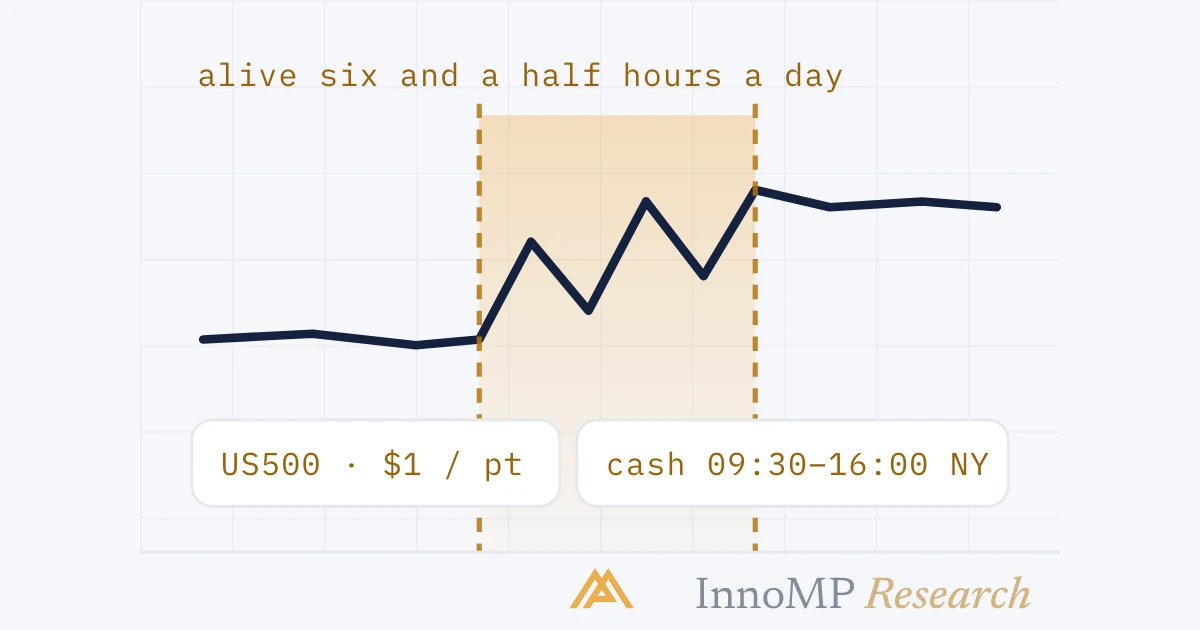
US500 is a CFD on the S&P 500, the index of the largest US listed companies. It moves on earnings, interest-rate expectations and risk appetite, and its character changes sharply between the US cash session — 09:30 to 16:00 New York, when the underlying stocks actually trade — and the thinner hours around it. On InnoMP one lot is one contract, so one index point is 1 USD per lot. Size from the stop distance in points and that point value, and treat the cash open and close as the events they are.
An index CFD looks like the easiest market to trade: one number, one direction, and a chart that moves all day. What it hides is that the number has a life of its own for only six and a half hours, and that the rest of the clock is a different, thinner market wearing the same name. This is a framework for trading US500 deliberately: what moves it, how the contract is priced, when it is actually alive, and how to size for it.
What actually moves the index
Earnings. The S&P 500 is a weighted sum of company values, and company values are re-priced four times a year when results land. Earnings season — the weeks after each quarter closes — is when the index moves on news specific to its constituents rather than on macro. Because the index is weighted by market value, the largest companies carry a disproportionate share of its moves; a single report from one of them can move the whole index.
Rates. Equity prices are future cash flows discounted at a rate, and the rate is set by expectations of the Federal Reserve. The Fed’s eight scheduled decisions a year are the largest calendar events for the index, and the data that shapes those expectations — inflation and payrolls above all — is the second tier. When the market moves on rates, it moves on the whole index at once.
Risk appetite. The index is the market’s default expression of “risk on” or “risk off.” When confidence falls, the index falls alongside other risk assets and the dollar and bonds rise; the session clock shows nothing of this, but the correlation across markets does.
The practical use, as in every instrument in this series, is filtering: a technical setup aligned with what rates and earnings are doing deserves more confidence than one fighting both.
The contract
US500 quotes the index level in US dollars. The InnoMP specifics that matter before the first order:
- Contract size — one lot is one contract, and one index point is 1 USD per lot. The smallest quoted increment is 0.1 points, or 0.10 USD. This is the simplest point value in the series, which is exactly why it tempts traders into sizes the stop distance does not support.
- Leverage — indices carry a maximum of 1:500 on InnoMP, the same tier as metals. The margin calculator in the order ticket applies it.
- Trading hours — the CFD quotes nearly around the clock on weekdays, with a short daily break. That is not the same as being liquid around the clock; see the next section.
- Financing and dividends — an index CFD carries overnight swap, and because the underlying stocks pay dividends, index CFDs are typically adjusted when constituents go ex-dividend. The arithmetic for swap is in the real cost of a trade; the dividend treatment is in your platform’s contract details.
Sessions and the calendar
The index has two markets a day, and knowing which one you are in is most of the session work.
The cash session. The NYSE core session runs 09:30 to 16:00 Eastern Time, opening and closing with an auction. This is when the underlying stocks trade, when the flows that move the index actually happen, and when the CFD’s liquidity is deepest. The first thirty minutes and the last thirty are the most active of the day — the open prices overnight news, the close prices the day.
Everything else. Outside cash hours the CFD tracks the futures market, on thinner liquidity and without stock-level flows. Ranges are narrower, spreads wider, and a level formed at 03:00 New York was formed by far fewer participants than one formed at 10:00. The timeframe logic applies: a level’s weight scales with the participation that made it.
The calendar. Fed decisions land at 14:00 New York, inside the cash session; the scheduled dates are on the economic calendar. US CPI and payrolls land at 08:30, an hour before the open, so the cash session opens already knowing the number. Earnings from the largest constituents land before the open or after the close, never during — which means the reaction is the open itself.
Key takeaway The one-dollar point value makes US500 feel cheap to size. It is not: a 40-point stop is ordinary in the cash session and small around the Fed, and at 5 lots that stop is 200 USD before costs. Size from the stop distance in points, never from the roundness of the point value.
Sizing for an index
The position-sizing arithmetic is unchanged. A worked example on a 10,000 account risking 1%:
- Risk budget: 100
- Stop distance from the chart: say 40 points
- Point value at one contract per lot: 1 USD per point
- Size: 100 ÷ (40 × 1) = 2.5 lots
Run it in the position size calculator — US500 is pre-loaded at one contract per lot. The size looks generous next to the fractions of a lot that gold and silver produce, and that is the trap: the number of lots is not the risk, the stop distance times the point value is. A 40-point stop and a 20-point stop on the same 2.5 lots are two different trades.
Where the stop goes depends on which session made the level. A level from the cash session deserves a stop just beyond it; a level from the overnight range is weaker and a stop placed at it is inside the noise — the failure mode in stop placement. Around the Fed, widen the stop and cut the size, or stand aside; the calendar playbook covers the choice.
A closing framework
Trade US500 with three questions on every idea. Which session am I in, and did the cash session make this level? What are rates and earnings doing, and do they agree with the setup? What size does a stop beyond a real level permit at 1 USD a point? The index rewards the trader who knows what time it is — literally — more than most markets, because the same chart pattern at 10:00 New York and at 03:00 New York is two different pieces of evidence.
- US500 tracks the S&P 500, an index of large US listed companies weighted by market value.
- On InnoMP one lot of US500 is one contract; one index point is 1 USD per lot, and the 0.1 tick is 0.10 USD.
- The NYSE core trading session runs 09:30 to 16:00 Eastern Time, opening and closing with an auction.
- The index CFD trades outside those hours on thinner liquidity; the cash open and close are the two most active moments of the day.
- The Federal Reserve's eight scheduled decisions a year are the single largest calendar risk for the index.