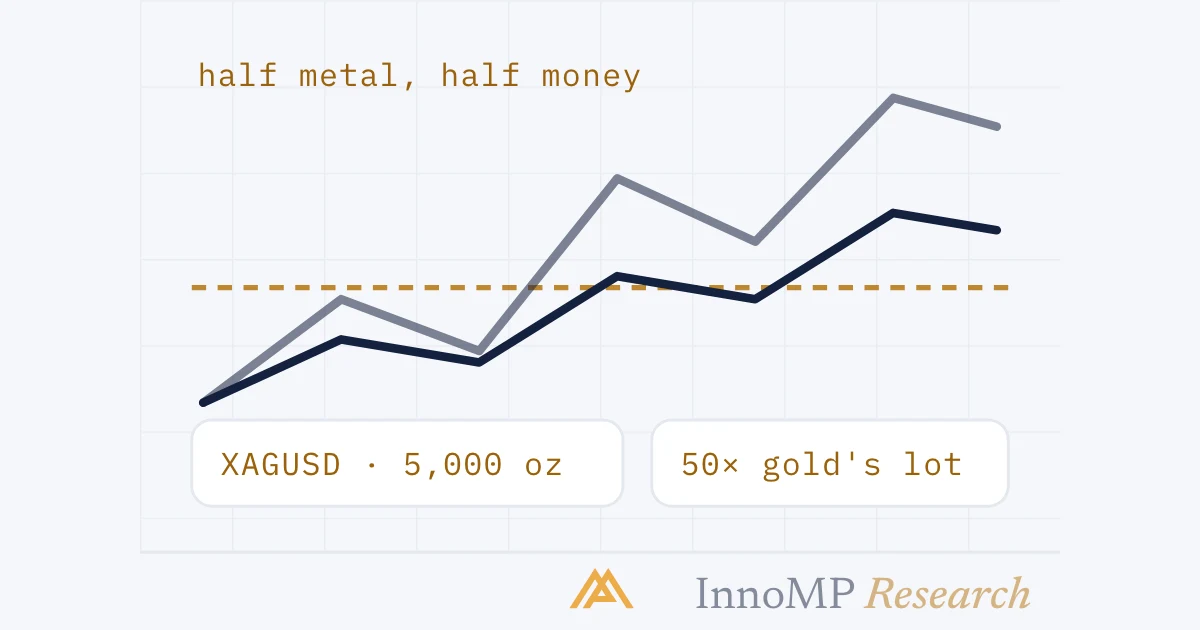
Silver trades as a precious metal and an industrial metal at once, so it follows gold's drivers — real yields and the dollar — while adding an industrial-demand cycle of its own. The result is a market that moves more than gold in percentage terms in both directions. The standard silver contract is 5,000 troy ounces, so a one-dollar move is 5,000 USD per lot, and position size has to come from the stop distance and that point value rather than from habits formed on gold or currency pairs.
Silver is the metal traders arrive at after gold, expecting gold with a lower price tag. It is not. Silver is half a precious metal and half an industrial one, and that second half is why it moves more than gold in both directions — a fact that shows up in the account before it shows up in the analysis. This is a framework for trading it deliberately: what moves it, how the contract is sized, when it trades, and how to size for a market that ranges like this one.
What actually moves silver
Gold’s drivers, inherited. Silver is priced as a precious metal first. Real yields — what cash and bonds pay after inflation — set the cost of holding a metal that pays nothing, and the US dollar is the unit it is quoted in. When gold moves on those, silver usually moves the same way. The gold framework covers both drivers and applies here unchanged.
Industrial demand, added. Unlike gold, most silver is used rather than stored — in electronics, solar cells, and a long list of manufactured goods. The Silver Institute reports that industrial demand set another record in 2024 even as total demand fell 3% to 1.16 billion ounces. That gives silver a cycle gold does not have: when manufacturing expectations rise or fall, silver has a reason to move that has nothing to do with rates.
A smaller market. Silver’s total market is a fraction of gold’s, so the same flow moves it further. This is the mechanical reason silver’s percentage moves are larger, and it cuts both ways.
The ratio. The gold-silver ratio — the gold price divided by the silver price — is watched as a relative-value gauge. A high ratio says silver is cheap against gold; a low one says it is expensive. What the ratio does not say is which metal will move to close the gap, or when. Treat it as context for a setup, not as the setup.
The practical use is the same as in gold: drivers filter, they do not forecast. A technical setup aligned with what real yields and the industrial cycle are doing deserves more confidence than one fighting both.
The contract
XAGUSD quotes dollars per troy ounce. The specifics that matter before the first order:
- Contract size — the standard silver contract is 5,000 troy ounces per lot, fifty times gold’s 100 ounces. A one-dollar move is therefore 5,000 USD per lot, and the smallest quoted increment of 0.001 is 5 USD. The calculators on this site use the standard size; confirm it in your platform’s contract details.
- Price scale — silver trades at a small fraction of gold’s price, so a dollar of movement is a far larger percentage. A two-dollar day in silver is a routine event and a large one at the same time.
- Leverage — metals typically carry a lower maximum than major forex pairs. On InnoMP, gold’s cap is 1:500 and the margin calculator in the order ticket reflects the tier that applies to silver.
- Trading hours and swap — silver trades around the clock on weekdays with a daily settlement break, and multi-week holds pay meaningful financing. The arithmetic is in the real cost of a trade.
Sessions and the calendar
Silver’s liquidity follows gold’s: deepest in the London–New York overlap, thinner and more ranged in Asia. Two fixed points are worth knowing.
The LBMA silver price is set once a day at 12:00 London time. It is a reference price rather than a trading session, but flows cluster around it.
US data dominates the calendar for the same reason it does in gold — the drivers are dollar rates. CPI, payrolls and Fed communication move silver at least as much as gold, and usually more. The calendar playbook applies with extra force: spreads widen further in silver than in gold around releases, and the first move reverses more often.
Manufacturing data — PMIs in particular — is the addition. It rarely moves gold; it can move silver.
Key takeaway Silver’s daily range, in percentage terms, is routinely larger than gold’s, and gold’s is already a multiple of a major currency pair’s. A position sized by feel — carried over from gold, let alone from EURUSD — is oversized in silver by default. Size from the stop distance and the contract’s point value, and expect the number to be small.
Sizing for silver specifically
The position-sizing arithmetic is unchanged; the inputs are what change. A worked example on a 10,000 account risking 1%:
- Risk budget: 100
- Stop distance from the chart: say 0.60 in price terms
- Point value at 5,000 oz/lot: 5,000 per dollar of movement, so 0.60 is 3,000 per lot
- Size: 100 ÷ 3,000 = 0.03 lots
Run it in the position size calculator — silver is pre-loaded at 5,000 ounces per lot. Notice what the contract size did: an honest silver stop of sixty cents produced a position of three hundredths of a lot. Traders who find that number uncomfortably small are discovering that the contract is fifty times gold’s, and that the discomfort is information.
Stops in silver need more room than in gold, not less. The metal overshoots levels in both directions, and a stop set exactly at an obvious swing point is inside the noise — the failure mode covered in stop placement. Where the ATR reads wide, the stop must be wider still, and the size smaller still.
A closing framework
Trade silver with the gold questions plus one. What are real yields doing? What is the industrial picture doing — and do the two agree? Where is the level structure, drawn in a quiet moment? What size does the stop distance permit on a 5,000-ounce contract? When rates and industry disagree, silver tends to be the noisier metal and the harder one to hold; when they agree, it tends to be the one that moves furthest. Either way the size question is the one that decides whether you are still there to find out.
- XAGUSD quotes the US dollar price of one troy ounce of silver.
- The standard silver contract is 5,000 troy ounces per lot; a one-dollar move is 5,000 USD per lot and a 0.001 tick is 5 USD.
- Silver's industrial demand set a record in 2024 while total demand fell 3% to 1.16 billion ounces, per the Silver Institute.
- The gold-silver ratio is the number of ounces of silver one ounce of gold buys; traders read it as a relative-value gauge, not a signal on its own.
- The LBMA silver price is set once a day at 12:00 London time.