A review cadence fixes when the system is examined and what each review may change: weekly for execution, monthly for the statistics and error bars, quarterly for regime and re-validation. Kill criteria are thresholds written before trade one — a drawdown beyond the percentile sized for, an expectancy interval below costs after a set number of trades, an execution-error rate that points at the trader — at which the system pauses or stops. Like control limits, crossing one triggers an investigation, not a feeling.
A review cadence fixes when the system is examined and what each review is allowed to change. Kill criteria fix, before the first live trade, the thresholds at which it is paused or stopped. Both exist for one reason: so that the decision to continue is made by the record, on a date, and not by the last week.
This is the last part of the level. The system now has a table, alerts and execution rules, a record with error bars, a drawdown it was sized for and a trial log. What it does not yet have is a rule for its own continuation, and without one it will be run on feel — which is the failure mode every part of the psychology series describes from a different side.
Two ways to fail at review
A system reviewed never and a system reviewed after every loss fail in opposite directions.
The left failure is Part 13’s overfitting arriving one small edit at a time: each adjustment felt like learning, none was a trial in the log, and the record that results describes no single set of rules. The right failure is Part 12’s runs being treated as news: a setup with a 45% win rate is expected to lose eight in a row somewhere in its first three hundred trades, and a trader who stops at five never reaches a sample that could show anything. The cadence is the answer to the first; the kill criteria are the answer to the second.
The cadence
A review cadence is a fixed schedule of reviews, each with a fixed scope and a fixed limit on what it may change. Three levels are enough.
The weekly review reads the alert log from the previous part: how many alerts, how many consulted the table, how many entries, and how many of the entries were taken by the rules. It may change execution — where the alert sits, whether the platform was open — and it may size down. It may not change a rule. The monthly review updates the numbers of Part 11 and Part 12: the running expectancy and its interval, the drawdown against the percentile the sizing planned for, the else count. It may not change a rule either, but it is where the kill criteria are read. The quarterly review is the only one allowed to touch the table, and it does so with the validation tools: is the regime the one the setup was tested in, does the mechanism the setup rests on — the session behaviour, the spread pattern, the level’s reason for holding — still exist, and does a walk-forward re-run of the last quarter agree with the record before it.
The daily routines of the psychology series are not reviews and are not on this list. They run the system; they do not judge it.
Control limits on the record
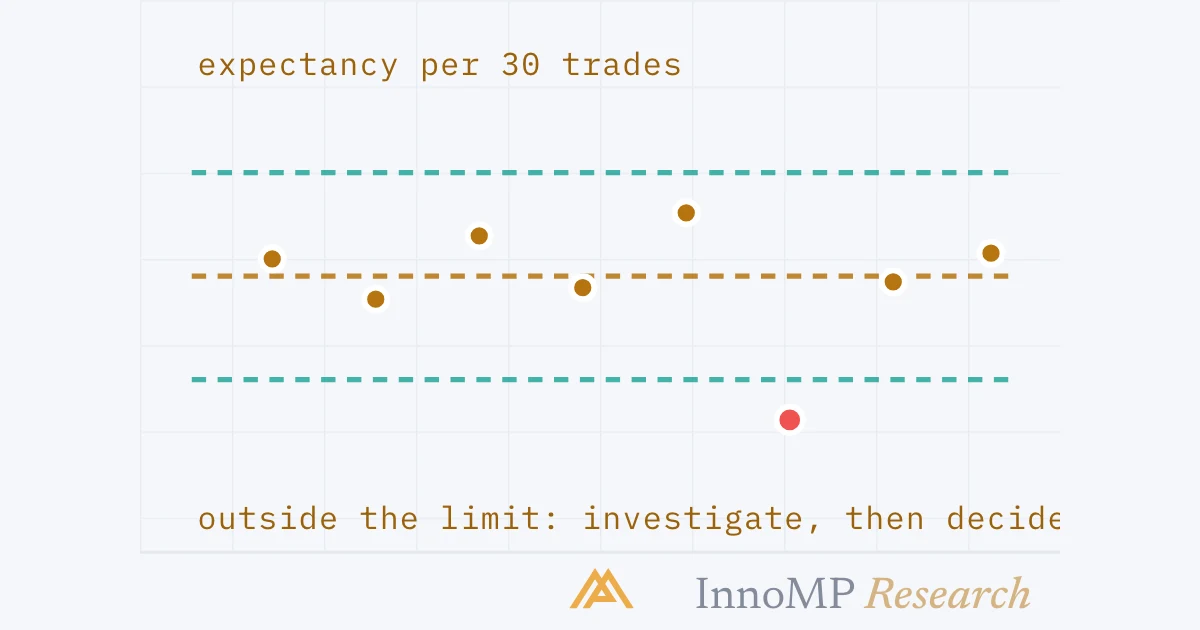
The monthly review needs a way to tell an ordinary bad month from a signal, and statistics has had one since the 1920s. The NIST handbook describes a control chart: a centre line for the in-control process, and upper and lower control limits placed so that almost all points fall inside them as long as the process remains in control. If a point falls outside, the process is probably out of control and an investigation is warranted to find the cause.
A control chart applied to a record plots the expectancy of each block of trades against the validated expectancy as the centre line, with limits from the standard error of a block — Part 11’s arithmetic, which at thirty trades and a 1.2R spread is about 0.22R, so limits two of those either side sit near +0.7R and −0.2R. The point that falls outside is the part the handbook is careful about: it means the process is probably out of control and an investigation is warranted. It does not, on its own, mean stop. A block below the limit in the month the regime turned loud is a different finding from a block below the limit with the regime unchanged and the error rate up, and the investigation is what tells them apart.
Kill criteria
Kill criteria are the thresholds, written before the first live trade, at which the system is paused or stopped regardless of how the trader feels about it that week. Their numbers are not chosen at the time; they are the numbers the validation produced.
The drawdown criterion comes straight from Part 12: the sizing was chosen so that the 95th-percentile drawdown was survivable, so a drawdown past it is the record leaving the distribution it was validated on. The expectancy criterion comes from Part 11: the sample at which the setup’s edge should have cleared zero is known, so an interval that has not cleared costs after that many new trades is evidence, not noise. The error criterion is the alert log’s count of trades taken outside the table. The mechanism criterion has no number, and it is the most important: a setup that traded the London open’s liquidity does not survive a change in how the London open behaves, and no amount of record will show that faster than the quarterly review asking the question.
Key takeaway Review on a schedule, with scope and authority that rise with the interval, and never change a rule below the quarterly level. Put control limits on the running expectancy and treat a point outside as an investigation. Write the kill criteria before trade one, taking their numbers from the validation, and let them decide when the system pauses or stops.
Pause, kill, restart
The criteria produce two different responses, and the difference is what happens afterwards.
A pause returns the system to demo with the rules unchanged. It is the response when the trader, not the setup, has crossed a limit — the error rate, or a drawdown that is inside the plan on paper and outside it in the trader’s behaviour, which the psychology series describes in detail. Restart criteria are written with the kill criteria: a number of demo trades inside the limits, an error rate back under the threshold, a size on return that is smaller than the size on leaving. A kill retires the rule set. Whatever replaces it is a new setup, and the discipline of Part 13 applies without exception: a new entry in the trial log, and a record that begins at zero.
Setup or trader
The last question every review asks is which of the two is failing, and the record can answer it if it was kept the way this level asked.
This split is why the table and the alert log were built: without a mark on every trade saying whether the rules took it, the record cannot separate the two, and every review collapses into the argument the psychology series warned about, between the part of the trader that wants to keep going and the part that wants to stop. With the mark, the argument has data. The rules that break under pressure show up as rule-breaking trades; the setup that has stopped working shows up in the trades that followed the rules.
The level, closed
This is where the three technical analysis levels end. Foundations gave a chart and the language to read it. The Intermediate level turned reading into a written setup and a record kept by hand. This level took the record apart: the mechanism under the price and the book behind it, the resting orders and the sweeps that take them, the volatility that sets the scale of everything, the statistics that say what a record is worth, and now the machinery that runs a setup and decides when it stops. A rule at the end of it has a table, an alert, an order fixed in advance, error bars, a drawdown it was sized for, a trial log, and a date on which it will be reviewed. That is the whole of what this level meant by a system, and it is enough.
This completes the Professional level and the three technical analysis levels. Return to the series index · The Trading Psychology series runs alongside all three.
- A control chart has a centre line for the in-control process and upper and lower control limits set so that almost all points fall inside while the process is in control; a point outside warrants an investigation for the cause (NIST e-Handbook).
- A review cadence names what each review may change: weekly reviews change execution only, monthly reviews update the statistics, quarterly reviews may change rules.
- Kill criteria are written before the first live trade and take their numbers from the validation: the drawdown percentile sized for, the expectancy interval after costs, the trial log.
- A pause returns the system to demo with the rules unchanged; a kill retires the rule set, and a replacement starts its validation from zero.
- The execution-error rate separates a failing setup from a failing trader, and the two have different remedies.