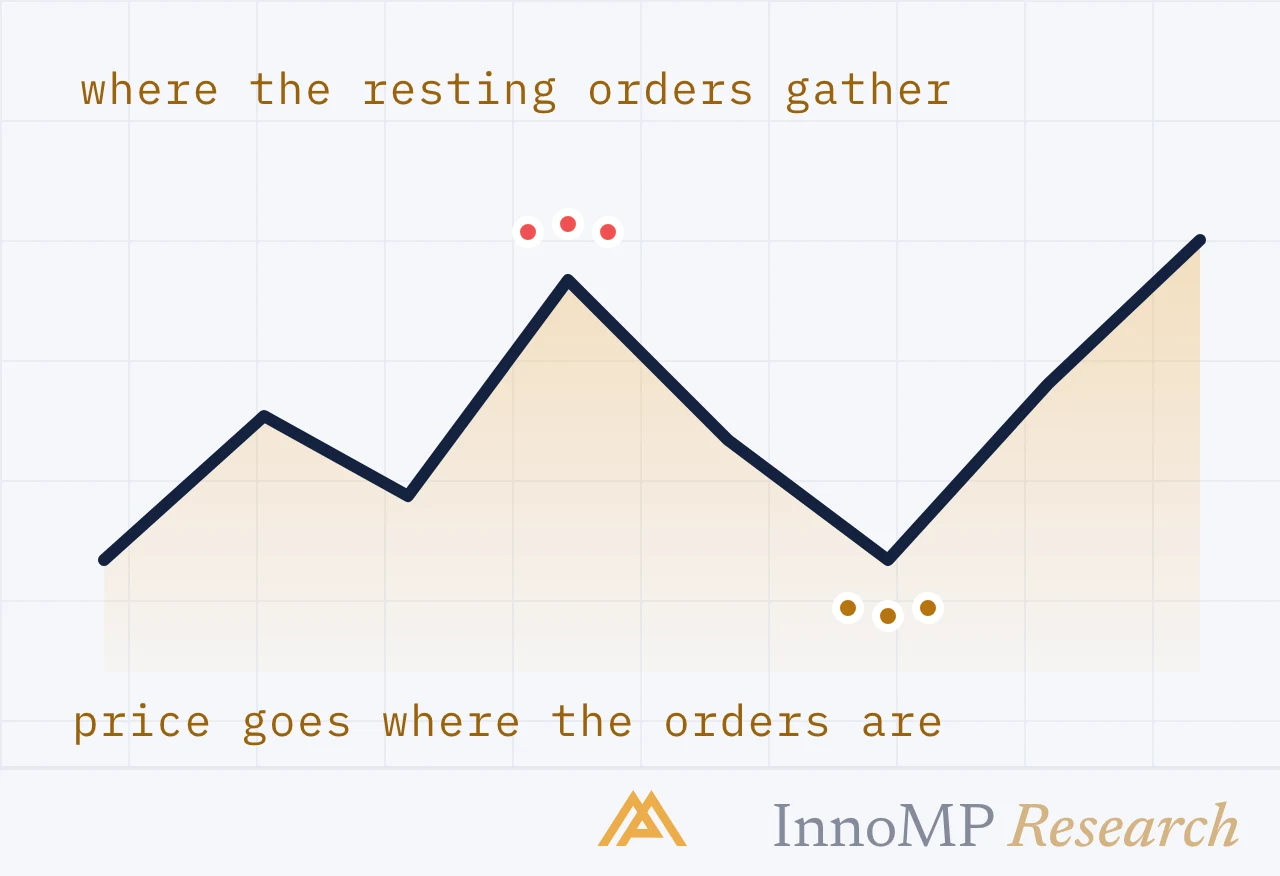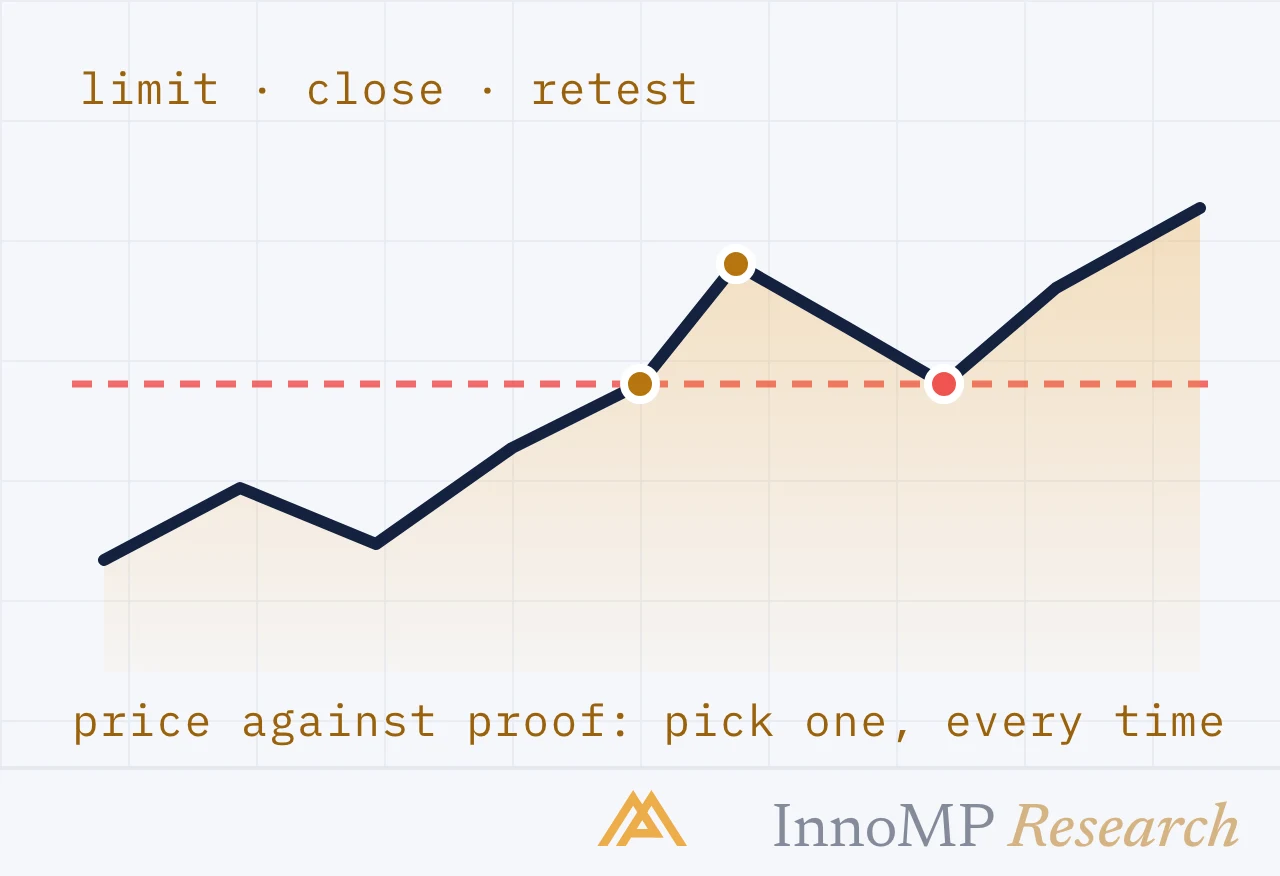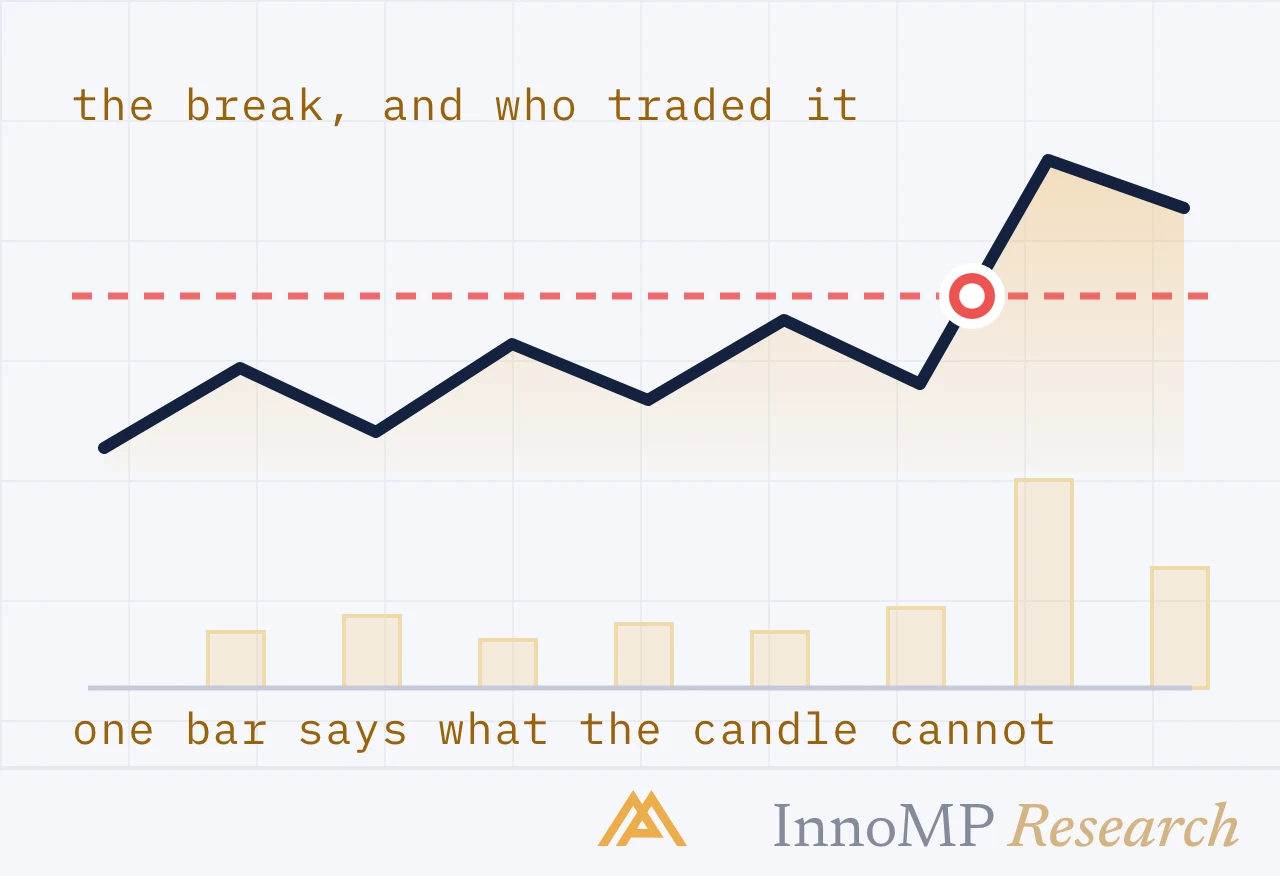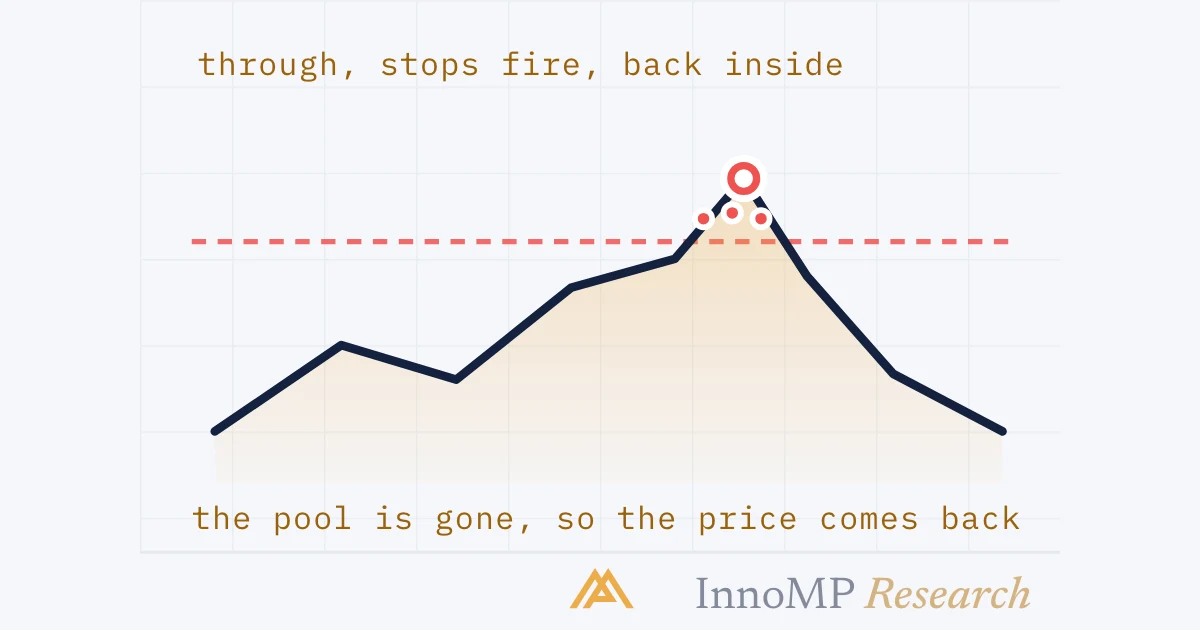
A liquidity sweep is price moving through an obvious level, triggering the stops resting beyond it, and reversing once that liquidity is consumed. The stops are market orders in waiting; when they fire they supply the other side for a large position, and once filled nothing beyond the level pushes on, so price comes back. A sweep and a real break start identically and part at the reclaim: a sweep closes back inside the level, a break holds beyond it — Foundations' retest evidence, read from inside the book.
A liquidity sweep is price moving through an obvious level, triggering the stop orders resting beyond it, and reversing once that liquidity has been consumed. It begins exactly like a break, and it parts from one at the reclaim — when price closes back on the side it came from.
Part 5 said where the pools are. This part is what happens when price reaches one. It is the false breakout from Foundations with the mechanism filled in — and once the mechanism is visible, so is the difference between a sweep and a break that is going to hold.
A sweep, step by step
1 — Through. Price reaches the level and passes it. On the entry timeframe this is a candle closing above the swing high, and it is, at that moment, indistinguishable from a break.
The run. The stops resting above the high trigger. Each becomes a market buy — Part 2 — and the cluster of them firing together is a stop run: a burst of movement in the direction of the break, fast, and over in a few candles. On the tick-volume bar of the Intermediate level it looks like confirmation.
2 — The reclaim. Price closes back below the level. The reclaim is the moment that names the event: what looked like a break was a sweep. From here the level has been tested from above and failed, and the move away from it is usually fast, because the traders who bought the break are now on the wrong side with stops of their own.
Who was on the other side
The stops did not fire into a vacuum. Someone was selling to them.
This is why sweeps happen where they do, and it needs no villain. A participant with a large sell order faces the impact problem: there is not enough resting volume at the quote. The largest reliable pool of buyers near the price is the cluster of buy stops above the last high. If price can be taken there — by the seller’s own early buying, by another participant, by the market’s ordinary reaching for liquidity — the stops fire, the seller is filled into them, and the seller’s need for the market to be above the level ends the moment the fill is complete.
The Foundations swing part said “it feels personal; it is structural.” This is the structure.
Sweep or break: identical until the reclaim
The problem a sweep poses is not that it exists. It is that for its first candle or two it is a break, and the evidence Foundations gave for a real break — a close beyond the level, follow-through — is exactly what the stop run produces.
So the reading is the one the Intermediate level already made, with a reason attached. The retest entry waits for price to return to the level and hold on the new side. A sweep returns to the level and does not hold — it goes through, and the retest never comes. The entry that waits for the retest is, mechanically, the entry that refuses to buy into a stop run.
Two readings help before the reclaim, though neither settles it.
How far beyond the level. A stop run travels as far as the stops go and no further. A move that extends well past the pool — past the buffer most traders would have used — is being bought by someone other than triggered stops. That is more likely a break.
What the bar does after. The effort-versus-result reading: a run on heavy tick volume that produces a wide candle beyond the level and then a small one is the classic shape of stops firing and finishing. A run that keeps producing range on each bar has participation behind it.
Key takeaway Every sweep is a break for one candle. The retest is the evidence a sweep cannot produce, which is why the entry that waits for it misses the runs it was always going to miss — and why “the breakout failed” is usually “the pool was used.”
Whose conduct, and whose market
Stop runs are the part of market structure most often described as someone’s doing. The Code is worth reading on this, because it draws the line precisely.
Principle 10 lists “trading or otherwise acting in a manner designed to move the market to the Stop Loss level” as an unacceptable practice, and Principle 12 says participants should not request transactions, create orders or provide prices with the intent of disrupting market functioning. That is the conduct the Code forbids: one participant deliberately driving price to a trigger it holds.
What the Code cannot forbid is the sum of everyone’s ordinary behaviour. Stops cluster because a good rule is widely followed. Large orders seek the clusters because that is where they can fill. Price reaches for the pools because the participants who move it need what is in them. A sweep is that arithmetic playing out, and it happens in markets with no dealer at all. Reading it as a conspiracy is comforting and useless; reading it as a pool being used is what lets the next section be written.
Inside the pool, or outside it
The practical question for a stop is whether it sits inside the pool or beyond it — and the honest answer is that either can be right, as long as the size matches.
Inside the pool — a stop just beyond the level, with the usual buffer — is the tight stop of Foundations, and it will be taken by sweeps some of the time. That is a known cost. Sized for it, with the sweep counted as one of the setup’s ordinary losses in the record, it is a legitimate choice with a smaller stop distance and a larger position.
Outside the pool — beyond where a sweep is likely to reach, which is past the cluster, not past the line — survives the sweep and pays for it with a wider stop and a smaller position for the same risk. It also changes the R of every target.
The choice that does not work is the third one: a stop inside the pool with a position sized as though the sweep could not happen. That is the trade Foundations’ drawdown part was written for.
Next: Order flow without an exchange — what an order-flow tool needs, why forex cannot supply it, and what a CFD trader can honestly read instead.
- A sweep is price passing through a level, triggering the stops beyond it, and reversing once they are consumed.
- Triggered stops are market orders, so a cluster of them supplies liquidity to whoever is on the other side.
- A sweep and a break look identical until the reclaim: a sweep closes back inside the level, a break holds beyond it.
- The FX Global Code prohibits trading intended to disrupt market functioning and acting to move the market to a stop level; a sweep is price seeking liquidity, not evidence that anyone did.
- A stop just beyond the obvious level is inside the pool; a stop beyond the sweep's likely reach is outside it, at the cost of size.