Skip to content
Research / Education / Position sizing

TA · Professional · Part 10 of 16

Sizing and stops by volatility: keeping risk constant when the range changes

A 30-pip stop is tight in one regime and inside the noise in another. How to place the stop as a multiple of ATR, size the position from it so that risk in money stays constant, and what changes when volatility does.

InnoMP Research · Education Desk Published 25 Sept 2026 · Updated 25 Sept 2026 8 min read
InnoMP Research cover art — same money, either way
In short

Sizing by volatility means expressing the stop as a multiple of ATR rather than fixed pips, and letting the position size follow from it, so that risk in money is constant while the stop in price adapts to the regime. When volatility doubles, an ATR stop doubles and the position halves; the loss at the stop is unchanged. The same multiple sets a trailing exit — the Chandelier form subtracts three ATRs from the highest high — and the same logic scales targets. It does not change how often a given multiple is hit.

Sizing by volatility means placing the stop as a multiple of ATR rather than a fixed number of pips, and deriving the position size from it, so that the money at risk is constant across regimes while the stop in price adapts to them. When volatility doubles, the stop doubles and the position halves. The loss at the stop is unchanged.

The two parts before this one measured volatility and showed that it moves in regimes. This part is what a setup does about it — and it is the mechanical answer to a problem every earlier level circled: a rule written in pips was written in some regime, and the regime changed.

A fixed stop in two regimes

Take the setup from the Intermediate level with a 30-pip stop, and run it in a quiet market and a loud one.

The same setup in two regimes with a fixed 30-pip stop Two panels. Left, quiet, ATR 40 pips: price wiggles gently above a dashed stop line thirty pips below the entry, noted outside the noise. Right, loud, ATR 120 pips: the same thirty-pip stop sits inside the much larger swings, and price takes it out on an ordinary wiggle, noted inside the noise. Quiet · ATR 40outside the noisefixed 30 pipsLoud · ATR 120inside the noisefixed 30 pips InnoMP Research
Thirty pips is a reasonable stop when a typical bar moves forty. When a typical bar moves a hundred and twenty it is a stop placed inside the noise, and it is taken by movement that means nothing.

The left stop is beyond the swing that invalidates the trade, as Foundations asked. The right stop is the same number of pips and is inside the ordinary range of a single bar. Nothing about the idea changed; the unit it was written in stopped meaning what it meant.

The stop as a multiple of ATR

The fix is to write the stop in volatility units. An ATR stop is placed a multiple of the current ATR from the entry — one and a half, two, whatever the setup’s testing settled on — and the multiple, not the pip count, is the rule.

An ATR stop: the same multiple, two regimes Two panels. Left, quiet, ATR 40: the entry line and a stop line one and a half ATRs below it, sixty pips, with gentle price movement staying above it. Right, loud, ATR 120: the same one-and-a-half multiple puts the stop 180 pips below the entry, and the much larger swings stay above it. Both noted: scales with the range; same multiple. Quiet · ATR 401.5 ATR = 60 pipsscales with the rangesame multipleLoud · ATR 1201.5 ATR = 180 pipsscales with the rangesame multiple InnoMP Research
One rule — one and a half ATRs — placed in both regimes. In the quiet one it is sixty pips; in the loud one, a hundred and eighty. Both sit outside the noise of their own regime, because the noise is what they were measured from.

Two things about the multiple.

It is still placed beyond the invalidation. The ATR multiple is a floor, not a replacement for structure. A stop that is one and a half ATRs away and beyond the swing low does both jobs; one that is one and a half ATRs away but inside the swing is a stop inside the pool with a volatility label on it. Where the two disagree, the structural level wins and the multiple says whether that level is realistic in this regime.

Which ATR is part of the rule. Part 8 ended on the lookback: a 14-bar ATR and a 100-bar ATR give different stops after a spike. The setup names one, on the timeframe it trades, and tests with it.

Size follows the stop

The stop distance is now a moving quantity. The position size has to move with it, and the way it moves is the position sizing arithmetic Foundations started with: money at risk divided by stop distance in price.

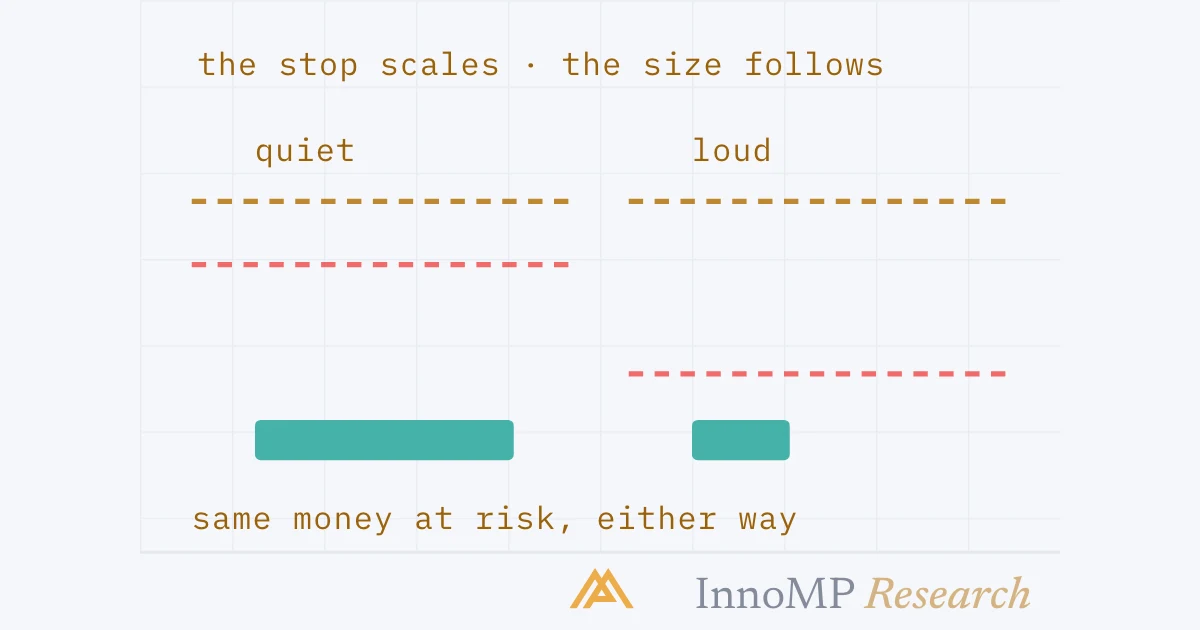
Size follows the stop: risk in money stays constant Two horizontal bars for the same account and the same one percent risk. Quiet regime, sixty-pip stop: a long bar, 0.17 lots. Loud regime, 180-pip stop: a bar a third as long, 0.06 lots. A note says the loss at the stop is one hundred dollars in both. same 1%, same accountquiet · 60-pip stop0.17 lotsloud · 180-pip stop0.06 lotsthe loss at the stop is 100 USD in both InnoMP Research
The same one per cent, the same account, two regimes. The stop tripled, so the position is a third of the size — and the money lost if either stop is hit is identical.

The figure’s numbers are illustrative — one per cent of a 10,000-unit account, on a pair where a lot is worth ten a pip — and the calculator does the division for any real values. What is not illustrative is the relationship. A volatility-adjusted size is what falls out when a fixed money risk meets a stop that scales with the regime: lots go down when the range goes up, and the amount at risk never moves.

This is also the honest version of the Intermediate level’s correlated positions arithmetic. Two positions that are “the same size in lots” in two instruments with different volatility are not the same risk; two positions sized so that one ATR of adverse movement costs the same money are.

Key takeaway The stop is written in ATR, the size is derived from the stop, and the money at risk is the constant. When the regime changes, the pip distance and the lot size change together, in opposite directions, and the thing the plan actually promised — how much a loss costs — stays exactly where it was.

Trailing by volatility: the Chandelier Exit

The same multiple can trail. The Chandelier Exit, developed by Charles Le Beau, hangs a stop a multiple of ATR below the highest high since the trade began — by default the 22-period high minus three times the 22-period ATR for a long, and the mirror for a short.

Chandelier Exit: highest high minus three ATRs A rising price line. Beneath it a stepped dashed line, the Chandelier Exit, sits three ATRs below the highest high so far and steps up each time a new high is made, never stepping down. A note says the exit trails the high by a volatility unit. 22-day high − 3 × ATR(22)trails the high by a volatility unit InnoMP Research
The line only ratchets upward, and its distance from the high is a multiple of the current ATR. A trend with ordinary pullbacks stays above it; a pullback larger than the regime's noise crosses it.

This is the structural trail of the Intermediate level with the distance made explicit. That part warned against trailing a fixed few pips, because a fixed distance sits inside the noise; the Chandelier’s distance is the noise, measured, times a multiple, which is why it holds through ordinary pullbacks and exits on ones larger than the regime produces. Three is Le Beau’s default; the setup’s own testing decides whether it is the right number for the timeframe and the instrument.

The target scales for the same reason. A 4.5-ATR target against a 1.5-ATR stop is 3R in every regime. A 90-pip target against a 30-pip stop is 3R in the regime it was written in and something else everywhere else.

What it changes, and what it does not

What volatility sizing changes, and what it does not Two columns. Changes: the stop in pips, the position size, the target in pips, the trail distance — adapts to the regime. Does not change: money at the stop, how often it is hit, the drawdown shape — the regime's, still. Changesstop in pipsposition sizetarget in pipstrail distanceadapts to regimeDoes not changemoney at the stophow often it’s hitthe drawdown shaperegime’s, still InnoMP Research
Volatility sizing moves every distance and the lot size, and holds the money at risk still. It does not make a loud regime quiet: a multiple of the noise is hit as often as it ever was, and the losing runs are the setup's own.

What volatility sizing does not do is worth saying plainly, because it is often sold as more than it is. A stop at one and a half ATRs is hit about as often in a loud regime as in a quiet one — that is what scaling with the noise means. The losing runs in the record, and the drawdown they add up to, are properties of the setup and arrive in every regime. What changed is that a loud regime no longer produces larger losses, and a quiet one no longer produces a position too small to matter.

That is the whole claim: constant money risk, regime by regime. It is enough to make a record from one regime readable in another — and reading records is what the next group is about.

Next: Expectancy with error bars — the standard error and confidence interval of a record’s expectancy, and how many trades it takes to tell an edge from zero.

Key facts
  • An ATR stop is a multiple of the current ATR, so it widens when volatility rises and tightens when it falls.
  • Position size is derived from the stop distance and a fixed money risk; a wider ATR stop means a smaller position for the same risk.
  • When volatility doubles, an ATR-based stop doubles and the position halves; the loss at the stop is unchanged.
  • The Chandelier Exit sets a trailing stop at the 22-period high minus three times a 22-period ATR.
  • Volatility-adjusted sizing keeps money risk constant across regimes; it does not change how often a given multiple is hit.
Frequently asked questions

What is an ATR stop?

A stop placed a fixed multiple of the current Average True Range away from the entry — one and a half ATRs, two ATRs — instead of a fixed number of pips. Because ATR rises and falls with the regime, the stop in pips widens when the market is loud and tightens when it is quiet, while the rule that placed it stays the same.

How do I size a position using ATR?

Decide the money at risk per trade, place the stop as a multiple of ATR, and divide: risk in money over stop distance in price gives the position size. When ATR doubles the stop doubles and the size halves, so the loss at the stop is the same amount in every regime. The position size calculator does the division once the stop distance is known.

What is the Chandelier Exit?

A trailing stop developed by Charles Le Beau that hangs a multiple of ATR below the highest high since the trade began — by default the 22-period high minus three times a 22-period ATR for a long, and the mirror for a short. It trails price by a volatility unit rather than a fixed distance, so it stays outside the noise of the current regime.

Should the profit target also be based on ATR?

If the stop is, yes, for the same reason: a target of 90 pips is a different distance in R depending on the regime. Expressing both in ATR keeps the setup's R constant — a 1.5-ATR stop with a 4.5-ATR target is 3R in every regime — which is what lets its record from one regime be read in another.

Does volatility sizing reduce losses?

It makes each loss the same size in money regardless of regime, which is a different thing. A 1.5-ATR stop is hit about as often in a loud regime as in a quiet one, because it scaled with the noise; what changed is that the loss when it is hit is no larger. The number of losses in a row, and the drawdown they add up to, are properties of the setup, not of the sizing.

Sources

  1. StockCharts ChartSchool — Chandelier Exit: 22-day high minus ATR(22) × 3 for longs, developed by Charles Le BeauStockCharts ChartSchool
  2. StockCharts ChartSchool — Average True Range: 14-period default, price units, volatility not directionStockCharts ChartSchool
InnoMP Research · Education Desk

Trading education from first principles — position sizing, risk, market structure and the habits that keep accounts alive. Written for someone who has never opened a chart, with a diagram at every step.

Published 25 Sept 2026 · Updated 25 Sept 2026

Disclaimer: This content is provided for general informational purposes only and does not constitute investment advice, an offer, or a solicitation to buy or sell any financial instrument. It has been prepared without regard to your individual financial circumstances or objectives. Trading CFDs involves a high risk of loss.

Related notes

InnoMP Research cover art — one path of thousands
Drawdown

Monte Carlo and drawdown: what the record's order hides

The worst run in the record is one draw of many. How to resample the same trades thousands of times, read the distribution of maximum drawdown and losing streaks it produces, and size so the bad draws are survivable.

9 min read
InnoMP Research cover art — two names, one bet
Risk management

Correlated positions: when two trades are one

Long EURUSD and long GBPUSD is not two trades. It is one short-dollar position with two names, and the risk budget has to see it that way. How exposure adds up across pairs that share a leg, and how to size for it.

8 min read