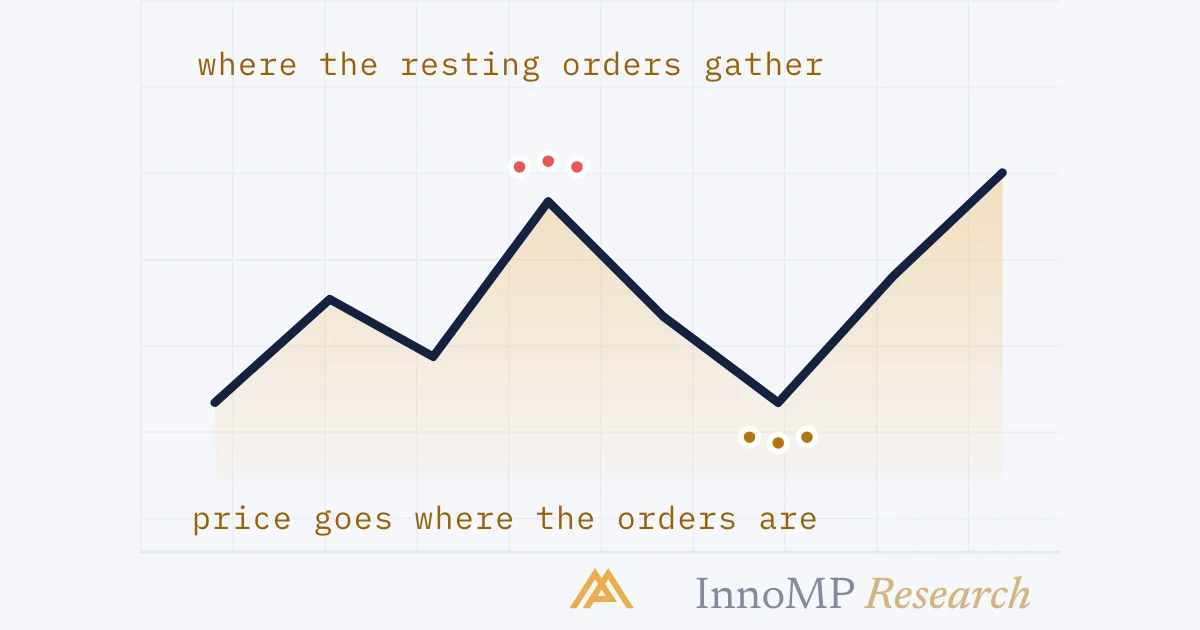
Liquidity is the resting orders a market can trade against, and it gathers where many participants have a reason to place an order: stops beyond swing highs and lows, limits at reference levels and round numbers, and both on the far side of any level that is obvious on the chart. A large order needs that resting volume to fill, so price is drawn toward the pools where it sits. Reading a chart for liquidity means asking, at each level, whose orders rest there and on which side — that is what price will meet.
Liquidity is the resting orders a market can trade against, and it is not spread evenly. It gathers where many participants have the same reason to place an order — stops beyond swing points, limits at reference levels and round numbers — and price is drawn to those pools because that is where a large order can fill.
The first group of this level described the book. This group is about what sits in it and beside it: the resting orders, where they gather, and what happens when price reaches them. It is the mechanism under two things the earlier levels stated as observations — that price hunts swing points, and that reference levels work because they are watched.
Resting orders, and where they gather
A resting order is one that has not traded yet: a limit waiting in the book at its price, or a stop waiting beside it for its trigger. Every resting order was placed for a reason, and the reasons are not random. They repeat, because traders use the same tools on the same charts.
Where they gather is called a liquidity pool — a place where more can be traded at once than anywhere near it. The rest of this part walks through the three kinds, and the next part is about what price does when it arrives at one.
Stops beyond the swings
Foundations taught that a stop belongs beyond the swing that invalidates the trade, plus a buffer. Every trader who learned that rule — and it is the rule most trading education teaches — puts their stop in the same place relative to the same swing.
That is a stop cluster: stop orders gathered just beyond an obvious level, placed by traders who used the same invalidation. It has a property no limit cluster has. When a stop triggers it becomes a market order — Part 2 — and a market order crosses the spread and takes whatever is on the other side. A cluster of sell stops under a low is a cluster of market sells waiting to fire together, pushing the same way the move that triggered them was already going.
So a stop cluster is liquidity of a particular kind: not orders that oppose price, like resting limits, but orders that join it, once reached. Whoever wants to buy a lot below that low will find, once it breaks, a crowd of sellers appearing at exactly that moment.
Limits at levels and round numbers
The other kind of pool is resting limits, and they gather where people have chosen to wait. The reference levels of the Intermediate level — yesterday’s high and low, the daily open — are on every screen; a limit to buy the previous day’s low is one of the most common orders there is. Round numbers are the same mechanism with less to draw: a great many take-profits and entries sit at 1.1000 because it is a number people say out loud.
Limits and stops behave oppositely when reached. Resting sell limits at a level absorb buying — the absorption of the Intermediate effort-versus-result part, now with a mechanism — and price stalls. Resting stops beyond a level add to the move. The same line can have both: sell limits sitting on it from traders fading the level, and buy stops sitting just above it from traders who are short. Which is larger decides what the level does.
Why price is drawn to the pools
A participant who needs to trade in size has a problem the retail trader never meets: their order is bigger than the book at the quote. Part 3 described what happens — the order walks the book and pays impact. The alternative is to trade where the book is deepest, and the deepest places are the pools.
This is the mechanism behind the sentence Foundations offered without one: resting orders are liquidity, and markets move toward liquidity. A large buyer who wants to fill below the current price is best served by the market going through the swing low, because the sell stops under it supply the volume; a large seller wants the buy stops above the high. Price is drawn to the pools because the participants who move price need what is in them.
It also explains why the pools are where they are. They are on the far side of whatever is obvious, because obviousness is what put the orders there.
Key takeaway A level on a chart is a pool of orders on the far side of it. The question at every level is not “will it hold?” but “whose orders are resting beyond it, on which side, and who needs them?” — because that is what the price will meet when it arrives.
What the Code says about stops
Stop orders handled by a dealer are addressed directly in the FX Global Code. Principle 10 says a participant handling a client’s stop loss order should obtain the information that fully defines it — the reference price, the amount, the time period and the trigger — and should disclose whether its own risk management transactions may be executed close to the trigger level, and that those transactions may impact the reference price and result in the stop being triggered. It gives two examples of unacceptable practice: acting in a manner designed to move the market to the stop level, and offering stop loss orders on a purposefully loss-making basis.
Read that in the light of this part. A dealer holding a client’s stop knows where a market order will appear. The Code requires it to say how it handles that knowledge, and forbids it to move the market to the trigger. What the Code does not — and cannot — forbid is the market itself being drawn to a pool of stops, because that is not one participant’s conduct. It is the sum of everyone’s.
Reading a level for its orders
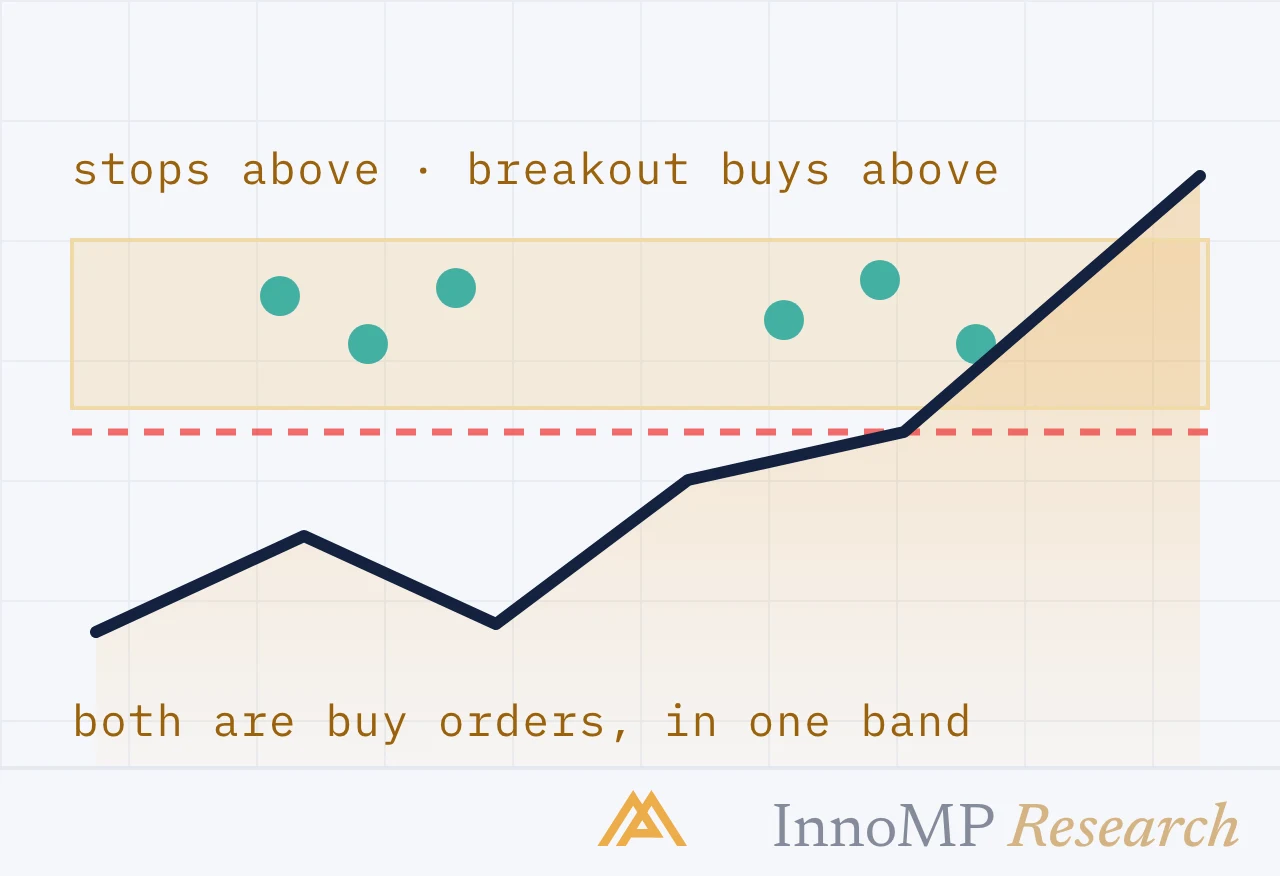
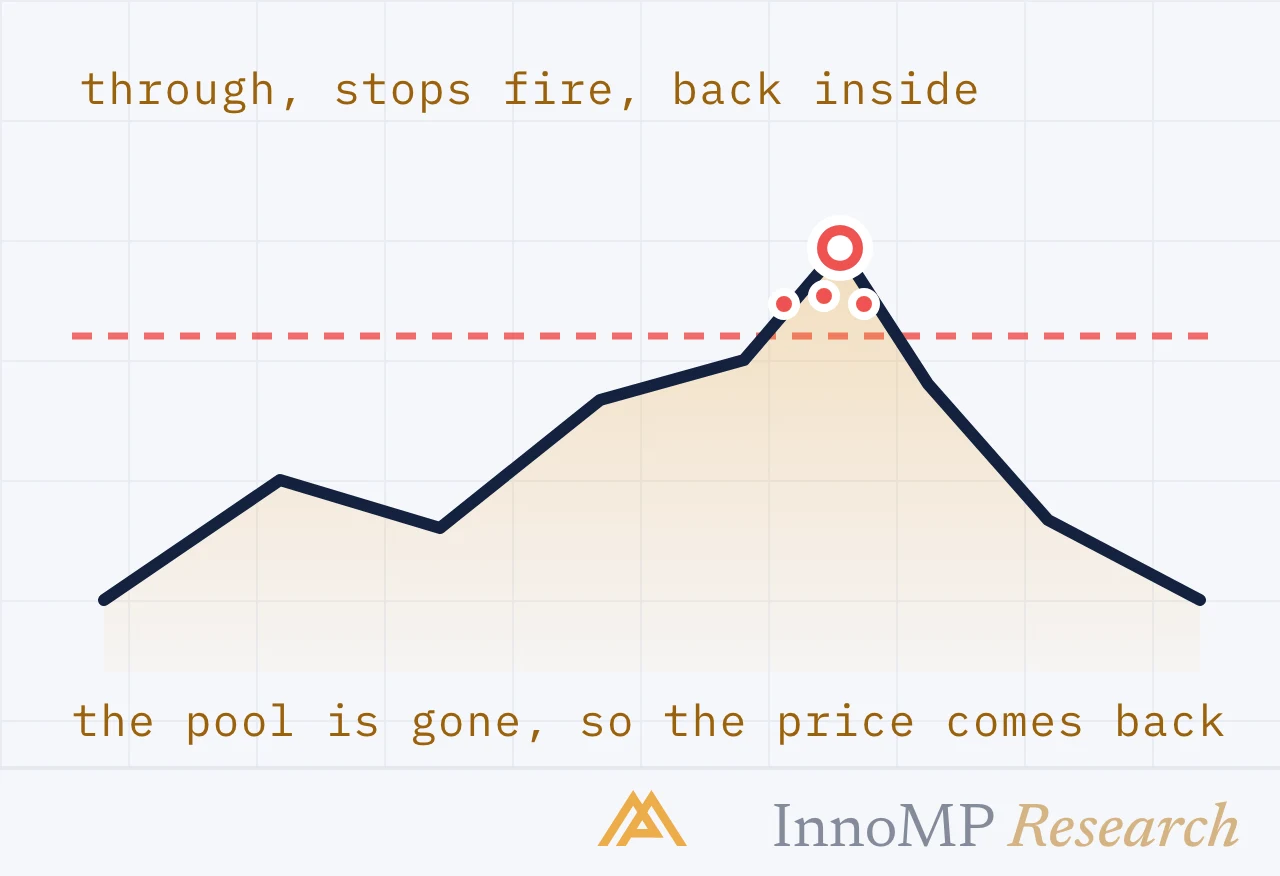
Above a swing high rest the stops of everyone short, which are buys; the entry orders of breakout traders, which are buys; and the limits of traders fading the level, which are sells. Two of the three push up. Below a swing low the mirror: two of the three push down. So a break through a level usually accelerates first — the stops and the breakout orders fire together — and what happens next depends on the third kind, the limits, and on whether the large participant who needed the pool has finished using it.
That sequence — through the level, the acceleration, and then either the continuation or the return — is the next part.
Next: Liquidity sweeps and stop runs — what price does when it reaches a pool, and how to tell a sweep from a break that is going to hold.
- Liquidity is resting orders; where more of them rest, more can be traded without moving price.
- Stop orders cluster just beyond swing highs and lows, because that is where invalidation sits for most traders.
- Limit orders cluster at reference levels and round numbers, where many participants have chosen to wait.
- A large order fills where liquidity rests, so price is drawn toward the pools of resting orders.
- Stops are market orders in waiting; when a pool of them triggers it adds to the move rather than opposing it.