Managing an open trade means the actions taken between entry and exit: taking part of the position off at an interim price, moving the stop to break-even, trailing the stop behind price, or doing nothing until the stop or target is hit. Each changes the setup's expectancy — usually by cutting the average win more than it cuts the average loss — and each is a rule decided before entry, not a reaction during the trade. The honest test is the record: management that feels better and tests worse is a cost.
Trade management is what is done to a position between entry and exit: partial exits, a stop moved to break-even, a trailing stop, or nothing. Each is a rule of the setup, decided before entry, and each changes the setup’s expectancy — usually by less than it changes how the trade feels.
Part 15 wrote the setup down; Part 16 priced the entry. Between entry and exit there is a stretch of time in which the trader can act, and most of what goes wrong with a good setup goes wrong there — not by breaking the rules, but by improvising where there were none.
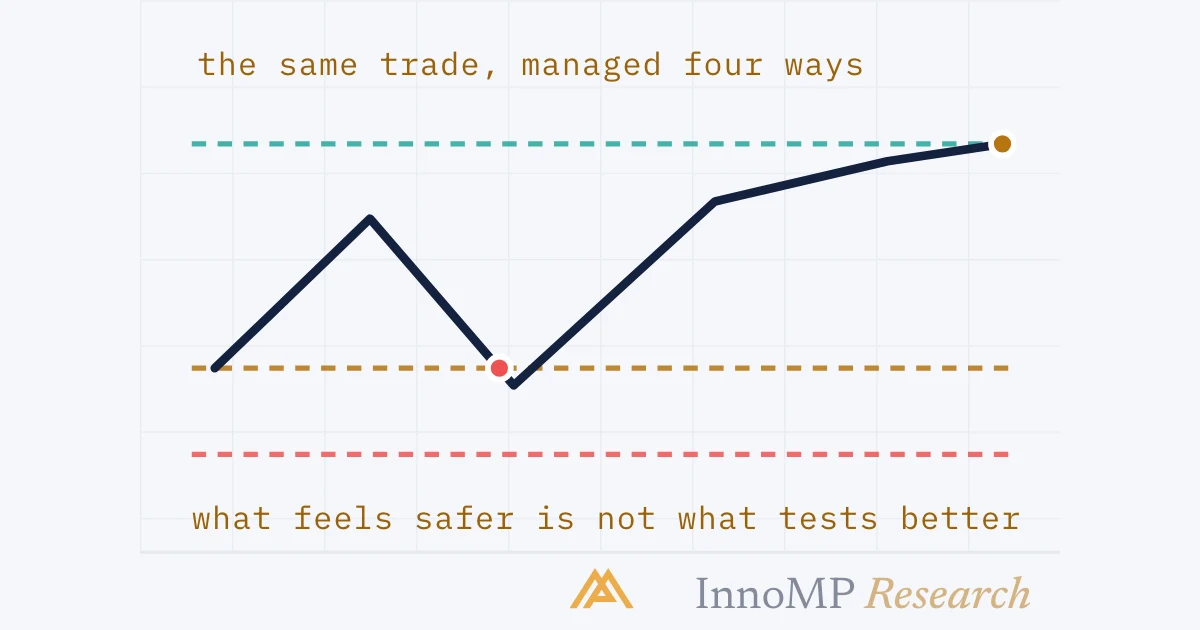
Four ways to manage the same trade
Take one trade and one price path: entry, a run to 2R, a pullback that dips just below the entry, then a run to the 3R target. Four management rules produce four different results from the identical market.
One path proves nothing about which rule is best; a path that stopped at the dip and never recovered would rank them the other way. What it proves is that management is not neutral. Every rule is a bet on how winners and losers are distributed, and the setup’s record is the only place that distribution is visible.
Break-even: safety, priced
Moving the stop to the entry price once the trade has moved in its favour is the most common management rule, and the most misunderstood. What it buys is obvious: that trade can no longer lose. What it costs is less obvious, because the cost lands on trades that would have won.
A scratch — a trade closed at entry, zero R — is not a loss, and a break-even rule is usually justified by the losses it avoided. But the same rule scratches every winner that dipped through the entry on the way to the target, and in a setup whose entries sit near a level, that is many of them: price returning to test the entry area is what Part 2’s reaction looks like from inside the trade.
So the rule lowers the average loss and the average win, and lowers the win rate by turning wins into scratches. Whether the setup’s expectancy goes up or down depends on which effect is bigger, and that is not a matter of opinion — it is a count in the record. Where break-even is used at all, it is used late, after the trade has moved far enough that a return to entry would itself be a break of structure on the trading timeframe.
Partial exits: variance, priced
Taking half the position off at an interim level — 1R, say — and letting the rest run is the rule that makes trading feel best. Something is banked, the remainder is “free,” and the equity curve is smoother.
The numbers are illustrative, but the direction is structural. The half taken off at 1R is, on every winning trade, the half that would have gone to 3R; it is only on the trades that reversed after 1R that the partial earned its keep. A setup whose winners mostly run pays for the partial; a setup whose moves mostly stall after 1R is paid by it. Which kind the setup is, is in the record.
What the partial reliably buys is lower variance — a smaller drawdown for the same expectancy, or a slightly smaller expectancy with a much smaller drawdown. That can be worth paying for, because a drawdown the trader cannot sit through ends the setup regardless of its arithmetic. It is a purchase, not a free lunch, and it is made deliberately.
Key takeaway Break-even and partials both trade expectancy for comfort. Sometimes that is the right trade — a smaller edge you will actually keep taking beats a larger one you will abandon in the first drawdown. But it is made with the record open, not with the position open.
Trailing: where the trail sits
A trailing stop lets a trade stay in a trend for as long as the trend lasts, which is the one management rule that can raise the average win rather than lower it. Whether it does depends entirely on where the trail is placed.
The structural trail is the swing reading from Foundations applied to an open trade: in an uptrend on the trading timeframe, the stop moves to beneath each new higher low, with the same buffer the initial stop had. It is hit when the trend’s structure breaks — which is the moment Part 4 said the bias should be questioned anyway. The fixed-distance trail is hit by ordinary pullbacks, and converts every trend into a series of 1R wins.
A trail also replaces the target, and that is a choice with the same arithmetic as everything else here. A fixed target at 3R banks 3R on every trade that gets there and gives up the trades that would have run to 6R; a structural trail catches the runners and gives back a swing’s worth on every trade that reverses. Neither is better. The record says which fits.
The record decides
Every rule in this part can be argued for. None can be argued into a setup. They are tested into one.
The baseline is do nothing: entry, stop, target, and no action in between. That produces the setup’s raw numbers. Each management rule is then applied to the same replayed trades — Part 18 is how — and keeps its place only if it beats the baseline on expectancy, or buys a drawdown reduction the trader has decided is worth the price.
| Rule | What it reliably does | What it costs | Keep it if |
|---|---|---|---|
| Do nothing | Produces the setup’s raw numbers | Full variance | It is the baseline; always tested |
| Break-even | Removes losses on trades that moved | Scratches the winners that pulled back | The record says expectancy held |
| Partial exit | Smooths the equity curve | Cuts the average win | The drawdown saved is worth the edge lost |
| Structural trail | Catches the runners | Gives back a swing on reversals | Winners in the record often exceed the fixed target |
What does not survive this table is management by feel — the stop moved because the trade “looks tired,” the half taken because a loss last week still hurts. Those are the cutting winners and revenge parts of Foundations, arriving through the management door. A rule that was written and tested is followed. Anything else is a different setup each time, and its record reads accordingly.
Next: Testing a setup by hand — replaying the chart candle by candle, keeping the record honestly, and knowing how many trades it takes before the numbers mean anything.
- Every management action changes the setup's average win, average loss or win rate; none changes only how the trade feels.
- Moving the stop to break-even early converts a share of winners into scratches; it lowers the average win, not only the average loss.
- A partial exit reduces both the average win and the average loss; whether it pays depends on the setup's own numbers.
- Trailing a stop behind structure keeps a trade in a trend; trailing it too close converts trends into a series of small wins.
- Management rules are written into the setup and tested with it; changed by feel, they make a different setup each time.