Correlated positions are trades that share a leg or a driver, so that their profits and losses move together. Two long dollar-quoted pairs are largely one short-dollar position. The risk budget has to count exposure, not tickets: the risk on correlated positions is added together and compared with the per-trade limit as if it were one trade. When the sum exceeds the limit, the second position is sized down or not taken. Spreading risk across pairs that share a leg is not diversification.
Correlated positions are open trades that share a leg or a driver, so that their profits and losses move together. The risk budget has to count them as the exposure they add up to, not as the number of tickets they occupy.
Part 11 said correlation matters for risk before it matters for analysis. Part 12 showed every major pair sharing one leg. This part is the arithmetic that follows — what a book of several pairs actually holds, and how the per-trade limit from CFD Foundations has to be applied to it.
Two names, one exposure
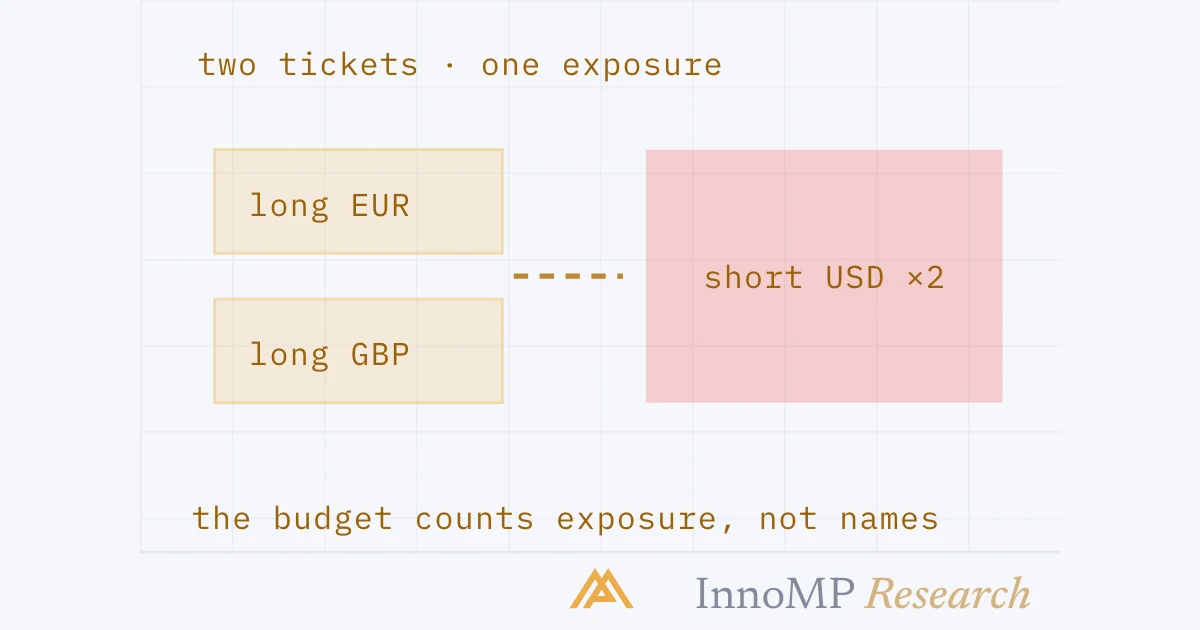
Long EURUSD profits when the dollar falls. So does long GBPUSD. Open both at 1% risk each and the account is not holding two 1% trades; it is holding one short-dollar position, sized at 2%, with a small euro-against-pound residual on top.
The ticket count is the account’s view. The exposure is the market’s, and the market is the one that settles.
Netting the legs
Every pair position is a position in two currencies. Long a pair is long the base and short the quote; short a pair is the reverse. A book’s real holdings are found by adding each currency’s legs across every open position.
| Position | Long leg | Short leg |
|---|---|---|
| Long EURUSD, 1 lot | EUR +1 | USD −1 |
| Long GBPUSD, 1 lot | GBP +1 | USD −1 |
| Short USDJPY, 1 lot | JPY +1 | USD −1 |
| Net | EUR +1 · GBP +1 · JPY +1 | USD −3 |
Lots are an approximation, because a lot of EURUSD and a lot of USDJPY are different amounts of dollar. The exact version converts each position to its notional value in one currency and nets those. For the question this part asks — is the dollar most of what this book holds? — lots are usually enough to see the answer.
The budget counts exposure, not tickets
The risk rule from Foundations is a per-trade limit — 1% of the account, say, at the stop. It was written for a trade. Three tickets on one exposure are one trade for the purpose of that rule, and the arithmetic is unforgiving.
The failure mode is not exotic. A dollar rally takes out all three stops at once, and a day the plan priced as a 1% loss costs 3%. The drawdown arithmetic from Foundations then applies to a losing run the plan never sized for — because the plan counted tickets.
Key takeaway “How much is at risk?” is asked of the exposure, not the ticket. If two positions would be stopped out by the same move, they are one position for the risk budget, and the budget is shared between them.
Sizing for it
Two honest ways to hold a second position that shares a leg, and one dishonest one.
Split the budget. Half the per-trade risk in each pair. The position size calculator takes the halved risk and each pair’s own stop distance, and gives two smaller positions whose combined loss at the stops is the original limit.
Concentrate it. All of the budget in one pair and none in the other. Which one is what Part 13 answers — the pair that puts the strongest leg against the weakest is the one carrying the move, and the second ticket was mostly a weaker copy of it.
The dishonest way is a full ticket on each, on the grounds that they are “different pairs.” They are different names. The move that stops one out stops the other out, and the budget was doubled by a change of label.
Opposite signs are not a hedge
The mirror image is just as common: long one dollar-quoted pair and short another, on the theory that the two offset. They do offset — in the leg they share — and what remains is a position nobody chose.
Netting the legs makes this visible immediately: EUR +1, USD −1 from the first ticket; GBP −1, USD +1 from the second; the dollar sums to zero and the book is long euro, short pound. If that is the trade wanted, EURGBP is one ticket and one spread. If it is not, the two tickets have quietly become a position in a cross nobody analysed.
Correlation by driver
Shared legs are the arithmetic case. The other kind — instruments that move together because one driver dominates, the regime correlation of Part 11 — is handled the same way, with a measurement in place of the netting.
| Coefficient on the trading timeframe | Treat the pair of positions as |
|---|---|
| Above about 0.7, or below −0.7 | One exposure. Combined risk against the limit |
| Between about 0.3 and 0.7, either sign | Partly one. Reduce the second position by roughly half |
| Between −0.3 and 0.3 | Separate trades, each with its own budget |
The thresholds are a working structure, not a law; the point is that the decision is made from a number read on the chart, over the same window every time, and not from the feeling that two instruments are “different markets.” Gold and a dollar-quoted pair, an index and a commodity currency — the coefficient says how much of one is already in the other, for the window that matters.
And the regime rule from Part 11 applies in reverse: a correlation that arrived with a theme will leave with it. Two positions treated as one during the theme are two positions again afterward, and the budget can be re-read when the window rolls.
Where this group ends
Four parts, one idea seen from four sides. A coefficient measures how two instruments moved together over a window, and no more than that. Every major pair contains the dollar, so most of a major’s move is the dollar’s until proven otherwise. Ranking every leg against every other says which pair has both legs pushing. And whatever the tickets say, the account holds exposures — netted by leg, measured by coefficient, and budgeted as one where they overlap.
The last group puts the whole level together — structure, levels, timeframes, volume, sessions, correlation — into a setup that can be written down, triggered the same way each time, managed without improvising, and tested by hand before it is trusted.
Next: Anatomy of a trading setup — context, trigger, invalidation, target: the four decisions a setup is made of.
- Positions that share a leg — the same currency — or a driver move together, and their risk adds up.
- Long EURUSD and long GBPUSD is largely one short-dollar exposure, not two independent trades.
- The per-trade risk limit applies to the combined risk of correlated positions, not to each ticket.
- Net exposure per currency is found by netting the legs: each pair is long its base currency and short its quote, or the reverse.
- Spreading risk across pairs that share the dollar does not diversify it; it repeats it.