Skip to content
Research / Education / Discipline

TA · Intermediate · Part 15 of 18

Anatomy of a trading setup: context, trigger, invalidation, target

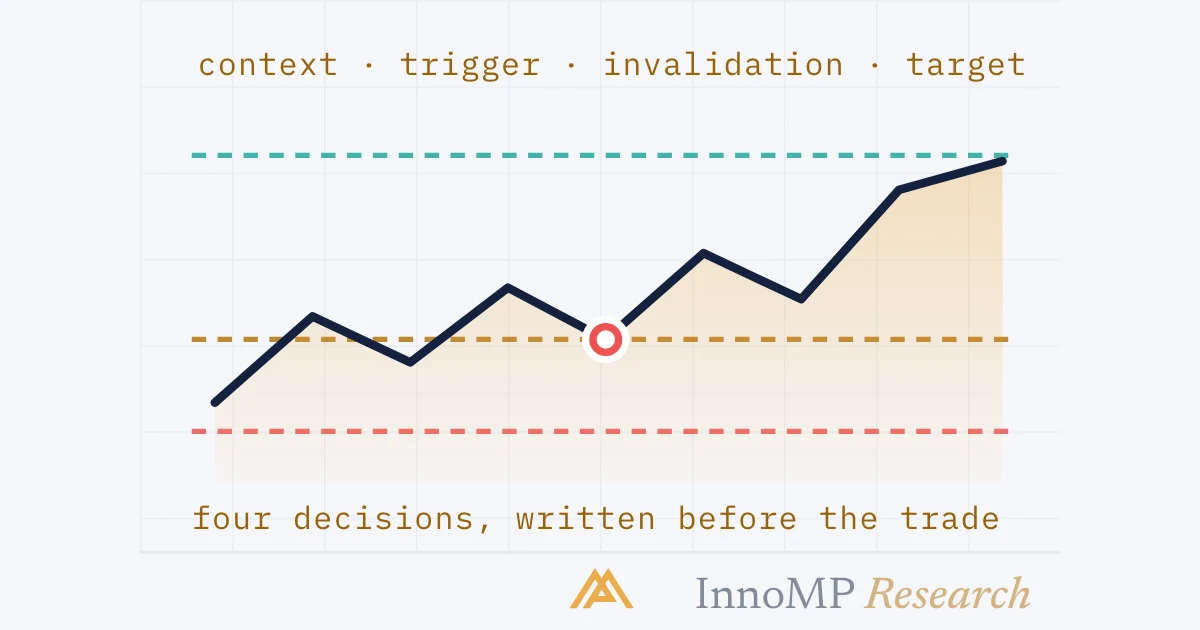
A setup is not a pattern. It is four decisions written before the trade: the context that makes it worth watching, the trigger that makes it a trade, the price that proves it wrong, and the price it aims at.

InnoMP Research · Education Desk Published 22 Sept 2026 · Updated 22 Sept 2026 8 min read
InnoMP Research cover art — four decisions, in order
In short

A trading setup is a written statement of four things: the context in which a trade is worth looking for, the trigger that turns watching into entering, the invalidation price that proves the idea wrong, and the target the idea is aiming at. Each is decided before the trade from a named source: the higher-timeframe bias, a level, a session, an event on the entry chart. Written this way a setup can be taken the same way every time, sized from its stop distance, and tested; a pattern noticed on the day cannot.

A trading setup is a written statement of four decisions made before the trade: the context in which it is worth looking, the trigger that turns looking into entering, the invalidation price that proves it wrong, and the target it is aiming at.

Fourteen parts of this level have supplied pieces — bias and levels, volume, sessions, correlation. This group puts them together into something that can be written on a card, taken the same way every time, and tested. That thing is a setup, and it is not a pattern.

Four parts, in order

A pattern is a shape. A setup is a decision with four parts, and each part answers a question the trade has to answer before it exists.

The four parts of a setup Four stacked panels. One, context: when is it worth looking? Two, trigger: what turns looking into a trade? Three, invalidation: where is the idea wrong? Four, target: where is it going, and how far in R? 1 · Contextwhen is it worth looking?2 · Triggerwhat turns looking into a trade?3 · Invalidationwhere is the idea wrong?4 · Targetwhere is it going, and how far in R? InnoMP Research
Four questions, answered in this order, before the trade. A setup is the written answers; a pattern is at most an answer to the second.

The order matters for the same reason it mattered in Part 1. Context is decided before a trigger is looked for, so that the trigger cannot invent its own context. Invalidation is decided before size, so that size cannot decide where the stop goes. Target is decided before entry, so that it cannot drift once the trade is open — the target creep Foundations warned about is a target that was never written down.

Context: what must be true before looking

Context is everything that has to be true before the entry chart is opened. It is where most of this level goes, and it is the part most trades skip.

Context is a stack of filters, all of which must be true Five stacked bands, each a condition: one, bias — daily structure says long; two, level — price is inside a daily zone; three, session — London or the overlap; four, dollar — the index agrees; five, count — at least three reasons. A note above says all true, or no trade. all true, or no trade1 · biasdaily structure says long2 · levelprice is inside a daily zone3 · sessionLondon or the overlap4 · dollarthe index agrees5 · countat least three reasons InnoMP Research
Every filter is a part of this level. A trade is looked for only when the whole stack is true — which is most of the reason a good setup fires rarely.

Each line is a part already written. The bias is Step 1; the level is Part 2; the session is Part 8; the dollar’s agreement is Part 12; the count is Part 3. A setup’s context is a list of which of these it requires — not all of them, but the ones it names, and all of those.

Context is also what makes a setup rare. A stack of five filters is true a few times a week on a few instruments. That is not a flaw; a setup that fires every hour has no context, and the overtrading Foundations described is usually a setup with its context removed.

Trigger: one event, not a feeling

The trigger is the single observable event on the entry chart that turns watching into entering. It has to be something two people looking at the same chart would agree happened.

The trigger is one observable event, not a feeling Two panels. Left, a feeling: price is falling toward a shaded level and an entry is marked before anything has happened there, with the note it should hold here — not a trigger. Right, an event: price inside the pullback makes lower highs, then closes above the last lower high, and the close is circled, with the note 1-hour close above the last lower high — a trigger. A feelingit should hold herenot a triggerAn event1-hour close above LHa trigger InnoMP Research
The left entry is a prediction that the level will hold. The right entry is a fact that the pullback's structure has broken. Only the second can be written down and taken the same way twice.

The triggers this level has used are all events of that kind: a close beyond a level, the break of the pullback’s last lower high from Part 1, the third step of the reaction in Part 2, a retest that holds from Part 6. Which one a setup uses, and what each costs, is the next part. What matters here is that it names one.

Invalidation: the price that proves it wrong

Invalidation is the price at which the reason for the trade is no longer true — the swing that would have to break, the level that would have to fail. The stop goes there, with the buffer Foundations described. It is written before entry and it is not moved further away afterward.

Everything about size follows from it, which is the argument position sizing made and Part 14 extended: the risk budget is fixed, the stop distance is set by the invalidation, and the number of lots is what the calculator gives for those two inputs.

Invalidation decides the size Two panels with the same entry line. Left, tight stop: the stop sits at the 1-hour swing, forty pips away, giving 0.25 lots for one percent of risk — same one percent, more size. Right, wide stop: the stop sits at the daily swing, 120 pips away, giving 0.08 lots for the same one percent — same one percent, less size. Tight stop40 pips: 0.25 lotssame 1%, more sizeWide stop120 pips: 0.08 lotssame 1%, less size InnoMP Research
Same account, same risk, same entry. The invalidation the setup names sets the stop distance, and the stop distance sets the size — never the other way round.

The figure’s numbers are illustrative — one per cent of a 10,000-unit account on a pair where a lot is worth ten per pip — but the relationship is not. Which invalidation a setup uses is part of the setup, and it decides how large every trade it produces will be.

Key takeaway Invalidation is chosen for where the idea is wrong, and size is whatever that allows. A setup that chooses its stop to afford a size has reversed the order, and its record will show it.

Target: where it is going, in R

The target is written as a price and as a multiple of the stop distance — the R-multiple from Foundations. It comes from structure: the prior swing, the next higher-timeframe level from Part 2, or a measured move.

Target from structure, and the R it implies A rising price chart with three horizontal lines. The lowest, red, is the stop at the invalidation. The middle, gold, is the entry. The highest, green, is the target at the prior swing high. The distance from entry to stop is marked 1R and from entry to target 3R. target: prior swing highentrystop: invalidation1R3R InnoMP Research
Stop, entry, target — three prices, all from structure, all written before the trade. The ratio between the two distances is the setup's R, and it is known before the first candle.

Writing the target in R does two things. It tells the setup’s expectancy arithmetic what a winner is worth, which testing will need. And it makes the trade’s quality visible before entry: a setup whose targets are usually under 1R needs a win rate the break-even arithmetic says is hard to sustain, and it is better to know that from the card than from the record.

The card

Put the four parts on one card and it reads like this.

PartThis setup
ContextDaily structure making higher highs and higher lows. Price in a flipped daily level. London open or the overlap. Dollar index not breaking its own support. Three or more reasons.
Trigger1-hour close above the pullback’s last lower high.
InvalidationBelow the 1-hour swing low that preceded the trigger, plus a buffer of one 1-hour ATR.
TargetThe prior daily swing high. Take only if at least 2R from entry.

That is a setup. It can be handed to someone else and produce the same trade from the same conditions. It can be sized from its stop distance by the calculator. It can be replayed over a year of charts and given a record, which is Part 18. And it can be refused: the last line of the target row is a filter, and most days it, or the context stack, says no.

A pattern can do none of those things — which is why the record of “trading patterns” is usually a record of a different setup every day.

Next: Entry triggers and confirmation — the three common triggers, and what each one costs in price, evidence and trades not taken.

Key facts
  • A setup has four parts, each decided before the trade: context, trigger, invalidation, target.
  • Context is everything that has to be true before the entry chart is opened: bias, level, session, alignment, the count of reasons.
  • The trigger is one observable event on the entry chart; a feeling that the level will hold is not one.
  • Invalidation is the price at which the reason for the trade is false; the stop goes there, and size is derived from it.
  • A setup that cannot be written in a paragraph cannot be repeated or tested.
Frequently asked questions

What is a trading setup?

A written specification of a trade, decided before it exists: the context that has to be true for it to be worth looking for, the trigger that turns looking into entering, the price at which the idea is proven wrong, and the price it is aiming at. It is a procedure that produces the same trade from the same conditions every time, not a chart pattern noticed on the day.

What is the difference between a setup and a pattern?

A pattern is a shape on the chart. A setup is the whole decision: which chart, in what context, on what event, with the stop and the target already placed. Two traders can see the same head-and-shoulders and have two different setups, or none — one enters on the neckline break with a stop above the right shoulder, the other has no rule and is guessing.

What counts as a trigger?

One event on the entry chart that can be pointed at: a candle close beyond a level, a break of the pullback's last lower high, a fill at an order resting at the level. It has to be something two people would agree happened. Anticipating that a level will hold is a reason to watch, not a trigger.

Where does the target come from?

From structure, before the trade: the prior swing high or low, the next higher-timeframe level, or a measured move from a pattern. It is written as a price and as a multiple of the stop distance, so that the setup's risk-reward is known before entry and the target cannot be moved once the trade is on.

How detailed should a written setup be?

One paragraph, or a card with four lines. If the context, trigger, invalidation and target cannot be stated in that space, the setup has not been decided yet. The test is whether someone else could take the same trade from the description — because if they could, the record from testing it means something.

InnoMP Research · Education Desk

Trading education from first principles — position sizing, risk, market structure and the habits that keep accounts alive. Written for someone who has never opened a chart, with a diagram at every step.

Published 22 Sept 2026 · Updated 22 Sept 2026

Disclaimer: This content is provided for general informational purposes only and does not constitute investment advice, an offer, or a solicitation to buy or sell any financial instrument. It has been prepared without regard to your individual financial circumstances or objectives. Trading CFDs involves a high risk of loss.

Related notes

InnoMP Research cover art — a number and its doubt
Trading journal

Expectancy with error bars: how sure the record lets you be

A record says +0.25R per trade. The question is how far from that the truth could be. How to put a standard error and a confidence interval on expectancy, and how many trades it takes to tell an edge from zero.

9 min read