Skip to content
Research / Education / Market structure

TA · Intermediate · Part 3 of 18

Multi-timeframe confluence: what agreement between charts is worth

When the daily, the 4-hour and the 1-hour point the same way a trade has more behind it — if the reasons are independent. How to count confluence honestly, and why two indicators on one chart are one reason.

InnoMP Research · Education Desk Published 19 Sept 2026 · Updated 22 Sept 2026 8 min read
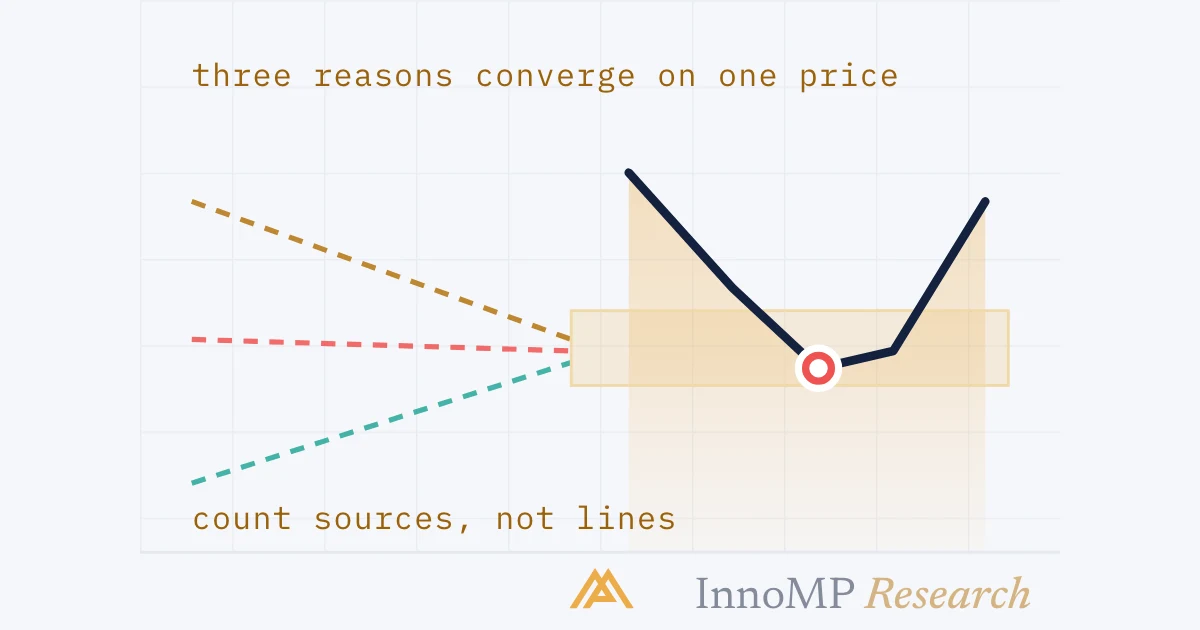
InnoMP Research cover art — count sources, not lines
In short

Confluence is several independent reasons pointing to the same trade at the same place. Across timeframes it means the higher chart's structure, the trading chart's level and the entry chart's trigger all agree — timeframe alignment. Its value comes from independence: a daily level and an hourly trigger are two pieces of evidence, but a moving average and a MACD on the same chart are one, because both are computed from the same prices. Count reasons, not indicators, and set the minimum before the chart is opened.

Confluence is several independent reasons pointing to the same trade at the same place. The word matters less than the adjective: reasons that come from the same source are one reason, however many names they have.

Part 9 of Foundations introduced confluence as a way of choosing between retracement levels. This part makes it the way trades are ranked — across timeframes, across kinds of evidence — and puts a rule on it so that it cannot be gamed.

What counts as a reason

The test is independence. Two reasons are independent when one could be true while the other is false. A daily level and a 1-hour trigger pass: the level can be there and the trigger never come. A rising 50-period average and a MACD above zero do not: both are computed from the same recent closes, so if one is true the other nearly always is.

Independent reasons versus the same reason counted three times Two columns. The left, labelled independent, lists daily structure being long, a flipped daily level, a 4-hour pullback ending and a 1-hour trigger, counted as four reasons. The right, labelled same thing thrice, lists a rising 50-period moving average, MACD above zero and RSI above 50, noting that all three say price went up, counted as one reason. Independentdaily structure: longdaily level, flipped4-hour pullback ends1-hour triggercountfour reasonsSame thing, thrice50-period MA risingMACD above zeroRSI above 50all say: price went upcountone reason InnoMP Research
Four sources on the left, one source with three names on the right. An indicator stack looks like confluence and is not — every line in it is a function of the same closes.

This is the single most common way confluence is miscounted, and Foundations warned about it from the other side — stochastic and KDJ ended with the advice to stop adding indicators. The moving averages, RSI and MACD parts each describe a useful tool. Stacked, they describe one tool three times.

Independent sources look like this:

  • Structure on the higher timeframe — the direction
  • A level with a reason: a swing point, a flip, a range edge (Part 2)
  • A timeframe below, showing its own structure change — the trigger
  • The session, when a move happens in hours that carry participation (Part 8)
  • A related instrument confirming or failing to (Part 11)
  • One indicator, if the plan uses one — momentum, or volatility — counted once

A trade can have a reason from each. It cannot have three from the third bullet and call it five.

Alignment across timeframes

The strongest form of confluence is the one Part 1 built: three charts, three different questions, three answers that agree. That is timeframe alignment, and it is strong precisely because the three sources cannot be the same thing — a daily structure read and an hourly trigger are not computed from each other.

Three timeframes agreeing at one place A price line pulling back into a shaded zone labelled as the daily level, ending its pullback inside it, with the turning point circled and labelled as the 1-hour trigger inside the zone. Notes explain that the 4-hour pullback ends in the zone and that three charts are agreeing at one place. Daily · the level1-hour: trigger inside the zoneThree charts, one place4-hour: the pullback ends in the zone InnoMP Research
The daily supplies the level, the 4-hour supplies the pullback into it, the 1-hour supplies the trigger inside it. Three charts, one price — the thing the whole procedure is for.

When the three do not agree, the disagreement has a name and a procedure of its own — Part 4. For now the point is narrower: alignment is what a full count looks like, and anything less is a smaller number.

Confluence at a price

Reasons can also stack at a single level rather than across charts. A daily flipped level, a prior 4-hour swing low, a 61.8% retracement and a round number all landing within a few pips of each other is a place worth waiting at. The same four reasons spread across a hundred pips are four places, and none of them is special.

Reasons stacking at one price versus spread out Two columns. On the left, labelled stacked, four different dashed lines sit almost on top of one another inside a shaded zone, with the four reasons named around it: daily flipped level, prior 4-hour low, 61.8% retracement, round number. On the right, labelled spread out, the same four lines are drawn far apart down the panel, with a note that they are four places and no reason. Stackeddaily flipped levelprior 4-hour low61.8% retracementround numberone zone, four reasonsSpread outdaily flipped levelprior 4-hour low61.8% retracementround numberfour places, no reason InnoMP Research
Left: the same four reasons within a zone the width of a few pips. Right: the same four, each at its own price. Confluence is the left panel; the right panel is a chart with lines on it.

The zone that results is drawn as in Part 2 — as wide as the reasons that make it, no wider. Stacking does not make a level exact. It makes it populated: several groups of participants have a reason to act there, and that is what a level is.

What confluence changes — and what it does not

More reasons make a trade better. They do not make it different. This is the part most often got wrong in practice, because a high count feels like permission.

What confluence changes, and what it does not Two columns. The left, labelled changes, lists whether to take the trade, the share of the risk budget, how long to wait, and the journal note. The right, labelled does not change, lists the stop as the invalidation, the target, the bias, and the trigger. Below, the left says more reasons mean the same stop with more size, and the right says fewer reasons mean the same stop with less size. Changeswhether to take itshare of risk budgethow long to waitthe journal notemore reasonssame stop, more sizeDoes not changethe stop: invalidationthe targetthe biasthe triggerfewer reasonssame stop, less size InnoMP Research
Confluence is allowed to move the decision and the size. It is not allowed to move the stop, because the stop is where the idea is wrong, and the idea is not more right for having more reasons.

The stop stays where the idea is wrong. Stop placement put it beyond the swing that invalidates the read, and five reasons for the read do not move that swing. A trader who widens the stop “because the setup is so good” has converted confluence into a larger loss.

Size is where confluence is allowed to act — and cautiously. A common structure: below the plan’s minimum, no trade; at the minimum, standard risk; well above it, standard risk and a note in the journal. Size up on high-confluence setups only after the journal shows they actually did better. Until then, the extra reasons buy patience, not lots.

Key takeaway Confluence answers “is this worth taking, and with how much of the budget?” It never answers “where is the stop?” The stop was answered by structure, and structure does not count reasons.

Counted before, not found after

There is a version of confluence that is confirmation bias with a checklist. It goes: want the trade, then look for reasons, then count the reasons found. With three charts and a handful of tools, three reasons can always be found — that was the bottom-up problem of Part 1, wearing a number.

Two rules close the gap.

The minimum is written in the plan. “Three independent reasons, from the list” — decided before any chart is open, as part of writing a trading plan. The count is then a comparison against a fixed number, not a judgement made while wanting something.

The list is closed. The reasons that count are the ones the plan names. A reason invented on the day — “and it is Tuesday, which has been strong lately” — does not count, however plausible, because a list that can grow on demand is not a list.

Confluence and confirmation

One more distinction, because the two words are used interchangeably and mean different things.

Confluence is counted before the setup completes: the reasons that make a place worth watching. Confirmation is waited for after: the reaction at that place — the rejection wick, the higher low, the break of the last minor high from Part 2 — that shows the level is doing what the reasons said it would.

Confluence is counted before the setup; confirmation is waited for after A price line falls toward a shaded zone, touches it, and rises away. A vertical divider at the touch splits the figure. On the left, labelled before, confluence: reasons counted, minimum set in the plan. On the right, labelled after, confirmation: the reaction watched for — wick, higher low, break. before: confluencereasons countedminimum set in the planafter: confirmationreaction watched forwick, higher low, breakcount first, then wait for the reaction InnoMP Research
Left of the touch, the work is counting. Right of it, the work is waiting. Confluence chooses the place; confirmation chooses the moment.

Confluence without confirmation is entering because a place should hold. Confirmation without confluence is entering because something did happen, somewhere that had no reason to matter. The setup needs both, in that order, and the entry-trigger part of this level (Part 16) is about pricing the second one — how much of the move waiting for confirmation costs, and what it buys.

Next: When timeframes disagree — the lower chart is falling while the higher one rises. Pullback, or the start of a reversal, and how to tell.

Key facts
  • Confluence is several independent reasons for the same trade at the same place.
  • Timeframe alignment is confluence across charts: direction, level and trigger agreeing.
  • Two indicators derived from the same price series are one reason, not two.
  • The minimum number of reasons is set in the plan, before the chart is opened.
  • More confluence can justify a larger share of the risk budget; it never justifies a wider stop.
Frequently asked questions

What is confluence in trading?

Several independent reasons pointing to the same trade at the same place — for example a daily level, a pullback ending on the 4-hour chart, and a break of structure on the 1-hour chart, all in the direction of the daily trend. The word means the reasons flow together; the value is in their being separate sources.

What is timeframe alignment?

The higher timeframe's direction, the trading timeframe's setup and the entry timeframe's trigger all agreeing. It is confluence across charts rather than within one, and it is the strongest form because the three charts are answering three different questions.

Do more indicators mean more confluence?

Usually not. A rising moving average, a MACD above zero and an RSI above 50 all say the same thing — price has gone up recently — because all three are calculated from the same closing prices. They count as one reason. Independent reasons come from different sources: structure, a level, a timeframe, a session, a related instrument.

How many reasons should a trade have?

Enough that the number was decided before looking. Three independent reasons is a common minimum — direction, a level, a trigger — and the point of the minimum is that it is written in the plan, so that the count cannot be adjusted to fit the trade in front of you.

What is the difference between confluence and confirmation?

Confluence is counted before the setup completes: the reasons that make a place worth watching. Confirmation is waited for after: the reaction that shows the level is holding — a rejection wick, a higher low, a break of the last minor high. Confluence decides whether to wait somewhere; confirmation decides whether to enter.

InnoMP Research · Education Desk

Trading education from first principles — position sizing, risk, market structure and the habits that keep accounts alive. Written for someone who has never opened a chart, with a diagram at every step.

Published 19 Sept 2026 · Updated 22 Sept 2026

Disclaimer: This content is provided for general informational purposes only and does not constitute investment advice, an offer, or a solicitation to buy or sell any financial instrument. It has been prepared without regard to your individual financial circumstances or objectives. Trading CFDs involves a high risk of loss.

Related notes